
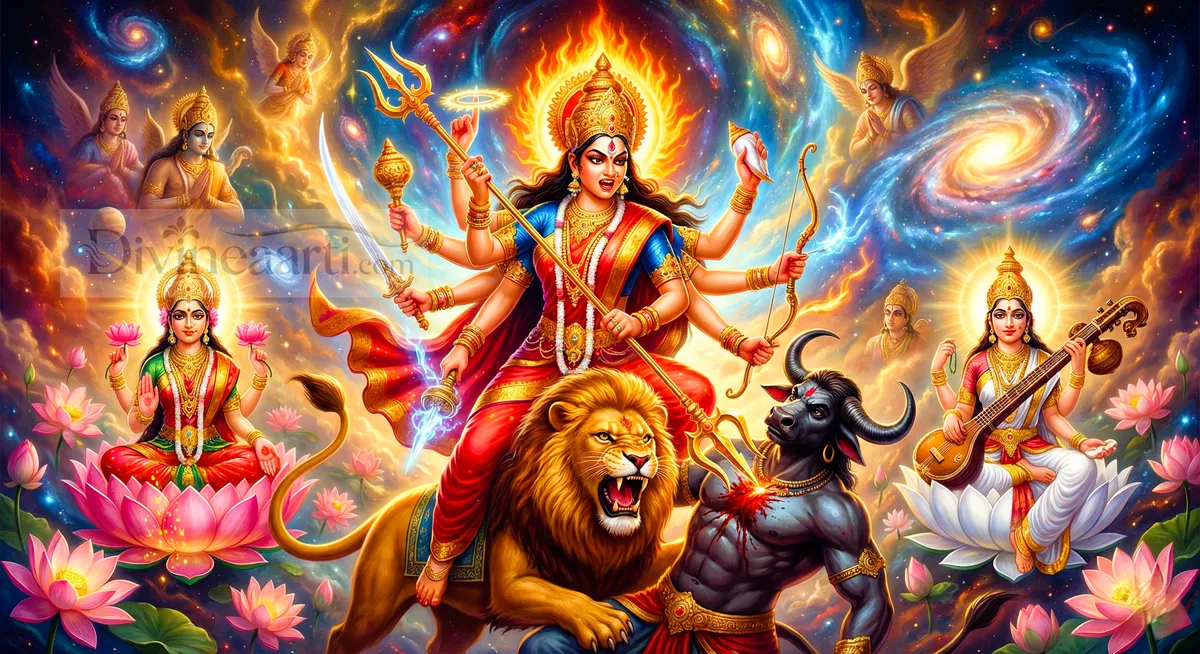
The Devi Mahatmya (देवी माहात्म्य) is the foundational scripture of Shakta Hinduism—the worship of the Divine Feminine as the Supreme Reality. In 700 powerful verses, it tells the story of Goddess Durga defeating the demons that threaten cosmic order, revealing Her as the ultimate power behind creation, preservation, and destruction.
Also known as Durga Saptashati (700 verses of Durga) and Chandi Path (Way of Chandi), this text is the heart of Navratri worship and one of the most recited scriptures in Hindu homes and temples. It celebrates the Goddess not merely as a consort of the gods, but as the source of all divine power.
नमस्तस्यै नमस्तस्यै नमस्तस्यै नमो नमः॥
— Devi Mahatmya 5.19 (Repeated for various attributes)
📜 What You'll Learn in This Guide:
- ✅ What is Devi Mahatmya and its place in Hindu tradition
- ✅ The three cosmic battles (Charitas) in detail
- ✅ The forms of the Goddess: Mahakali, Mahalakshmi, Mahasaraswati
- ✅ Key mantras and hymns with meanings
- ✅ How it's recited during Navratri
- ✅ The philosophical meaning behind the battles
- ✅ Practical guidance for parayana (recitation)
🔤 Pronunciation Guide
Mahatmya = "Muh-HAAT-myuh" (Greatness, Glory)
Saptashati = "Sup-tuh-SHUH-tee" (Seven hundred)
Chandi = "CHUN-dee" (Fierce form of Devi)
Durga = "DOOR-gaa" (The Invincible)
Mahishasura = "Muh-hee-SHAA-soor" (Buffalo Demon)
Shakti = "SHUK-tee" (Power, Energy)
📑 Table of Contents
🕉️ What Is Devi Mahatmya?
The Devi Mahatmya is a section of the Markandeya Purana (chapters 81-93), one of the eighteen major Puranas. It is the earliest comprehensive text establishing the Goddess as the Supreme Being—not as a mere helper of the gods but as the source of their power.
📊 Text Details
- Verses: 700 (hence Saptashati)
- Chapters: 13
- Episodes: 3 (Charitas)
- Source: Markandeya Purana
- Period: ~5th-6th century CE
🎯 Central Theme
- Goddess as Supreme Power
- Victory of good over evil
- Divine protection of devotees
- Unity of all goddess forms
- Shakti as cosmic energy
📚 Also Known As
- Durga Saptashati
- Chandi Path
- Chandi Saptashati
- Sometimes: Devi Suktam
- Part of Pancha Ratriya
📖 The Frame Story
The Devi Mahatmya is narrated by the sage Markandeya within a frame story involving a king and a merchant:
👑 The King and the Merchant
King Suratha has lost his kingdom to enemies and wanders in the forest, depressed. There he meets Samadhi, a merchant who was cheated and cast out by his own family, yet still worries about their welfare.
Both wonder: Why do we remain attached to those who harm us? They seek wisdom from the sage Medhas, who explains that it is Mahamaya—the Great Illusion, a form of the Goddess—who binds beings to delusion. But She also liberates those who worship Her.
To illustrate the Goddess's power, Medhas narrates the three great stories of Her victories over demons.
This frame reveals the text's purpose: to show that the same Divine Mother who creates illusion also grants liberation. By hearing Her glories, the bound become free.
⚫ First Episode: Mahakali and Madhu-Kaitabha
1 The Primal Battle (Chapter 1)
Form of Goddess: Mahakali (Yoganidra/Tamasi Devi)
Demons: Madhu and Kaitabha
Setting: Before creation, when Vishnu sleeps on the cosmic ocean
The Story:
At the end of a cosmic cycle, Lord Vishnu sleeps on the serpent Shesha in the primordial waters. From the wax of His ears arise two demons—Madhu (representing tamas, inertia) and Kaitabha (representing rajas, passion).
These demons try to kill Brahma, who sits on the lotus emerging from Vishnu's navel. Brahma cannot wake Vishnu because the Goddess as Yoganidra (the Yoga of Sleep) has him in divine slumber.
Brahma prays to the Goddess, praising Her as the power that pervades all. Pleased, Yoganidra withdraws from Vishnu, who awakens and battles the demons for 5,000 years.
Finally, the Goddess as Mahamaya deludes the demons into offering Vishnu a boon. Vishnu asks to kill them—and they, in their pride, say "Kill us where there is no water." Vishnu expands His thighs above the cosmic waters and slays them there.
योगनिद्रां भगवतीं विष्णोरतुल-तेजसः॥
Symbolism: The demons represent the primal forces of unconsciousness (tamas) and agitation (rajas). Only when the Divine Feminine (Shakti) empowers Vishnu can he act. The Goddess is revealed as the power behind even the great Preserver.
🔴 Second Episode: Mahalakshmi and Mahishasura
2 The Battle Against the Buffalo Demon (Chapters 2-4)
Form of Goddess: Mahalakshmi / Durga (Rajasi Devi)
Demon: Mahishasura (the Buffalo Demon)
Setting: The demon has conquered heaven; gods are homeless
The Story:
Mahishasura, a powerful demon who can change forms between buffalo and human, defeats Indra and the gods. He usurps heaven, forcing the gods to wander on earth.
The gods approach Brahma, who leads them to Vishnu and Shiva. In rage at the demons' atrocities, great light (tejas) blazes from the faces of all the gods—Brahma, Vishnu, Shiva, and all others—and converges into one blinding radiance.
From this combined divine energy, Goddess Durga takes form—more beautiful than anything in creation, yet terrible in power. Each god contributes a weapon: Shiva's trident, Vishnu's discus, Indra's thunderbolt, and so on. She rides a lion given by Himalaya.
The Goddess battles Mahishasura's vast army, destroying generals like Chikshura, Chamara, Asiloman, and Udagra. Finally, She faces Mahishasura himself, who keeps changing forms to escape death—elephant, lion, man, buffalo.
In the climactic moment, as he emerges from the buffalo form, Durga pierces him with her trident and beheads him. Heaven is restored to the gods.
ततो देव्या शरीरात्तु स्वतेजश्चण्डिकां ददे॥
Symbolism: Mahishasura represents the ego—powerful, shape-shifting, seemingly invincible. The ego cannot be destroyed by any single divine quality; it takes the combined force of all divine energies, unified in the Goddess. Only total surrender to Shakti destroys ego.
⚪ Third Episode: Mahasaraswati and Shumbha-Nishumbha
3 The Final Battles (Chapters 5-13)
Form of Goddess: Mahasaraswati / Ambika / Kaushiki (Sattviki Devi)
Demons: Shumbha, Nishumbha, Dhumralochana, Chanda-Munda, Raktabija
Setting: Demons have again conquered heaven
The Story:
Two demon brothers, Shumbha and Nishumbha, defeat the gods and seize heaven. The gods remember the Goddess's promise to help when invoked, and they pray to Her on the Himalaya.
Parvati hears their prayers. From Her body emerges Kaushiki (also called Ambika)—a radiantly beautiful goddess. Shumbha's messengers see Her and report Her beauty to the demon king, who sends them to propose marriage.
The Goddess replies: "I have made a vow—I will marry only the one who defeats me in battle." Enraged, Shumbha sends his general Dhumralochana, whom the Goddess reduces to ashes with a mere "Hum!"
Next come Chanda and Munda. From the Goddess's frown emerges Kali—black, emaciated, wearing a garland of skulls. Kali slays both generals and brings their heads to Ambika, earning the name Chamunda.
Then comes Raktabija—a demon with a terrible boon: every drop of his blood that touches the ground creates a duplicate demon. The battlefield fills with thousands of Raktabijas. Kali solves this by spreading her tongue across the battlefield and drinking every drop of blood before it lands, while the Goddess kills the original.
Finally, Nishumbha and Shumbha enter battle. From the bodies of all the gods emerge their feminine powers (shaktis)—Brahmani, Vaishnavi, Maheshvari, Kaumari, Varahi, Narasimhi, Aindri—forming the Saptamatrikas (Seven Mothers). Together they destroy the demon army.
Nishumbha is slain. Shumbha, the last, accuses the Goddess of unfairly using helpers. She replies with profound words and absorbs all Her emanations back into Herself, proving She alone is all.
पश्यैता दुष्ट मय्येव विशन्त्यो मद्विभूतयः॥
Symbolism: Shumbha represents "asmita" (I-am-ness, pride of identity); Nishumbha represents "nishumbha" (rejection of others). Raktabija represents how negative tendencies multiply when attacked directly—spiritual wisdom (Kali) must absorb them at the root. The Goddess's final statement reveals ultimate non-duality: all forms are Her.
🌺 The Three Great Forms of the Goddess
The three episodes correspond to three aspects of the Goddess, associated with the three gunas (qualities of nature):
⚫ Mahakali
Guna: Tamas (Darkness, Rest)
Episode: First (Madhu-Kaitabha)
Power: Destruction of primordial unconsciousness
Appearance: Dark, formidable, wielding sword and skull
Associated with: Night, dissolution, the void
🔴 Mahalakshmi
Guna: Rajas (Passion, Activity)
Episode: Second (Mahishasura)
Power: Destruction of ego and arrogance
Appearance: Resplendent, riding lion, eighteen-armed
Associated with: Prosperity, victory, action
⚪ Mahasaraswati
Guna: Sattva (Purity, Wisdom)
Episode: Third (Shumbha-Nishumbha)
Power: Destruction of pride and duality
Appearance: Pure white, gentle yet fierce
Associated with: Knowledge, final liberation
🔱 Unity of the Three
Though appearing as three, the Goddess is one. Mahakali, Mahalakshmi, and Mahasaraswati are not separate deities but aspects of the same Supreme Shakti. Just as light appears different through colored glass, the One Goddess manifests differently according to the function She performs.
🎵 Key Hymns & Mantras
The Devi Mahatmya contains several famous hymns still recited today:
1. Ya Devi Sarvabhuteshu (Tantric Hymn)
This hymn appears in Chapter 5, where the gods praise the Goddess. It follows a pattern, addressing her as dwelling in all beings in various forms:
नमस्तस्यै नमस्तस्यै नमस्तस्यै नमो नमः॥
या देवी सर्वभूतेषु निद्रारूपेण संस्थिता।
नमस्तस्यै नमस्तस्यै नमस्तस्यै नमो नमः॥
या देवी सर्वभूतेषु शक्तिरूपेण संस्थिता।
नमस्तस्यै नमस्तस्यै नमस्तस्यै नमो नमः॥
To the Goddess who abides in all beings as Sleep—salutations...
To the Goddess who abides in all beings as Power—salutations..."
2. Aparajita Stuti (Hymn by the Gods)
After the Goddess defeats Mahishasura, the gods praise Her:
निश्शेषदेवगणशक्तिसमूहमूर्त्या।
तामम्बिकामखिलदेवमहर्षिपूज्यां
भक्त्या नताः स्म विदधातु शुभानि सा नः॥
3. Narayani Stuti (Chapter 11)
The grand hymn after final victory, addressing Her as Narayani:
शरण्ये त्र्यम्बके गौरि नारायणि नमोऽस्तु ते॥
💭 The Deeper Philosophy
The Devi Mahatmya is not merely mythology—it presents profound spiritual philosophy:
🔮 Shakti as Supreme
The text establishes that power (Shakti) is feminine and primary. Even the male gods derive their strength from the Goddess. Without Shakti, Shiva is shava (a corpse). This reverses the common assumption that the feminine is secondary.
🔮 Maya as Divine
Mahamaya (Great Illusion) is not evil but the creative power of the Goddess. She deludes—but also liberates. The same force that binds becomes the force that frees when we surrender to Her.
🔮 Inner Demons
The demons represent psychological obstacles: Madhu-Kaitabha (tamas & rajas), Mahishasura (ego), Raktabija (multiplying desires), Shumbha-Nishumbha (pride & rejection). The Goddess destroys these in devotees.
🌙 Recitation During Navratri
Navratri (Nine Nights) is the primary festival for Devi Mahatmya recitation. The text is chanted over nine days:
Some devotees recite the entire text daily during Navratri. Others do a complete recitation on Ashtami (8th day) or perform Akhand Path—continuous recitation by groups taking turns.
📿 How to Recite Devi Mahatmya
🕐 Preparation
- Bathe and wear clean clothes
- Sit facing East or North
- Light a lamp before the Goddess image
- Offer flowers if available
- Begin with Kavach-Argala-Kilakam
📖 During Recitation
- Recite with devotion, not speed
- Correct pronunciation is valued
- Do not leave mid-chapter
- Keep water nearby
- Full recitation takes ~3 hours
🙏 After Recitation
- Recite Devi Suktam or Kshama Prarthana
- Offer aarti to the Goddess
- Distribute prasad if possible
- Maintain a devotional attitude
- Practice for 9, 40, or 108 days
📚 Ancillary Texts (Anganyasa)
Before the main text, three preliminary pieces are traditionally recited:
- Devi Kavacham — The Goddess's armor (for protection)
- Argala Stotram — The bolt (to unlock blessings)
- Kilakam — The key (to release the text's power)
After the 13 chapters, the Devi Suktam from the Rig Veda and the Rahasya Trayam (Three Secrets) may be added.
❓ Frequently Asked Questions
Can women recite Devi Mahatmya?
Absolutely yes. The text glorifies the Divine Feminine—there is no restriction on women. In fact, women are often the primary keepers of this tradition in families. The Goddess's grace flows to all who call upon Her with devotion.
Can I recite during menstruation?
Views vary by tradition. Many modern practitioners and teachers say the Goddess who pervades all beings does not discriminate based on bodily functions. Some women pause; others continue with mental recitation. Follow your tradition or heart.
Is initiation required?
For devotional reading (parayana), no initiation is required. For using the text in Tantric ritual (puja, homa) or for specific sadhanas, guidance from a guru is recommended. The text itself says hearing it with faith brings blessings.
Can I listen instead of reciting?
Yes. The text specifically mentions the merit of hearing it. If you cannot recite Sanskrit, listening to a recording with devotion is beneficial. Many traditions consider shravanam (hearing) as valid as pathanam (reciting).
What if I make mistakes in pronunciation?
The Goddess values devotion over perfection. The Kilakam specifically addresses this—any errors are covered by the text's own power. Continue with sincerity; pronunciation improves with practice.
🙏 Conclusion: The Ever-Present Mother
The Devi Mahatmya is not a story from the past—it is an eternal truth. The same Goddess who defeated Mahishasura defeats the demons of ignorance in us. The same Shakti who empowers Vishnu empowers every noble action.
Whether you recite the full 700 verses during Navratri or simply remember the Goddess's name in times of trouble, Her promise stands:
तदा तदावतीर्याहं करिष्याम्यरिसंक्षयम्॥
— Devi Mahatmya 11.55