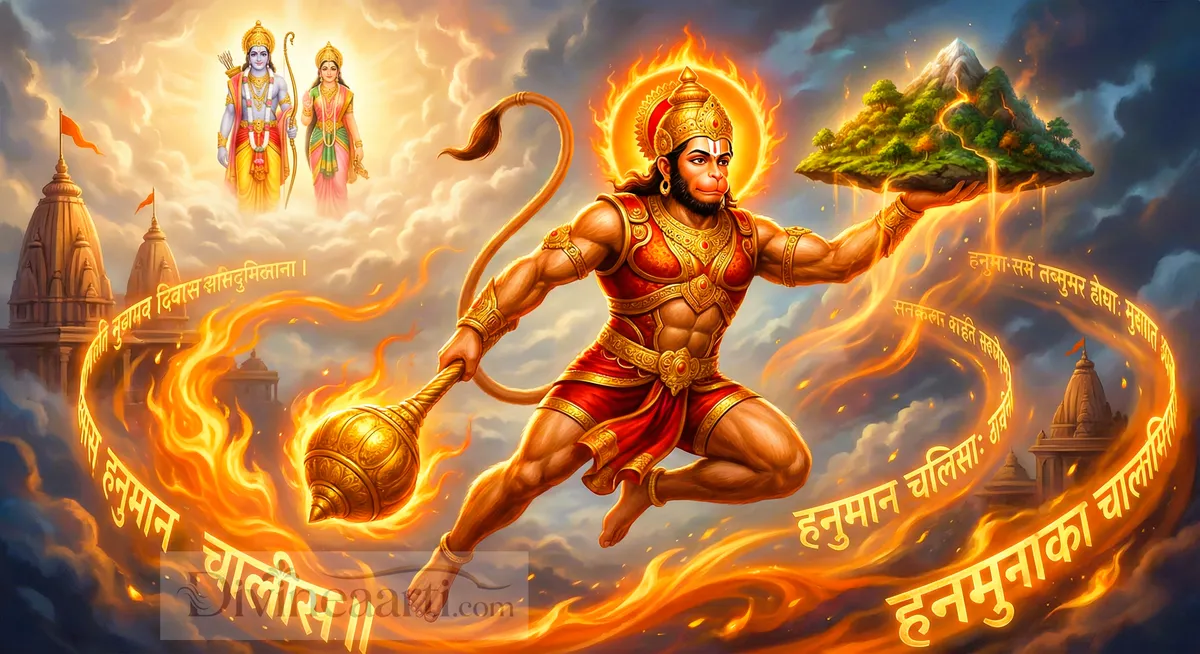
The Hanuman Chalisa (हनुमान चालीसा) is one of the most beloved hymns in Hindu devotion. Composed by the great saint-poet Tulsidas in the 16th century, these 40 verses (chalisa = forty) praise Lord Hanuman's divine qualities, recount his heroic deeds from the Ramayana, and invoke his powerful blessings.
Millions recite the Hanuman Chalisa daily across the world—from homes in India to temples in America, from offices before important meetings to bedsides seeking healing. This guide explains every verse with translation, meaning, and spiritual significance, so you can understand what you're chanting and deepen your connection with Hanuman Ji.
📜 What You'll Learn in This Guide:
- ✅ Who was Tulsidas and why he composed the Chalisa
- ✅ The structure: 2 opening dohas, 40 chaupais, 1 closing doha
- ✅ Complete translation of every verse
- ✅ Significance and deeper meaning of key verses
- ✅ Benefits of recitation as stated in the text
- ✅ How to recite with proper devotion
🔤 Pronunciation Guide for Key Terms
Hanuman = "Huh-noo-MAAN" (The monkey god)
Chalisa = "Chaa-LEE-saa" (Forty verses)
Tulsidas = "Tul-see-DAAS" (The author)
Doha = "DOH-haa" (Couplet)
Chaupai = "CHAU-pie" (Four-line verse)
Pavan Putra = "PUH-vun POO-truh" (Son of Wind)
Bajrang Bali = "Buj-RUNG BAA-lee" (Thunder-limbed warrior)
Ram Bhakt = "RAAM Bhukt" (Devotee of Rama)
🕉️ About the Hanuman Chalisa
The Hanuman Chalisa is a 40-verse devotional poem dedicated to Lord Hanuman, the divine monkey warrior who served Lord Rama with unwavering devotion. Written in Awadhi (a dialect of Hindi), it is considered one of the most powerful prayers in Hindu tradition.
📊 Quick Facts
- Language: Awadhi Hindi
- Author: Goswami Tulsidas
- Period: 16th century CE
- Verses: 40 chaupais + 3 dohas
- Recitation time: 5-7 minutes
🙏 Why Hanuman?
- Chiranjeevi (Immortal)
- Perfect devotee of Rama
- Remover of obstacles
- Protector from evil
- Grants strength & courage
📖 Key Themes
- Hanuman's divine qualities
- His service to Lord Rama
- Heroic deeds in Ramayana
- Blessings for devotees
- Power of devotion (bhakti)
👤 Who Was Tulsidas?
Goswami Tulsidas (1532-1623 CE) was one of the greatest saint-poets in Indian history. Born in Rajapur, Uttar Pradesh, he is best known for Ramcharitmanas—the Hindi retelling of the Ramayana that transformed spiritual devotion in North India.
According to tradition, Tulsidas composed the Hanuman Chalisa during a remarkable incident:
📜 The Origin Story
While in Varanasi, Tulsidas was falsely accused and imprisoned by the Mughal emperor's men. In his cell, with deep devotion, he composed and recited the Hanuman Chalisa. It is said that legions of monkeys appeared and caused such chaos that the guards freed Tulsidas out of fear. Some versions say Hanuman himself appeared to liberate his devotee.
Whether historically accurate or legendary, this story illustrates the power attributed to the Chalisa—that sincere recitation invokes Hanuman's protection.
📐 Structure of the Chalisa
The Hanuman Chalisa has a specific poetic structure:
| Section |
Type |
Description |
| Opening |
2 Dohas |
Invocation to Guru and Hanuman |
| Main Body |
40 Chaupais |
Praise, deeds, and blessings |
| Closing |
1 Doha |
Final prayer for Rama's abode in the heart |
- Doha — A couplet with two lines (each line has 13-11 beats)
- Chaupai — A quatrain with four lines (each line has 16 beats)
- Chalisa — Means "forty" (referring to the 40 chaupais)
🙏 Opening Dohas (Invocation)
Doha 1: Salutation to Guru
श्रीगुरु चरन सरोज रज, निज मनु मुकुरु सुधारि।
बरनउँ रघुबर बिमल जसु, जो दायकु फल चारि॥
Śrīguru carana saroja raja, nija manu mukuru sudhāri |
Baranauṁ raghubara bimala jasu, jo dāyaku phala cāri ||
Translation: "Having purified the mirror of my mind with the dust of my Guru's lotus feet, I describe the pure glory of Sri Rama (the best of Raghu's dynasty), who bestows the four fruits of life."
Significance: Tulsidas begins by honoring his Guru—a tradition in Indian spirituality. The "four fruits" are Dharma (righteousness), Artha (prosperity), Kama (fulfillment), and Moksha (liberation). By cleansing the mind with humility, one becomes fit to receive grace.
Doha 2: Invocation to Hanuman
बुद्धिहीन तनु जानिके, सुमिरौं पवनकुमार।
बल बुद्धि बिद्या देहु मोहिं, हरहु कलेस बिकार॥
Buddhihīna tanu jānike, sumirauṁ pavanakumāra |
Bala buddhi bidyā dehu mohiṁ, harahu kalesa bikāra ||
Translation: "Knowing myself to be ignorant, I meditate upon the Son of the Wind (Hanuman). O Lord, grant me strength, wisdom, and knowledge, and remove my afflictions and impurities."
Significance: This is the devotee's humble prayer. By acknowledging our limitations, we open ourselves to Hanuman's grace. He grants bala (strength), buddhi (wisdom), and vidya (knowledge)—the three essential qualities for both worldly success and spiritual progress.
🌟 Verses 1-10: Divine Description
The first ten verses describe Hanuman's divine form, qualities, and close relationship with Lord Rama.
1 Chaupai 1
जय हनुमान ज्ञान गुन सागर।
जय कपीस तिहुँ लोक उजागर॥
Jaya hanumāna jñāna guna sāgara | Jaya kapīsa tihuṁ loka ujāgara ||
Translation: "Victory to Hanuman, the ocean of wisdom and virtue! Victory to the Lord of Monkeys, illuminator of the three worlds!"
The opening praise establishes Hanuman as an ocean (infinite) of knowledge and good qualities. The "three worlds" are Svarga (heaven), Prithvi (earth), and Patala (netherworld). Hanuman's glory illuminates all realms.
2 Chaupai 2
राम दूत अतुलित बल धामा।
अंजनि-पुत्र पवनसुत नामा॥
Rāma dūta atulita bala dhāmā | Añjani-putra pavanasuta nāmā ||
Translation: "You are Rama's messenger, the abode of incomparable strength, known as the son of Anjani and son of the Wind God (Vayu)."
Hanuman's identity is defined by service—he is Rama's duta (messenger). His physical father was Kesari, but through divine grace, Vayu (Wind God) is his spiritual father, giving Hanuman the power to fly and his name "Pavan Putra."
3 Chaupai 3
महावीर विक्रम बजरंगी।
कुमति निवार सुमति के संगी॥
Mahāvīra vikrama bajaraṅgī | Kumati nivāra sumati ke saṅgī ||
Translation: "O great hero, valorous one with limbs as strong as thunderbolts! You dispel evil thoughts and are the companion of good thoughts."
Bajrangi (Thunderbolt-limbed) is a famous epithet—Hanuman's body is said to be as hard as vajra (diamond/thunderbolt). Beyond physical strength, he protects the mind by removing kumati (evil intellect) and fostering sumati (good intellect).
4 Chaupai 4
कंचन बरन बिराज सुबेसा।
कानन कुंडल कुंचित केसा॥
Kañcana barana birāja subesā | Kānana kuṇḍala kuñcita kesā ||
Translation: "Your complexion is golden, magnificently adorned. You wear earrings and have curly hair."
This verse describes Hanuman's beautiful divine form—golden-hued like dawn, adorned with earrings (kundal), with curly locks. This is the form worshipped in temples.
5 Chaupai 5
हाथ बज्र औ ध्वजा बिराजै।
काँधे मूँज जनेऊ साजै॥
Hātha bajra au dhvajā birājai | Kāṅdhe mūṅja janeū sājai ||
Translation: "In your hands shine the thunderbolt and banner. On your shoulder rests the sacred thread made of munja grass."
The vajra (mace/thunderbolt) represents power; the dhvaja (flag) represents victory. The janeu (sacred thread) indicates Hanuman is a learned Brahmin—he was the student of Surya (the Sun God) who taught him all scriptures.
6 Chaupai 6
संकर सुवन केसरीनंदन।
तेज प्रताप महा जग बंदन॥
Saṅkara suvana kesarīnandana | Teja pratāpa mahā jaga bandana ||
Translation: "You are the manifestation of Lord Shiva and the delight of Kesari. Your radiance and glory are immense—the whole world worships you."
Hanuman is considered an avatar of Shiva (Rudra). Kesari was his physical father, a vanara king. The whole world (jag) honors Hanuman for his extraordinary teja (brilliance) and pratap (valor).
7 Chaupai 7
विद्यावान गुनी अति चातुर।
राम काज करिबे को आतुर॥
Vidyāvāna gunī ati cātura | Rāma kāja karibe ko ātura ||
Translation: "You are supremely learned, virtuous, and clever. You are ever eager to perform Lord Rama's work."
Despite his power, Hanuman's defining quality is seva (service). He is atura (eager, restless) to serve Rama—this is the model of perfect devotion. His learning includes all Vedas, his virtue is tested and true, his cleverness evident in every Ramayana episode.
8 Chaupai 8
प्रभु चरित्र सुनिबे को रसिया।
राम लखन सीता मन बसिया॥
Prabhu caritra sunibe ko rasiyā | Rāma lakhana sītā mana basiyā ||
Translation: "You delight in hearing the stories of the Lord. Rama, Lakshmana, and Sita dwell in your heart."
Rasiya means one who relishes. Hanuman never tires of hearing Rama's glories. And in his heart, the divine trinity—Rama, his brother Lakshmana, and Sita—reside eternally. This is antaryami—the Lord dwelling within.
9 Chaupai 9
सूक्ष्म रूप धरि सियहिं दिखावा।
विकट रूप धरि लंक जरावा॥
Sūkṣma rūpa dhari siyahiṁ dikhāvā | Vikaṭa rūpa dhari laṅka jarāvā ||
Translation: "You assumed a tiny form to show yourself to Sita (in Lanka). You assumed a gigantic, terrible form to burn Lanka."
This refers to Hanuman's search for Sita in Lanka. He became tiny (sukshma) to avoid detection and approach Sita gently in the Ashoka garden. Later, when captured and his tail set on fire, he grew gigantic (vikat) and set all of Lanka ablaze. He has complete mastery over his form.
10 Chaupai 10
भीम रूप धरि असुर सँहारे।
रामचंद्र के काज सँवारे॥
Bhīma rūpa dhari asura saṁhāre | Rāmacandra ke kāja saṁvāre ||
Translation: "Assuming a fierce form, you destroyed the demons. Thus you accomplished the tasks of Lord Rama."
In battle, Hanuman was terrifying to behold. He single-handedly killed countless rakshasas (demons) in Lanka. But note: all this power was directed solely toward Rama's kaja—serving his Lord. Power without devotion leads to ego; Hanuman's power was always consecrated.
⚔️ Verses 11-20: Heroic Deeds
These verses recount Hanuman's famous exploits from the Ramayana—bringing the life-saving herb, receiving Sita's blessings, and more.
11 Chaupai 11
लाय सजीवन लखन जियाये।
श्रीरघुबीर हरषि उर लाये॥
Lāya sajīvana lakhana jiyāye | Śrīraghubīra haraṣi ura lāye ||
Translation: "You brought the Sanjeevani herb and revived Lakshmana. Sri Rama, delighted, embraced you to his heart."
One of Hanuman's greatest feats: when Lakshmana was struck unconscious by Meghanada's shakti weapon, only the Sanjeevani herb from the Himalayas could save him. Hanuman flew overnight, and unable to identify the exact herb, lifted the entire mountain! Rama embraced him with tears of joy.
12 Chaupai 12
रघुपति कीन्ही बहुत बड़ाई।
तुम मम प्रिय भरतहि सम भाई॥
Raghupati kīnhī bahuta baḍāī | Tuma mama priya bharatahi sama bhāī ||
Translation: "Lord Rama praised you greatly, saying: 'You are as dear to me as my brother Bharata.'"
This is extraordinary—Rama declares Hanuman equal to Bharata, his beloved brother who ruled Ayodhya in Rama's name with Rama's sandals on the throne. There is no higher honor. Devotion makes one family with the Lord.
13 Chaupai 13
सहस बदन तुम्हरो जस गावैं।
अस कहि श्रीपति कंठ लगावैं॥
Sahasa badana tumharo jasa gāvaiṁ | Asa kahi śrīpati kaṇṭha lagāvaiṁ ||
Translation: "'May the thousand-headed Shesha sing your glory!' So saying, the Lord of Lakshmi (Rama) embraced you."
Shesha Naga, the cosmic serpent with a thousand hoods, eternally sings Vishnu's praises. Rama declares even Shesha should sing Hanuman's glory! The embrace (kantha lagave) signifies complete acceptance—Hanuman has merged with his Lord.
14 Chaupai 14
सनकादिक ब्रह्मादि मुनीसा।
नारद सारद सहित अहीसा॥
Sanakādika brahmādi munīsā | Nārada sārada sahita ahīsā ||
Translation: "Sanaka and other sages, Brahma, the great munis, Narada, Saraswati, and Shesha..."
15 Chaupai 15
जम कुबेर दिगपाल जहाँ ते।
कवि कोविद कहि सके कहाँ ते॥
Jama kubera digapāla jahāṁ te | Kavi kovida kahi sake kahāṁ te ||
Translation: "...Yama, Kubera, and the guardians of directions—where can poets and scholars find words to describe your glory?"
Verses 14-15 form a single thought: even the greatest beings—the Four Kumaras, Brahma, celestial musicians, Yama (god of death), Kubera (god of wealth), the eight dikpalas (directional guardians)—even they cannot fully describe Hanuman's greatness. What chance have mere poets?
16 Chaupai 16
तुम उपकार सुग्रीवहिं कीन्हा।
राम मिलाय राज पद दीन्हा॥
Tuma upakāra sugrīvahiṁ kīnhā | Rāma milāya rāja pada dīnhā ||
Translation: "You did a great service to Sugriva—you united him with Rama, and he regained his kingdom."
Sugriva, the vanara king, was exiled by his brother Vali. Hanuman arranged the alliance between Sugriva and Rama. Rama killed Vali, and Sugriva was restored to his throne. Hanuman's role as mediator and facilitator is highlighted—he creates connections.
17 Chaupai 17
तुम्हरो मंत्र विभीषन माना।
लंकेश्वर भए सब जग जाना॥
Tumharo mantra vibhīṣana mānā | Laṅkeśvara bhae saba jaga jānā ||
Translation: "Vibhishana heeded your counsel and became the Lord of Lanka, as all the world knows."
Vibhishana was Ravana's righteous brother. When he sought to join Rama, Hanuman vouched for his sincerity. His wise counsel (mantra) guided Vibhishana to righteousness, and after the war, he became Lanka's king. Good counsel transforms destinies.
18 Chaupai 18
जुग सहस्र जोजन पर भानू।
लील्यो ताहि मधुर फल जानू॥
Juga sahasra jojana para bhānū | Līlyo tāhi madhura phala jānū ||
Translation: "The Sun, which is thousands of yojanas away, you leaped toward and swallowed it, thinking it a sweet fruit!"
This refers to baby Hanuman's famous leap. Seeing the rising sun, the child thought it was a ripe fruit and flew toward it! The gods were alarmed; Indra struck him with a thunderbolt, breaking his jaw (hanu), hence the name "Hanuman." This verse celebrates his fearlessness from birth.
19 Chaupai 19
प्रभु मुद्रिका मेलि मुख माहीं।
जलधि लाँघि गये अचरज नाहीं॥
Prabhu mudrikā meli mukha māhīṁ | Jaladhi lāṅghi gaye acaraja nāhīṁ ||
Translation: "Placing the Lord's ring in your mouth, you crossed the ocean—no wonder at all!"
Rama gave Hanuman his ring as a token for Sita. With this divine credential, Hanuman made the legendary leap across the 100-yojana ocean to Lanka. For such a being, this was acharaj nahi—no surprise!
20 Chaupai 20
दुर्गम काज जगत के जेते।
सुगम अनुग्रह तुम्हरे तेते॥
Durgama kāja jagata ke jete | Sugama anugraha tumhare tete ||
Translation: "All the difficult tasks of the world become easy by your grace."
This is a key promise of the Chalisa: no matter how durgam (impossible) a task seems, with Hanuman's anugraha (grace), it becomes sugam (easy). Devotees recite this verse when facing daunting challenges.
🛡️ Verses 21-30: Powers & Protection
These verses describe Hanuman as protector, gatekeeper to Rama, and remover of all obstacles.
21 Chaupai 21
राम दुआरे तुम रखवारे।
होत न आज्ञा बिनु पैसारे॥
Rāma duāre tuma rakhavāre | Hota na ājñā binu paisāre ||
Translation: "You are the guardian at Rama's door. No one may enter without your permission."
Hanuman controls access to Rama—this is a profound statement. Those who wish to reach God must first have Hanuman's blessing. Pleasing the devotee pleases the Lord. This is why devotees pray to Hanuman first.
22 Chaupai 22
सब सुख लहै तुम्हारी सरना।
तुम रक्षक काहू को डर ना॥
Saba sukha lahai tumhārī saranā | Tuma rakṣaka kāhū ko ḍara nā ||
Translation: "One who takes refuge in you attains all happiness. With you as protector, there is nothing to fear."
Sarana means taking refuge. This verse promises complete security—sab sukh (all happiness) and kahu ko dar na (fear of nothing). Hanuman is the ultimate protector.
23 Chaupai 23
आपन तेज सम्हारो आपै।
तीनों लोक हाँक तें काँपै॥
Āpana teja samhāro āpai | Tīnoṁ loka hāṅka teṁ kāṅpai ||
Translation: "You alone can contain your own brilliance. The three worlds tremble at your roar."
Hanuman's power is so immense that only he can control it! When he roars in battle, all three worlds shake. This is virat shakti—cosmic power. Yet he keeps it perfectly restrained in humble service.
24 Chaupai 24
भूत पिसाच निकट नहिं आवै।
महाबीर जब नाम सुनावै॥
Bhūta pisāca nikaṭa nahiṁ āvai | Mahābīra jaba nāma sunāvai ||
Translation: "Ghosts and evil spirits do not come near when one chants the name of Mahavira (Hanuman)."
This is why Hanuman Chalisa is recited for protection. The name Mahavira (Great Hero) itself dispels negative energies. Bhut-pisach (malevolent spirits) flee at the very sound.
25 Chaupai 25
नासै रोग हरै सब पीरा।
जपत निरंतर हनुमत बीरा॥
Nāsai roga harai saba pīrā | Japata nirantara hanumata bīrā ||
Translation: "Diseases are destroyed and all pain is removed by constantly chanting Hanuman's name."
The healing power of devotion! Rog (disease) and pira (pain) are removed through nirantar jap—continuous chanting. This verse is particularly recited during illness.
26 Chaupai 26
संकट तें हनुमान छुड़ावै।
मन क्रम बचन ध्यान जो लावै॥
Saṅkaṭa teṁ hanumāna chuḍāvai | Mana krama bacana dhyāna jo lāvai ||
Translation: "Hanuman liberates from all troubles those who meditate on him with mind, action, and speech."
The three dimensions of devotion: man (thought), kram (action), and vachan (word). When all three are aligned in remembering Hanuman, liberation from sankat (difficulties) is assured.
27 Chaupai 27
सब पर राम तपस्वी राजा।
तिन के काज सकल तुम साजा॥
Saba para rāma tapasvī rājā | Tina ke kāja sakala tuma sājā ||
Translation: "Rama is the supreme king among ascetic-kings. You accomplished all his tasks."
Rama is tapasvi raja—a king who lived as an ascetic in the forest. Despite being God incarnate, he acted through helpers like Hanuman. This glorifies Hanuman as the one who made Rama's mission successful.
28 Chaupai 28
और मनोरथ जो कोई लावै।
सोई अमित जीवन फल पावै॥
Aura manoratha jo koī lāvai | Soī amita jīvana phala pāvai ||
Translation: "Whoever brings any desire (to you), that person attains immeasurable fruits in life."
Manorath means heart's desire. The promise: whatever wish you bring to Hanuman, you will receive amit (limitless) blessings. This is sankalpa-siddhi—the fulfillment of intentions through devotion.
29 Chaupai 29
चारों जुग परताप तुम्हारा।
है परसिद्ध जगत उजियारा॥
Cāroṁ juga paratāpa tumhārā | Hai parasiddha jagata ujiyārā ||
Translation: "Your glory extends through all four ages (yugas). Your fame illuminates the whole world."
The four yugas are Satya, Treta, Dvapara, and Kali. Hanuman is chiranjeevi (immortal)—he has lived through all ages and will continue. His light (ujiyara) is eternal, not limited to one era.
30 Chaupai 30
साधु संत के तुम रखवारे।
असुर निकंदन राम दुलारे॥
Sādhu santa ke tuma rakhavāre | Asura nikandana rāma dulāre ||
Translation: "You are the protector of saints and sages, the destroyer of demons, the beloved of Rama."
Hanuman's dual role: nurturing the righteous (sadhu-sant) and annihilating evil (asur nikandan). He is both gentle protector and fierce warrior. And above all, he is Ram dulare—Rama's darling.
🎁 Verses 31-40: Blessings & Benefits
The final verses describe the siddhis (powers) Hanuman grants and the specific benefits of reciting the Chalisa.
31 Chaupai 31
अष्ट सिद्धि नौ निधि के दाता।
अस बर दीन्ह जानकी माता॥
Aṣṭa siddhi nau nidhi ke dātā | Asa bara dīnha jānakī mātā ||
Translation: "You are the giver of the eight siddhis (powers) and nine nidhis (treasures)—this boon Mother Janaki (Sita) gave you."
The ashta siddhis are eight supernatural powers (like becoming tiny, huge, light, heavy, etc.). The nau nidhis are nine treasures of Kubera. Sita blessed Hanuman with the power to grant these to his devotees!
32 Chaupai 32
राम रसायन तुम्हरे पासा।
सदा रहो रघुपति के दासा॥
Rāma rasāyana tumhare pāsā | Sadā raho raghupati ke dāsā ||
Translation: "You possess the elixir of Rama-devotion. May you always remain the servant of the Lord of Raghus."
Ram rasayan—the nectar of Rama—is the secret of immortality. And despite all his power, Hanuman's highest aspiration is to remain das (servant). This is the paradox of bhakti: the greatest become servants.
33 Chaupai 33
तुम्हरे भजन राम को पावै।
जनम जनम के दुख बिसरावै॥
Tumhare bhajana rāma ko pāvai | Janama janama ke dukha bisarāvai ||
Translation: "By worshipping you, one attains Rama. The sorrows of many lifetimes are forgotten."
Key teaching: Worshipping Hanuman leads to Rama. The devotee isn't stopping at Hanuman but reaching the Lord through him. And the fruit? Janam janam ke dukh—suffering accumulated over countless births—is erased.
34 Chaupai 34
अंत काल रघुबर पुर जाई।
जहाँ जन्म हरिभक्त कहाई॥
Anta kāla raghubara pura jāī | Jahāṁ janma haribhakta kahāī ||
Translation: "At death, one goes to Rama's abode. Or if born again, one is known as a devotee of Hari."
The ultimate promise: liberation (Raghubar pur—Rama's city, i.e., Vaikuntha/Saket). And even if rebirth occurs, one will be born as a Hari-bhakta—continuing the spiritual journey with devotion.
35 Chaupai 35
और देवता चित्त न धरई।
हनुमत सेइ सर्ब सुख करई॥
Aura devatā citta na dharaī | Hanumata seī sarba sukha karaī ||
Translation: "Even without thinking of other deities, one who serves Hanuman attains all happiness."
This is not exclusivism—it means Hanuman is sufficient. You don't need to approach multiple deities anxiously. Whole-hearted devotion to Hanuman brings sarva sukh—complete fulfillment. He is the gateway to all blessings.
36 Chaupai 36
संकट कटै मिटै सब पीरा।
जो सुमिरै हनुमत बलबीरा॥
Saṅkaṭa kaṭai miṭai saba pīrā | Jo sumirai hanumata balabīrā ||
Translation: "Troubles are cut away and all pain removed for one who remembers Hanuman, the mighty hero."
A reinforcement of verse 25. Sankat (crisis) is cut—not just reduced, but eliminated. Sumiran (remembrance) is the key practice. Even a moment's genuine remembrance activates Hanuman's grace.
37 Chaupai 37
जै जै जै हनुमान गोसाईं।
कृपा करहु गुरुदेव की नाईं॥
Jai jai jai hanumāna gosāīṁ | Kṛpā karahu gurudeva kī nāīṁ ||
Translation: "Victory, victory, victory to Lord Hanuman! Bestow your grace upon me as a Guru bestows upon his disciple."
The triple Jai is the climax of praise. Gosain means master of senses—Hanuman is perfectly self-controlled. Tulsidas asks for grace (kripa) like a student receives from teacher—complete, transformative, personal.
38 Chaupai 38
जो सत बार पाठ कर कोई।
छूटहि बंदि महा सुख होई॥
Jo sata bāra pāṭha kara koī | Chūṭahi bandi mahā sukha hoī ||
Translation: "Whoever recites this a hundred times is freed from bondage and attains great bliss."
A specific practice is prescribed: sat bar (100 times) recitation. The result? Freedom from all bandhan (bondage) and maha sukh (supreme happiness). This is the origin of the practice of reciting Chalisa 100 or 108 times.
39 Chaupai 39
जो यह पढ़ै हनुमान चालीसा।
होय सिद्धि साखी गौरीसा॥
Jo yaha paḍhai hanumāna cālīsā | Hoya siddhi sākhī gaurīsā ||
Translation: "Whoever reads this Hanuman Chalisa attains perfection—Lord Shiva is witness to this."
Siddhi means accomplishment of one's goals. Shiva himself (Gaurisa—Gauri's lord) is called as sakshi (witness) to this promise. Since Hanuman is Shiva's avatar, the father validates the son's power.
40 Chaupai 40
तुलसीदास सदा हरि चेरा।
कीजै नाथ हृदय महँ डेरा॥
Tulasīdāsa sadā hari cerā | Kījai nātha hṛdaya mahaṁ ḍerā ||
Translation: "Tulsidas is forever the servant of Hari (God). O Lord, make your dwelling in my heart."
Tulsidas signs off with humility—he is always a chera (servant). His final prayer: may Hanuman/Rama reside permanently (dera—camp) in his heart. This is the devotee's highest aspiration—to become the temple of the Lord.
🙏 Closing Doha
Closing Couplet
पवनतनय संकट हरन मंगल मूरति रूप।
राम लखन सीता सहित हृदय बसहु सुर भूप॥
Pavanatanaya saṅkaṭa harana maṅgala mūrati rūpa |
Rāma lakhana sītā sahita hṛdaya basahu sura bhūpa ||
Translation: "O Son of the Wind, remover of difficulties, embodiment of auspiciousness! Along with Rama, Lakshmana, and Sita, dwell forever in my heart, O King of Gods!"
The Chalisa concludes with an invitation: may the entire divine family—Hanuman with Rama, Lakshmana, and Sita—take permanent residence in the devotee's heart. Sura bhup acknowledges Hanuman as king among celestials.
✨ Benefits of Reciting Hanuman Chalisa
According to the Chalisa itself and devotional tradition:
🛡️ Protection
From evil spirits, negative energies, and enemies (Verse 24)
💪 Strength & Courage
Physical and mental strength from the mighty Hanuman (Opening Doha)
🧠 Wisdom
Removal of ignorance, bestowal of knowledge (Opening Doha)
❤️ Healing
Diseases destroyed, pain removed (Verse 25)
🎯 Success
Difficult tasks become easy (Verse 20)
😌 Freedom from Troubles
All crises resolved through Hanuman's grace (Verse 36)
🪐 Saturn Relief
Protection from Shani's malefic effects (Traditional belief)
🙏 Spiritual Growth
Access to Rama through Hanuman (Verse 33)
📿 How to Recite the Hanuman Chalisa
🕐 Best Times
- Morning: After bath, before sunrise
- Evening: At twilight (sandhya)
- Tuesdays: Hanuman's primary day
- Saturdays: For Shani relief
- During difficulties: Anytime with devotion
📖 How Many Times?
- Daily: 1 time minimum
- Tuesdays/Saturdays: 7 times
- Special occasions: 11, 21, or 108 times
- For siddhi: 100 times (Verse 38)
- Key: Quality > Quantity
🙏 Proper Method
- Sit facing East or North
- Light a diya if possible
- Recite slowly with understanding
- Visualize Hanuman's form
- Conclude with pranaam
❓ Frequently Asked Questions
Can women recite Hanuman Chalisa?
Yes, absolutely. There is no scriptural prohibition. Hanuman protects all devotees regardless of gender. The myth that women cannot worship Hanuman has no basis in authentic texts. Many women saints have been devoted to Hanuman.
Can I recite Hanuman Chalisa during menstruation?
Different traditions have varying views. The most important thing is devotion in the heart. Many teachers say sincere prayer is always welcome. If you follow certain family customs, you may chant mentally. Hanuman is Sankat Mochan—he responds to the heart, not external conditions.
I don't know Hindi—can I still recite it?
Yes! The vibration of the sacred words carries power even if you don't fully understand. Many devotees worldwide recite in the original Awadhi. Use transliteration to pronounce correctly. Over time, learn the meanings to deepen your practice.
What if I make pronunciation mistakes?
Hanuman values devotion over perfection. Sincerity of heart matters more than linguistic accuracy. Keep practicing—your pronunciation will improve. The important thing is to begin with whatever ability you have.
Can I listen instead of reciting?
Yes. Listening with attention is also beneficial—this is shravan bhakti. But personal recitation engages you more deeply (speech, breath, focus). Ideally, combine both: listen to learn, then recite yourself.
🙏 Conclusion
The Hanuman Chalisa is more than poetry—it is a living transmission of devotion from Tulsidas to every sincere seeker. Each verse carries the power of the great saint's realization and Hanuman's eternal blessings.
Whether you recite for protection, healing, success, or spiritual growth, approach with an open heart. Hanuman responds to the call of the devoted. As the Chalisa promises: difficulties dissolve, fears vanish, and the light of Rama fills the heart.
"जय हनुमान ज्ञान गुन सागर। जय कपीस तिहुँ लोक उजागर॥"
"Victory to Hanuman, ocean of wisdom and virtue! Victory to the Lord of Monkeys, illuminator of the three worlds!"
— Hanuman Chalisa, Verse 1
📤 Share This Guide
Help others understand the Hanuman Chalisa.