
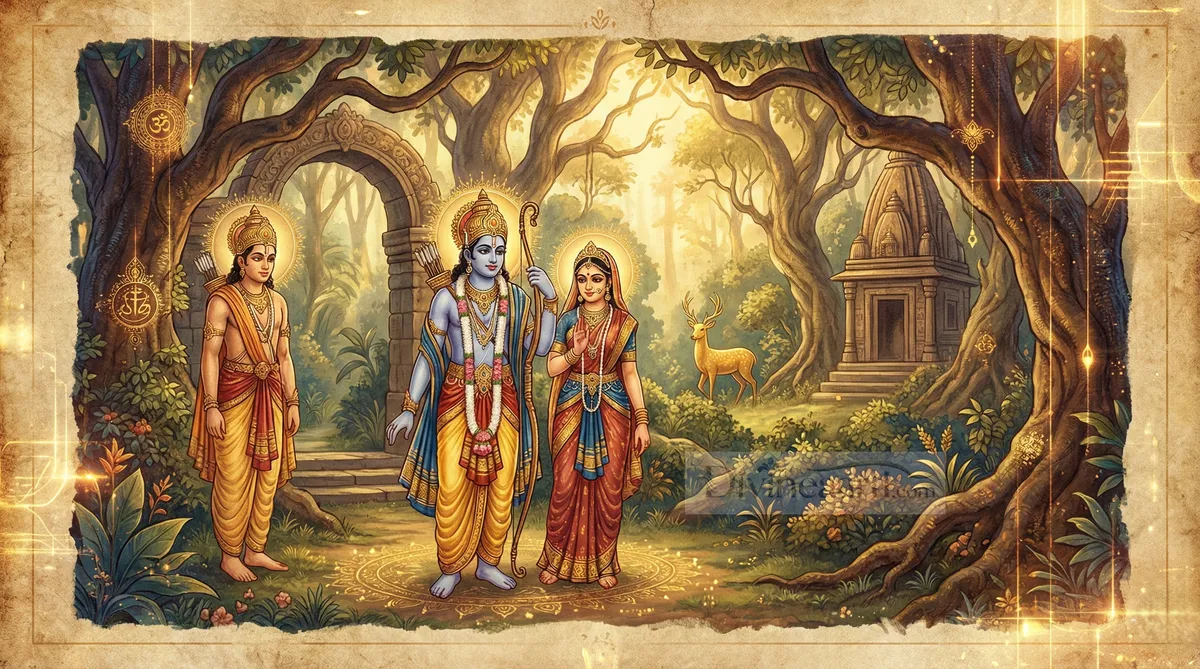
Picture an exiled prince, his devoted wife, and a loyal monkey warrior on a journey across ancient India—battling demons, building bridges across oceans, and ultimately confronting the ten-headed king of Lanka. This isn't fantasy fiction; it's the Ramayana, one of humanity's oldest and most influential stories, cherished by over a billion people for more than 2,500 years.
Whether you've heard of Diwali (the festival celebrating Rama's return home), seen Hanuman referenced in pop culture, or simply want to understand one of the world's great epics, this guide will take you through the complete story—no prior knowledge required.
🏹 What You'll Learn in This Guide:
- ✅ The complete Ramayana story (all 7 books summarized)
- ✅ Main characters with their significance
- ✅ Cultural context and historical background
- ✅ Life lessons that remain relevant today
- ✅ Different versions and regional traditions
- ✅ How to explore the Ramayana further
🔤 Pronunciation Guide for Key Names
Rama = "RAA-muh" (The hero prince)
Sita = "SEE-taa" (Rama's wife)
Hanuman = "HUH-noo-maan" (The monkey warrior)
Ravana = "RAA-vuh-nuh" (The demon king)
Lakshmana = "LUKSH-muh-nuh" (Rama's brother)
Ayodhya = "Uh-YOH-dhyaa" (Rama's kingdom)
Lanka = "LUNG-kaa" (Ravana's island kingdom)
Dharma = "DHAR-muh" (Righteous duty)
📑 Table of Contents
- What is the Ramayana?
- Historical & Cultural Context
- Main Characters Guide
- Book 1: Bala Kanda (Childhood)
- Book 2: Ayodhya Kanda (The Exile)
- Book 3: Aranya Kanda (Forest Life)
- Book 4: Kishkindha Kanda (Allies)
- Book 5: Sundara Kanda (Hanuman)
- Book 6: Yuddha Kanda (The War)
- Book 7: Uttara Kanda (Aftermath)
- Timeless Life Lessons
- Different Versions
- Frequently Asked Questions
🕉️ What is the Ramayana?
The Ramayana (Sanskrit: रामायण, literally "Rama's Journey") is one of the two great Sanskrit epics of ancient India, alongside the Mahabharata. Composed by the sage Valmiki between approximately 500 BCE and 100 BCE, it contains around 24,000 verses divided into seven books called kandas.
At its heart, the Ramayana is the story of:
- Rama — The ideal man who sacrifices personal happiness to uphold duty
- Sita — The ideal woman whose devotion and strength inspire millions
- Hanuman — The ideal devotee whose selfless service becomes legendary
- Ravana — A brilliant but flawed king whose desires lead to his downfall
But the Ramayana is more than a story—it's a guide to living. For millennia, it has taught lessons about family relationships, political ethics, personal duty, and spiritual devotion. Its influence extends across Southeast Asia, where it has shaped art, dance, theater, and moral education in countries from Thailand to Indonesia.
📊 Quick Facts
- Verses: ~24,000 (7 books)
- Language: Sanskrit
- Author: Sage Valmiki
- Date: 500-100 BCE
- Type: Itihasa (historical epic)
🌍 Global Influence
- Thailand: Ramakien
- Indonesia: Kakawin Ramayana
- Cambodia: Reamker
- Myanmar: Yama Zatdaw
- Malaysia: Hikayat Seri Rama
🎭 Cultural Impact
- Diwali festival origin
- Countless temple art
- Classical dance traditions
- Films, TV, animations
- Moral education source
📜 Historical & Cultural Context
To appreciate the Ramayana, understanding its context helps:
The Divine Purpose
According to Hindu tradition, Lord Vishnu—the preserver deity—incarnated as Rama to defeat the demon king Ravana. Ravana had obtained a boon (blessing) that made him invincible to gods, celestial beings, and demons. But in his arrogance, he didn't ask for protection from humans, considering them too weak to threaten him. So Vishnu took human form to exploit this loophole.
The Concept of Dharma
The Ramayana revolves around dharma—a complex term meaning righteous duty, moral law, and cosmic order. Rama is called Maryada Purushottam (the ideal man who upholds boundaries of righteousness). Every major decision in the epic—Rama's exile, Sita's trial, Bharata's regency—involves characters navigating conflicting dharmas.
🎯 Understanding Dharma
Dharma isn't simple "right vs. wrong." It varies by:
- Role: A king's dharma differs from a priest's
- Relationship: Duties to parents vs. spouse may conflict
- Circumstance: Context changes what's appropriate
- Stage of life: Duties change as we age
The World of the Ramayana
The story takes place in Treta Yuga, the second of four cosmic ages in Hindu cosmology—a time when dharma was stronger than today's Kali Yuga. The geography spans northern India (Ayodhya, Mithila, Chitrakoot), central India (Dandaka forest), and extends to Lanka (often identified with modern Sri Lanka).
👥 Main Characters Guide
The Heroes
Rama
Seventh avatar of Vishnu. Eldest son of King Dasharatha. Embodies perfect adherence to dharma, even at great personal cost. His name means "one who pleases."
Sita
Born from the earth, daughter of King Janaka. Rama's devoted wife. Represents purity, strength, and feminine power. Incarnation of Goddess Lakshmi.
Lakshmana
Rama's younger brother who voluntarily joins the exile. Represents brotherhood and service. Known for his fierce protectiveness.
Hanuman
Son of the wind god. Possesses immense strength and magical powers. His devotion to Rama makes him the ideal bhakta (devotee).
Bharata
Rama's brother whose mother caused the exile. Refuses the throne, rules as Rama's regent for 14 years, placing Rama's sandals on the throne.
Jatayu
Elderly vulture king who fights Ravana to save Sita. Though mortally wounded, he lives long enough to tell Rama what happened.
The Antagonists
Ravana
Ten-headed demon king. Brilliant scholar, powerful ruler, devoted Shiva worshipper—but his lust and pride lead to his doom. Complex, not purely evil.
Kumbhakarna
Ravana's massive brother who sleeps for six months at a time. Despite knowing Ravana is wrong, fights out of family loyalty.
Indrajit (Meghanada)
Ravana's son who defeated Indra (king of gods). Master of illusion and powerful warrior. Nearly kills Rama and Lakshmana.
Surpanakha
Ravana's sister whose encounter with Rama sets the main conflict in motion. Her humiliation leads her to incite Ravana against Rama.
Key Supporting Characters
Dasharatha
Rama's father. A righteous king bound by his word. Dies of grief after Rama's exile—a tragedy born from a past promise.
Kaikeyi
Dasharatha's wife who demands Rama's exile. Loved Rama but was manipulated by her maid. Later deeply regrets her actions.
Sugriva
King of Kishkindha who allies with Rama. His army of vanaras (monkey warriors) helps find Sita and fight Ravana.
Vibhishana
Ravana's brother who defects to Rama's side. Chooses dharma over family loyalty. Later crowned king of Lanka.
📚 The Story: Seven Books of the Ramayana
1 Bala Kanda — The Book of Childhood
Chapters: 77 | Theme: Origins and Youth
The Birth of Rama
King Dasharatha of Ayodhya has everything except an heir. After performing a sacred fire ritual, the fire-god appears with divine nectar. Dasharatha's three queens drink it, and soon four sons are born:
- Rama — born to Kaushalya
- Bharata — born to Kaikeyi
- Lakshmana & Shatrughna — twins born to Sumitra
The brothers grow up as skilled warriors. Rama and Lakshmana are particularly close, as are Bharata and Shatrughna.
Training with Vishwamitra
The sage Vishwamitra arrives seeking help—demons are disrupting his sacred rituals. Though reluctant to send his young sons into danger, Dasharatha agrees. Rama and Lakshmana accompany the sage and defeat the demons Tataka and Maricha.
Vishwamitra teaches them celestial weapons (divine missiles) and takes them to Mithila, the kingdom of King Janaka.
The Bow of Shiva & Marriage to Sita
King Janaka possesses the legendary bow of Lord Shiva. He has declared that whoever can string this bow will marry his daughter Sita—found as a baby in a furrow while Janaka was plowing sacred ground (her name means "furrow").
Many kings have tried and failed. Young Rama not only strings the bow but breaks it in two, causing a thunderous sound. Sita joyfully garlands Rama, and the couple is married. In a grand ceremony, all four brothers marry Janaka's daughters and nieces.
💡 Life Lesson: Preparation Meets Opportunity
Rama's victory with the bow came after years of training with Vishwamitra. When opportunity arrived, he was ready. Excellence requires patient preparation before moments of destiny.
2 Ayodhya Kanda — The Book of Ayodhya
Chapters: 119 | Theme: Duty vs. Desire, Family Conflict
This is the emotional heart of the Ramayana—a family drama of promises, manipulation, and sacrifice.
The Promise and the Plot
King Dasharatha decides to crown Rama as heir. The kingdom celebrates—Rama is beloved by all. But Queen Kaikeyi, poisoned by her maid Manthara's jealousy, invokes two boons Dasharatha had promised her years ago when she saved his life in battle.
Her demands:
- Her son Bharata must be crowned king
- Rama must be exiled to the forest for fourteen years
Dasharatha is devastated but bound by his word—a king's promise cannot be broken.
Rama's Response
When Rama learns of this, he shows no anger or disappointment. He calmly accepts the exile to preserve his father's honor. This is dharma in action—personal happiness sacrificed for greater principles.
Sita and Lakshmana Join
Sita refuses to stay behind. Despite Rama's protests about forest hardships, she insists that a wife's place is beside her husband—in palace or wilderness. Her famous response:
Lakshmana also refuses to let his brother go alone. Though his own wife stays behind, he will serve and protect Rama for fourteen years.
Departure and Death
Rama, Sita, and Lakshmana leave Ayodhya in simple clothes, traveling by chariot and then on foot. The entire city weeps. King Dasharatha, watching his beloved son disappear, collapses and dies of a broken heart.
Bharata's Righteousness
Bharata returns from visiting his grandfather to find his father dead and brother exiled—all because of his mother's scheming. He is furious with Kaikeyi and refuses the throne. He travels to the forest to beg Rama to return.
But Rama refuses—their father's word must be honored. In a compromise, Bharata takes Rama's sandals and places them on the throne. He rules as Rama's regent for fourteen years, living simply outside the city, waiting for his brother's return.
💡 Life Lesson: Integrity Over Convenience
Bharata could have simply accepted the throne. Instead, he chose righteousness over personal gain. True character is revealed when no one would blame you for taking the easy path, yet you choose what's right.
3 Aranya Kanda — The Book of the Forest
Chapters: 75 | Theme: Forest Life, Inciting Incident
Life Among the Sages
Rama, Sita, and Lakshmana spend years moving through the forest, living in hermitages, meeting sages, and protecting them from demons. They eventually settle in Panchavati by the Godavari River.
The Encounter with Surpanakha
One day, Surpanakha—Ravana's sister—sees Rama and is smitten. She approaches him romantically, but he refuses, pointing to Sita. She then tries Lakshmana, who also refuses. In a rage, she attacks Sita.
Lakshmana, protecting Sita, cuts off Surpanakha's nose and ears. Humiliated, she flees to her brother Khara, who attacks with 14,000 demons. Rama defeats them all single-handedly.
Surpanakha then goes to Ravana. She describes Sita's beauty, inflaming his desire. She also warns of Rama's power. But Ravana's arrogance—and lust—overcome his caution.
The Golden Deer & Abduction
Ravana sends the demon Maricha disguised as a golden deer. Enchanted, Sita asks Rama to catch it for her. Reluctantly, he follows, leaving Lakshmana to guard her.
When Rama realizes the deception and kills Maricha, the demon cries out in Rama's voice: "Help me, Lakshmana! Help me, Sita!" Hearing this, Sita panics and forces Lakshmana to go help. Before leaving, Lakshmana draws a protective line around their hut—the famous Lakshmana Rekha.
Ravana arrives disguised as a holy man asking for alms. When Sita steps outside the protective line to offer him food, he reveals his true form and abducts her in his flying chariot.
Jatayu's Sacrifice
The elderly vulture king Jatayu sees the abduction and attacks Ravana. Despite his age, he fights bravely, but Ravana cuts off his wings. Mortally wounded, Jatayu survives just long enough to tell Rama what happened and who took Sita.
💡 Life Lesson: Consequences of Anger
Lakshmana's harsh treatment of Surpanakha—though protecting Sita—set in motion the entire tragedy. The Ramayana shows how violence begets violence, and how momentary anger can have far-reaching consequences.
4 Kishkindha Kanda — The Book of Kishkindha
Chapters: 67 | Theme: Alliances, Friendship
Meeting Hanuman
Searching for Sita, Rama and Lakshmana reach the monkey kingdom of Kishkindha. There they meet Hanuman, a minister to the exiled monkey prince Sugriva.
Hanuman immediately recognizes Rama's divinity. He carries the brothers to meet Sugriva, who is hiding from his brother Vali, the current king who wrongly believes Sugriva betrayed him.
The Alliance
Rama and Sugriva form an alliance: Rama will help Sugriva defeat Vali; in return, Sugriva's monkey army will help find Sita.
In a controversial scene, Rama kills Vali by shooting him from hiding during his fight with Sugriva. Vali questions this—why did the righteous Rama not fight him face-to-face? Rama explains that as a king, he was enforcing justice for Sugriva's mistreatment; as a hunter, he killed a monkey (animals could be hunted from cover). This scene is debated by scholars—does it show Rama's pragmatism or a moral compromise?
The Search for Sita
Sugriva, now king, sends search parties in all directions. Months pass. Just as hope seems lost, the party led by Angada (Vali's son) and Hanuman learns from a vulture—Jatayu's brother Sampati—that Sita is in Lanka, across the ocean.
But who can leap across the vast sea? Only one being has that power...
💡 Life Lesson: The Power of Alliances
Rama, a human prince, couldn't defeat Ravana alone. He needed allies. Building genuine relationships—offering help before needing it—creates the support networks that help us achieve the seemingly impossible.
5 Sundara Kanda — The Beautiful Book
Chapters: 68 | Theme: Devotion, Hope, Hanuman's Glory
This is the most beloved book of the Ramayana—focusing entirely on Hanuman's mission to find Sita. Many Hindus read this kanda regularly for spiritual merit, as it's filled with demonstrations of faith, courage, and devotion.
The Leap to Lanka
Hanuman expands to enormous size and leaps across the ocean. He faces challenges: a mountain rising from the sea offers rest, but he continues; a demoness tries to swallow him, but he shrinks, enters her mouth, and exits before she can close it; a shadow-grasping demon attacks, but Hanuman defeats her.
Landing in Lanka, Hanuman shrinks to cat-size and explores the golden city at night.
Finding Sita
After searching Ravana's palace, Hanuman finally finds Sita in the Ashoka Grove, emaciated and grieving, surrounded by demon guards. She has refused all of Ravana's advances. He has given her one year to accept him, or die.
Hanuman approaches carefully, sings praises of Rama to identify himself, and shows her Rama's ring. Sita's joy is overwhelming—but she refuses Hanuman's offer to carry her back. She will not touch another man; Rama must come for her himself.
She gives Hanuman a jewel from her hair as proof of their meeting.
Captured and Defiant
Before leaving, Hanuman decides to assess Ravana's strength. He destroys the Ashoka Grove and kills guards. Eventually, Ravana's son Indrajit captures him with a divine weapon.
Brought before Ravana, Hanuman delivers Rama's message: release Sita or face destruction. Ravana, furious, orders Hanuman's death, but Vibhishana (Ravana's righteous brother) argues that envoys cannot be killed. Instead, they set Hanuman's tail on fire.
But Hanuman leaps from building to building, setting all of Lanka ablaze with his burning tail. He then douses the fire, returns to the sea, and leaps back to report his success.
💡 Life Lesson: The Devotee's Power
Hanuman's abilities came not from ego but from complete dedication to Rama. His famous reminder—"I can leap oceans for my Lord"—shows that purpose and devotion unlock powers we never knew we had.
6 Yuddha Kanda — The Book of War
Chapters: 128 | Theme: Epic Battle, Good vs. Evil
Building the Bridge
Rama's army marches to the southern tip of India. The challenge: how to cross the ocean? Rama fasts and prays for three days. The ocean god appears and reveals that the architect-monkey Nala has a boon—anything he throws in water will float.
The monkey army builds Rama Setu (Rama's Bridge) in five days—stones inscribed with Rama's name float on the water. (This bridge is identified by some with the chain of shoals between India and Sri Lanka, visible in satellite images.)
Vibhishana's Defection
Ravana's brother Vibhishana repeatedly urges returning Sita. When Ravana insults him, Vibhishana defects to Rama's side. Despite suspicion from some monkey generals, Rama accepts him—"One who seeks refuge cannot be turned away."
Vibhishana provides crucial intelligence about Lanka's defenses and Ravana's weaknesses.
The Great War
The battle rages for many days. Key moments:
Rama vs. Ravana
The final battle between Rama and Ravana lasts for days. Ravana has ten heads and twenty arms; each time Rama cuts off a head, another grows. The sage Agastya teaches Rama the Aditya Hridayam—a hymn to the Sun God for strength.
Finally, using a divine weapon given by Brahma—containing the powers of wind, fire, sun, and the energy of all creation—Rama strikes Ravana in the heart, where his immortality is stored. The demon king falls.
The Divine Restoration: Agni Pariksha Explained
The war is won, and now comes a deeply misunderstood episode that requires scriptural clarity. According to the Kurma Purana, Brahma Vaivarta Purana, and Adhyatma Ramayana, what happened was a divine restoration, not a trial of Sita's purity.
The Truth of Chaya Sita (Shadow Sita)
Before Ravana could abduct Sita, Agni Dev (the Fire God), under divine arrangement, replaced the real Sita with Chaya Sita (छाया सीता) or Maya Sita—a shadow form. The real Sita Mata was taken into Agni's protection, remaining pure and untouched throughout the events in Lanka.
Ravana never touched the real Sita—he could only capture her illusory form. This is why, despite his power, Ravana could never win Sita's consent.
The Fire Was Restoration, Not Trial
When Sita entered the fire, it was the Chaya Sita being consumed and the real Sita Mata being restored by Agni Dev. Lord Rama, being the Supreme Lord Vishnu himself, knew this divine play (leela) all along. The apparent "harsh words" were part of the divine drama to complete this restoration.
This understanding reveals:
- Sita Mata's absolute purity — She was never in Ravana's presence
- Divine protection — The Lord always protects His devotees
- Rama's omniscience — As Vishnu, He orchestrated the entire divine play
- Agni Dev's role — The Fire God served as protector and witness
Thus, the Agni Pariksha was not a test but a divine reunion—the moment when the real Sita Mata returned from Agni's protection to her Lord.
The Return to Ayodhya
Rama, Sita, Lakshmana, Hanuman, and their allies fly to Ayodhya in Ravana's captured aerial chariot Pushpaka. The fourteen-year exile is complete on the exact day. The people light lamps to welcome their king—the origin of Diwali, the Festival of Lights.
Rama is crowned king. The era of Ram Rajya (Rama's Rule) begins—an ideal of perfect governance that Indians still invoke today.
💡 Life Lesson: Divine Protection of the Devoted
The Chaya Sita episode teaches that the Lord always protects those devoted to Him. Sita Mata's unwavering devotion ensured she was never truly in danger. When we surrender to the divine, protection comes in ways we may not immediately understand.
7 Uttara Kanda — The Final Book
Chapters: 111 | Theme: Aftermath, Bittersweet Endings
Note: Some scholars believe this book was added later, as its tone differs from the rest. Many popular retellings end with Rama's coronation.
Backstories
This book reveals Ravana's history—his austerities, his boons, his past encounters with various beings. It humanizes him as a once-great devotee corrupted by power.
Sita's Second Exile
The most painful episode: even after the fire trial, some citizens of Ayodhya gossip about Sita's purity. Rama, believing a king must be above all suspicion, orders the pregnant Sita taken to the forest and abandoned near Valmiki's hermitage.
Sita gives birth to twin sons, Lava and Kusha, who grow up learning the Ramayana from Valmiki himself—not knowing they are its heroes' children.
The Final Parting
Years later, the twins recite the Ramayana at Rama's court. Rama recognizes them and summons Sita. She arrives but refuses to undergo another trial. Calling upon her mother Earth, she asks to be received if she has been pure. The earth opens, and Sita descends, returning to her origin.
Rama rules alone for many more years before entering the Sarayu River and returning to his divine form as Vishnu.
💡 Life Lesson: The Burden of Leadership
Rama's choices as king brought personal tragedy. The Uttara Kanda shows that leadership often requires sacrificing personal happiness for public duty. It's not a celebration but a sobering reflection on the cost of power.
✨ Timeless Life Lessons from the Ramayana
🎯 Dharma Over Desire
Rama could have fought for his throne. Instead, he honored his father's promise. Doing what's right often means sacrificing what we want.
💑 Devotion & Partnership
Sita and Rama show marriage as equal partnership. Sita isn't passive—she chooses to accompany Rama, she maintains her dignity in captivity, she speaks her truth.
🐒 Selfless Service
Hanuman wants nothing for himself. His joy is in serving. This "attitude of gratitude" brings him supernatural abilities and eternal fame.
👹 Pride's Downfall
Ravana was brilliant, powerful, and devoted to Shiva—yet lust and arrogance destroyed him. Talent without character leads to ruin.
👫 Brotherhood & Loyalty
Lakshmana gives up his wife and comfort for fourteen years. Bharata refuses an unearned throne. True family is built on sacrifice, not blood alone.
🌊 Patience in Adversity
Fourteen years of exile. Months of searching. Days of battle. The Ramayana teaches that great achievements require enduring long periods of difficulty.
📚 Different Versions of the Ramayana
The Ramayana has been retold in countless languages and traditions:
📖 Valmiki Ramayana
Sanskrit, ~500-100 BCE
The original epic by sage Valmiki. The authoritative source, written in elegant Sanskrit verse.
📖 Ramcharitmanas
Hindi, 16th century CE
Tulsidas's devotional retelling. Most popular version in North India. Emphasizes bhakti (devotion).
📖 Kamba Ramayanam
Tamil, 12th century CE
Kambar's poetic masterpiece. Beloved in South India. Explores Ravana's complexity.
📖 Adhyatma Ramayana
Sanskrit, ~14th century CE
A spiritual interpretation focusing on philosophical teachings. Rama as the ultimate reality.
📖 Ranganatha Ramayana
Telugu, 14th century CE
Gona Buddha Reddy's version for Telugu speakers. Rich in emotional depth.
📖 Jain/Buddhist Versions
Various dates
Alternative tellings where Ravana is a noble figure and Lakshmana, not Rama, kills him.
Modern Adaptations
- "The Palace of Illusions" by Chitra Banerjee Divakaruni — Retelling of Mahabharata with Ramayana connections
- "Sita: Warrior of Mithila" by Amish Tripathi — Modern retelling focusing on Sita
- "Ramayana: The Game of Life" by Shubha Vilas — Management lessons from the epic
- "Asura: Tale of the Vanquished" by Anand Neelakantan — Ravana's perspective
❓ Frequently Asked Questions
Is the Ramayana a true story?
Hindus traditionally consider it "itihasa" (history that happened), though the exact historical dating is debated. Archaeologists have found evidence of ancient settlements along Rama's traditional route. Whether literal history or mythologized history, its cultural and spiritual impact is undeniable.
Why is Sita called "Janaki" or "Maithili"?
These names refer to her father (King Janaka) and her birthplace (Mithila). In Sanskrit tradition, names often indicate lineage or origin. She's also called Vaidehi (from Videha, Janaka's kingdom).
Was Ravana really evil?
Ravana is complex. He was a great scholar, composed beautiful hymns to Shiva, and was a capable ruler. But his fatal flaws—lust and arrogance—led to his downfall. Many modern retellings explore his perspective sympathetically. He represents how even the gifted can fall to unchecked desires.
Why is Hanuman so popular?
Hanuman represents accessible divinity—strength combined with humility, power combined with devotion. Unlike Rama (an incarnation of God), Hanuman shows what's possible for a devotee. His image appears in more temples, homes, and vehicles across India than almost any other deity.
What is the connection between Ramayana and Diwali?
Diwali celebrates Rama's return to Ayodhya after fourteen years of exile and victory over Ravana. Citizens lit oil lamps (diyas) to welcome him home, symbolizing the triumph of light over darkness, good over evil. This is the most popular origin story for the festival.
How should I start reading the Ramayana?
For first-time readers, try C. Rajagopalachari's "Ramayana" (condensed prose) or Ramesh Menon's version. For children, Amar Chitra Katha comics are excellent. For the devotional experience, try listening to Ramcharitmanas recitations. For scholars, the Princeton University Press translation of Valmiki is definitive.
🙏 Conclusion: Why the Ramayana Still Matters
The Ramayana isn't just an ancient story—it's a living tradition. Every year, during Ram Lila performances across India, communities reenact the epic. The festival of Diwali brings families together. Hanuman's image protects travelers and wrestlers alike. "Ram Rajya" remains shorthand for ideal governance.
For modern readers, the Ramayana offers more than mythology. It presents case studies in ethics: What do you owe your parents? How should leaders balance personal happiness and public duty? When is violence justified? What does true devotion look like?
Start with the story. Let the characters become real. Then let the questions they raise work on you—questions that humanity has pondered for millennia and will continue to ponder long after we're gone.