
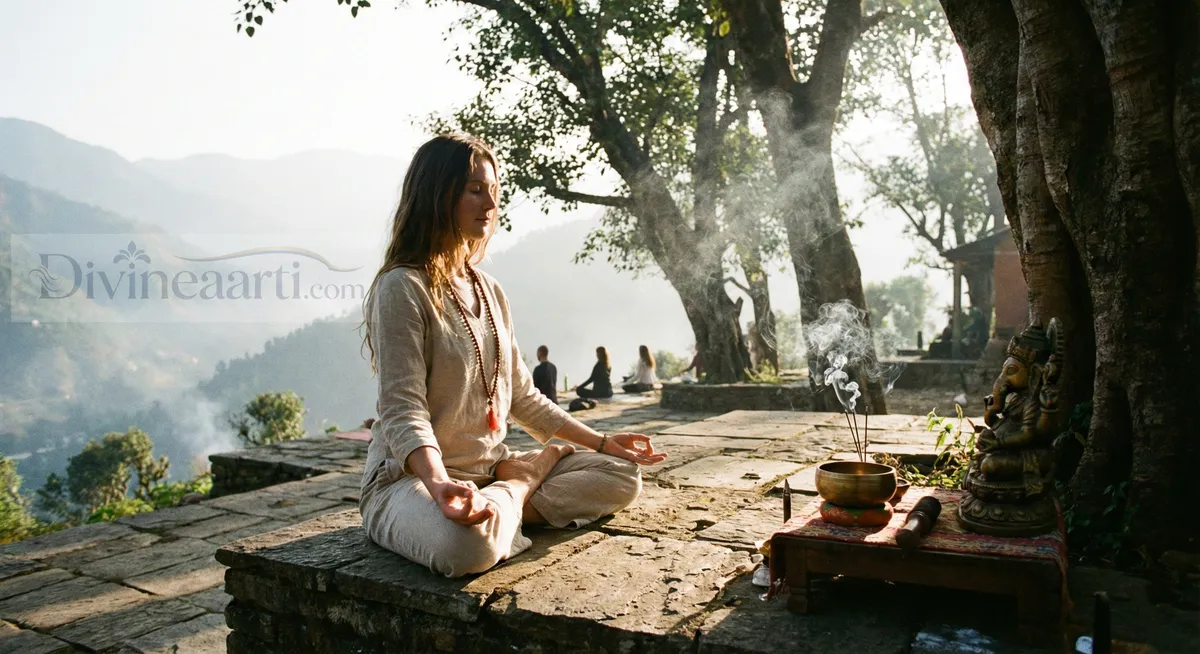
🕉️ Why Mantras Belong in Your Yoga Practice
If you've been practicing yoga at a gym or studio, you've probably experienced something like this: upbeat music playing, the instructor counting poses, maybe some inspirational quotes—and that's great! Yoga as physical exercise has incredible benefits for strength, flexibility, and stress relief.
But here's what you might be missing: Yoga's original purpose wasn't exercise—it was spiritual awakening.
For over 5,000 years, yoga has been practiced in India as a complete system that unites body, breath, mind, and spirit. And the secret ingredient that creates this union? Mantras—sacred sounds that transform your practice from a workout into a meditation in motion.
✨ What Mantras Will Add to Your Yoga:
- Deeper Focus: Your mind stops wandering, anchors to the present moment
- Energy Flow: Vibrations open subtle energy channels (nadis)
- Spiritual Connection: Feel part of something greater than yourself
- Enhanced Breath: Mantras naturally regulate your breathing
- Emotional Release: Sound vibrations help process stuck emotions
- Authentic Practice: Honor yoga's traditional roots
You don't need to be Hindu, speak Sanskrit, or consider yourself "spiritual" to benefit from yoga mantras. Think of them as vibrational tools—like tuning forks for your nervous system. When you add the right sounds to your yoga practice, everything shifts.
This comprehensive guide will teach you exactly which mantras to use, when to chant them, and how to integrate them seamlessly into your existing yoga routine—whether you practice alone at home or teach classes to others.
📜 The Ancient Connection: Yoga + Mantra = Tandem Practices
To understand why mantras and yoga go together, let's look at where they came from...
Yoga's Original Purpose
The Yoga Sutras of Patanjali (written around 400 CE) define yoga as "chitta vritti nirodha"—the cessation of mental fluctuations. In other words, yoga is about calming the mind, not just stretching the body. The physical poses (asanas) were designed to prepare the body to sit comfortably in meditation for hours.
Mantra's Role in Yoga
Patanjali specifically recommends mantra meditation as one of the most effective paths to yoga (union with the divine). He writes: "Tajjapas tadarthabhavanam" (Sutra 1.28)—"Repeat the sacred syllable (Om) and contemplate its meaning."
In traditional yoga practice:
- Hatha Yoga (physical yoga) was always combined with Mantra Yoga (sound yoga)
- Students would chant before, during, and after asana practice
- Each pose had corresponding mantras to activate specific energies
- The vibrations helped prana (life force) flow through energy channels
What Happened in the West
When yoga came to the West in the 1960s-70s, it was often "de-spiritualized" to make it more accessible (and less "religious" sounding). The mantras, chanting, and spiritual philosophy were stripped away, leaving just the physical poses.
This created "yoga-flavored exercise"—beneficial, but incomplete. It's like removing the cheese from pizza and just eating bread and sauce. Still tasty, but you're missing the best part!
💡 Good News: There's now a beautiful renaissance happening. More and more yoga practitioners and teachers are curious about the spiritual roots and want to experience the FULL power of yoga. That's where mantras come in.
🌟 7 Powerful Benefits of Adding Mantras to Your Yoga Practice
1. Enhanced Mental Focus & Presence
When you synchronize movement with mantra, your mind can't wander. Try it: do a Sun Salutation while thinking about your grocery list—easy. Now try it while chanting "Om Suryaya Namaha"—suddenly you're 100% present. The mantra becomes your anchor, keeping you in the now.
2. Activates Energy Flow (Prana)
Sanskrit mantras create specific vibrations that correspond to energy centers (chakras) and channels (nadis) in your body. When you chant while moving, you're not just stretching muscles—you're clearing energetic blockages. Many practitioners report feeling "buzzing" or warmth during mantra-infused yoga.
3. Deepens Breath Control (Pranayama)
Mantras require controlled exhalation, which naturally regulates your breathing. This is especially powerful during vinyasa flow. Instead of gasping through difficult sequences, the mantra creates a rhythmic breathing pattern that sustains you.
4. Builds Inner Strength & Confidence
Chanting during challenging poses (like Warrior or Boat pose) gives you something to focus on beyond the physical discomfort. The mantra becomes your mental strength. Many students report holding poses longer and with more grace when using mantras.
5. Emotional Release & Healing
Sound vibrations work on a subtle level to release stored emotions. Don't be surprised if you feel tears during or after chanting—this is healing. Heart-opening poses (like Camel or Fish) combined with heart-centered mantras can be especially cathartic.
6. Spiritual Connection & Meaning
Mantras connect you to thousands of years of yogic tradition. When you chant the same sounds that yogis have chanted for millennia, you tap into a collective spiritual energy. Your practice gains depth and meaning beyond "getting a good stretch."
7. Easier Transition to Meditation
If you struggle to sit still and meditate, adding mantras to your yoga creates a bridge. You're already in a meditative state by the time you reach Shavasana. The mind is calm, the body is relaxed, and meditation happens naturally.
🎯 Getting Started: Mantra Basics for Beginners
You Don't Need to Be an Expert
Let me address the elephant in the room: "But I don't speak Sanskrit! I'll pronounce it wrong!"
Here's the truth: Your intention matters more than perfect pronunciation. The ancient yogis understood that it's the vibration + the sincere effort that creates the effect, not academic perfection.
That said, here are some basics to help you feel confident:
Sanskrit Pronunciation Quick Guide
- A = "ah" (like father)
- I = "ee" (like sheep)
- U = "oo" (like moon)
- E = "ay" (like play)
- O = "oh" (like go)
- M = humming "mmm" (lips closed)
- H = always aspirated (breathy)
Three Ways to Chant
-
Out Loud (Vaikhari)
- Best for beginners—creates strong vibration
- Use at home or in mantra-friendly classes
- Helps you learn pronunciation
-
Whispered (Upamshu)
- Good for public classes where loud chanting isn't appropriate
- Still creates vibration but more subtle
- Others won't be distracted
-
Mental (Manasika)
- Silent repetition in your mind
- Most advanced—requires strong focus
- Use during inversions or balance poses where speaking is difficult
💡 Start Simple: Begin by chanting only at the beginning and end of practice. Once that feels natural, add mantras during Sun Salutations. Then gradually incorporate them into the entire practice. Don't overwhelm yourself on day one!
🙏 Opening Your Practice: Setting Sacred Intention
The Universal Opening: Om (3 times)
ॐ ॐ ॐ
Om Om Om
How to chant: Take a deep breath. Chant "Oooommmm" on one full exhale. Repeat 3 times.
Why this works: Om is the primordial sound—it represents all of creation. Chanting it three times signals to your mind and body: "We're transitioning from ordinary life to sacred practice." It's like ringing a bell to start class.
When to do it: Sit in Easy Pose (Sukhasana) or Lotus Pose at the very beginning of your practice, before any movement.
Traditional Invocation: Om Namah Shivaya
ॐ नमः शिवाय
Om Namah Shivaya
Pronunciation: ohm NAH-mah shee-VAH-yah
What it means: "I bow to Shiva"—Shiva represents transformation and the ultimate yogi. You don't have to believe in Hindu deities; think of it as honoring the transformative power within you.
How many times: Chant 3, 9, or 108 times before starting physical practice.
🔗 Learn more about Om Namah Shivaya →
Simple Modern Alternative: Setting an Intention
If Sanskrit feels uncomfortable, you can set an intention in your own words:
- "May this practice bring me peace"
- "I dedicate this practice to healing"
- "May I be present in each moment"
Then seal it with 3 Oms. This honors the tradition while making it personal.
☀️ The 12 Surya Mantras: Chanting During Sun Salutations
This is THE most popular way to integrate mantras into yoga! Surya Namaskar (Sun Salutation) has 12 positions, and each has a corresponding mantra honoring the sun god (Surya).
How It Works
Each time you transition to a new pose in the Sun Salutation sequence, you chant one mantra. By the time you complete 12 poses, you've chanted all 12 mantras. Then you start again on the second round.
⚡ The 12 Surya Mantras (In Order)
- Om Mitraya Namaha
मित्राय (Friend to all) - Om Ravaye Namaha
रवये (Shining one) - Om Suryaya Namaha
सूर्याय (Guide and teacher) - Om Bhanave Namaha
भानवे (Bestower of beauty) - Om Khagaya Namaha
खगाय (Stimulator of the senses) - Om Pushne Namaha
पूष्णे (Giver of strength) - Om Hiranyagarbhaya Namaha
हिरण्यगर्भाय (Golden cosmic self) - Om Marichaye Namaha
मरीचये (Rays of light) - Om Adityaya Namaha
आदित्याय (Son of Aditi, cosmic mother) - Om Savitre Namaha
सवित्रे (Stimulating/arousing principle) - Om Arkaya Namaha
अर्काय (Worthy of praise) - Om Bhaskaraya Namaha
भास्कराय (Leading to enlightenment)
Step-by-Step: Mantra + Movement
-
Position 1 - Mountain Pose (Pranamasana)
- Stand with palms together at heart
- Chant: Om Mitraya Namaha
-
Position 2 - Raised Arms Pose (Hasta Uttanasana)
- Raise arms overhead, arch back gently
- Chant: Om Ravaye Namaha
-
Position 3 - Standing Forward Bend (Hasta Padasana)
- Fold forward, hands to floor
- Chant: Om Suryaya Namaha
-
Position 4 - Equestrian Pose (Ashwa Sanchalanasana)
- Right leg back, left knee bent, look up
- Chant: Om Bhanave Namaha
-
Position 5 - Plank Pose (Dandasana)
- Both legs back, straight line from head to heels
- Chant: Om Khagaya Namaha
-
Position 6 - Eight-Limbed Pose (Ashtanga Namaskara)
- Knees, chest, chin to floor (or Chaturanga)
- Chant: Om Pushne Namaha
-
Position 7 - Cobra Pose (Bhujangasana)
- Chest up, shoulders back, look up
- Chant: Om Hiranyagarbhaya Namaha
-
Position 8 - Downward Dog (Adho Mukha Svanasana)
- Hips up, forming inverted V
- Chant: Om Marichaye Namaha
-
Position 9 - Equestrian Pose (Ashwa Sanchalanasana)
- Right foot forward, left leg back, look up
- Chant: Om Adityaya Namaha
-
Position 10 - Standing Forward Bend (Hasta Padasana)
- Both feet together, fold forward
- Chant: Om Savitre Namaha
-
Position 11 - Raised Arms Pose (Hasta Uttanasana)
- Rise up, arms overhead, arch back
- Chant: Om Arkaya Namaha
-
Position 12 - Mountain Pose (Pranamasana)
- Return to standing, palms at heart
- Chant: Om Bhaskaraya Namaha
💡 Beginner Tip: Don't worry about memorizing all 12 on day one! Start with just chanting "Om Suryaya Namaha" with every position. Once that's comfortable, learn the full sequence. You can also print the list and keep it at the top of your yoga mat.
🫁 Mantras for Pranayama (Breath Work)
Breath work (pranayama) and mantra naturally complement each other. Here are the best mantra-breath combinations:
So Hum (I Am That)
So Hum
Pronunciation: SO (inhale) - HUM (exhale)
How to practice:
- Sit comfortably with eyes closed
- Inhale deeply while mentally saying "So"
- Exhale fully while mentally saying "Hum"
- Continue for 5-10 minutes
What it means: "So Hum" means "I am That"—recognizing your connection to universal consciousness. It's the natural sound of your breath.
Om for Ujjayi Breath
During Ujjayi breathing (ocean breath), you can silently chant "Om" on each exhale. The throat constriction of Ujjayi combined with the Om vibration creates powerful energetic clearing.
Alternate Nostril Breathing with Bija Mantras
For Nadi Shodhana (alternate nostril breathing), advanced practitioners chant "Yam" (air element bija) mentally with each breath to enhance the clearing effect on energy channels.
🧘 Mantras for Specific Yoga Poses
Different poses have different energetic qualities. Here's how to match mantras to poses:
Grounding Poses (Root Chakra - Red)
Poses: Mountain, Warrior I, Chair, Goddess Squat
Mantra: Om Lam (root chakra bija sound)
Why: Connects you to earth energy, creates stability
Hip-Opening Poses (Sacral Chakra - Orange)
Poses: Pigeon, Lizard, Happy Baby, Bound Angle
Mantra: Om Vam (sacral chakra bija)
Why: Releases emotional blockages stored in hips
Core Poses (Solar Plexus Chakra - Yellow)
Poses: Boat, Plank, Side Plank, Warrior III
Mantra: Om Ram (solar plexus bija)
Why: Activates personal power and willpower
Heart-Opening Poses (Heart Chakra - Green)
Poses: Camel, Wheel, Cobra, Fish, Cow Face
Mantra: Om Yam (heart chakra bija)
Why: Opens capacity for love, compassion, forgiveness
Balance Poses (All Chakras)
Poses: Tree, Eagle, Dancer, Half Moon
Mantra: Om or Om Namah Shivaya
Why: Creates mental focus needed for physical balance
Inversions (Crown Chakra - Violet)
Poses: Headstand, Shoulderstand, Legs-Up-the-Wall
Mantra: Silent Om (mental chanting)
Why: Inversions naturally quiet the mind; silent mantra deepens the introspection
🌙 Closing Your Practice: Shavasana & Final Mantras
Shavasana (Corpse Pose) is where all the benefits of your practice integrate. This is the perfect time for calming, restorative mantras.
During Shavasana: Om Shanti Shanti Shanti
ॐ शान्तिः शान्तिः शान्तिः
Om Shanti Shanti Shanti
Pronunciation: ohm SHAN-tee SHAN-tee SHAN-tee
How to use: As you lie in Shavasana, silently chant "Om Shanti Shanti Shanti" with each exhale. The triple repetition invokes peace in body, mind, and environment.
Closing Invocation: Lokah Samastah
Lokah Samastah Sukhino Bhavantu
Pronunciation: low-KAH sah-MAH-stah soo-khee-NO bah-VAHN-too
What it means: "May all beings everywhere be happy and free, and may my thoughts, words, and actions contribute to that happiness and freedom for all."
When to chant: After coming out of Shavasana, sit up and chant this 3 times as your final offering—sending the benefits of your practice outward to all beings.
The Traditional Closing Sequence
-
Come Out of Shavasana
- Wiggle fingers and toes
- Roll to your right side
- Press up to seated position
-
Chant Om 3 Times
- Signals the transition back to ordinary consciousness
-
Chant Lokah Samastah (3 times)
- Dedicate practice to the wellbeing of all
-
Bow and Say "Namaste"
- Bring palms together at heart
- Bow forward slightly
- "Namaste" = "The divine in me honors the divine in you"
🌟 Teacher Perspective: "I started closing my classes with Lokah Samastah three years ago. Students LOVE it. Many have told me it's their favorite part—they feel like they're part of something bigger than just getting a workout. Several have even gotten it tattooed!" - Maya L., Yoga Teacher, California
✨ Pro Tips for Yoga Teachers & Practitioners
For Solo Practitioners (Home Practice)
- Create a Mantra Cheat Sheet: Print the Sun Salutation mantras and tape them to your wall where you practice
- Use Audio Guides: Find YouTube videos of Surya mantras and practice along until you memorize them
- Start Small: Week 1 = just opening Om. Week 2 = add closing Om. Week 3 = add Sun Salutation mantras. Build gradually.
- Journal the Effects: Note how you feel before vs. after mantra practice. Track energy shifts, mood changes, insights.
For Yoga Teachers (Teaching Mantras in Class)
- Explain First: Don't surprise students with chanting. Explain what mantras are, why you're using them, and that participation is optional.
- Offer Alternatives: "You can chant with me, listen silently, or focus on your breath—all are valid choices."
- Translate Meanings: Always share what the Sanskrit means so students understand
- Lead Confidently: Even if you're nervous, chant with full voice. Your confidence gives students permission to participate.
- Respect Boundaries: Some students may have religious concerns about chanting. Honor that without judgment.
- Start Slow: Introduce just one mantra per class. Don't overwhelm beginners with 12 Surya mantras on day one.
Common Challenges & Solutions
Challenge: "I feel self-conscious chanting out loud"
Solution: Start with whisper chanting at home alone. Gradually increase volume. Remember: everyone else feels self-conscious too! The first person who chants confidently gives others permission to join.
Challenge: "I can't remember all 12 Sun Salutation mantras"
Solution: You don't have to! Just chant "Om Suryaya Namaha" for all 12 positions. The intention matters more than variety.
Challenge: "My gym yoga class plays loud music—mantras don't fit"
Solution: Do mental chanting. The vibration is internal. Or find a more traditional yoga studio that honors the spiritual roots.
Challenge: "I'm Christian/Muslim/Atheist—is chanting Hindu mantras wrong?"
Solution: Mantras are tools, not religious conversion. Think of them as vibrational science. That said, honor your own comfort level—if it doesn't feel right, don't force it.
❓ Frequently Asked Questions
Q: Do I need to chant mantras to get benefits from yoga?
A: No, absolutely not. Yoga poses alone provide incredible physical and mental benefits. However, adding mantras deepens the practice exponentially—you're engaging more layers of your being (sound, vibration, intention, spirit) beyond just the physical. It's like the difference between black-and-white TV and full color HD.
Q: Can I make up my own mantras or use English affirmations?
A: Yes! While traditional Sanskrit mantras have specific vibrational properties that have been refined over millennia, you can absolutely use English affirmations or create personal mantras. Examples: "I am strong," "I am peace," "I trust my body." The key is repetition and sincere intention.
Q: What if I pronounce the Sanskrit wrong?
A: Your effort and intention are what matter most. Even in India, there are regional pronunciation differences. Do your best to approximate the sounds, and trust that the vibration + sincere heart create the effect. Listen to audio recordings to improve over time, but don't let fear of imperfection stop you from starting.
Q: Should I receive mantras from a guru?
A: In traditional Hindu practice, powerful mantras (especially personalized ones for specific spiritual goals) are ideally received from a qualified guru. However, the universal yoga mantras in this guide (Om, Surya mantras, Om Namah Shivaya, etc.) are considered open mantras that anyone can practice for wellness and spiritual growth. If you don't have access to a physical guru, you can connect with the divine directly—from your heart, consider any deity or higher power as your inner guru before starting practice.
Q: How long until I see results from adding mantras?
A: Immediate effects: You'll notice deeper focus and presence during your very first mantra-enhanced practice. Week 1-2: Enhanced mind-body connection, easier to "drop in" to meditative state. Month 1+: Profound shifts—yoga becomes spiritual practice, not just exercise. Students report feeling more grounded, emotionally balanced, and spiritually connected.
Q: Can kids use mantras in yoga?
A: Absolutely! Kids often love chanting—it's playful and fun. Start with simple, repetitive mantras like Om or the Surya mantras. Make it engaging: "Let's make the sound of the universe!" or "These are magic sounds that help us focus!" Many yoga studios now offer kid-friendly mantra-based classes.
Q: What's the difference between mantra and music in yoga?
A: Music is passive—you listen. Mantras are active—you create the vibration with your own voice and breath. Music can be inspiring, but mantras engage you as a participant in the energetic transformation. That said, kirtan (devotional chant music) bridges both worlds and can be powerful in yoga practice.
🌅 Transform Your Practice Starting Today
You now have everything you need to integrate the transformative power of mantras into your yoga practice. Whether you're a complete beginner or a seasoned yogi, whether you practice alone at home or teach classes to hundreds, these sacred sounds will elevate your experience.
Remember: Yoga's ultimate goal was never about touching your toes or holding a headstand for 5 minutes. It's about union—connecting body, breath, mind, and spirit into one harmonious whole. Mantras are the bridge that makes this union possible.
🎯 Your Action Plan:
- This Week: Chant Om 3 times at the beginning and end of your practice
- Next Week: Learn the 12 Surya mantras (or just use "Om Suryaya Namaha" for all positions)
- This Month: Experiment with different mantras during different poses—notice what resonates
- This Year: Experience yoga the way it was meant to be practiced—as a complete spiritual discipline
The ancient yogis left us this gift—these sacred sounds that have been chanted for over 5,000 years. When you chant, you join an unbroken lineage of seekers, teachers, and awakened beings. You tap into a river of collective spiritual energy.
Your mat is your temple. Your breath is your prayer. Your mantra is your offering.
Namaste 🙏
Deepen Your Yoga & Mantra Journey
Explore more sacred practices: