
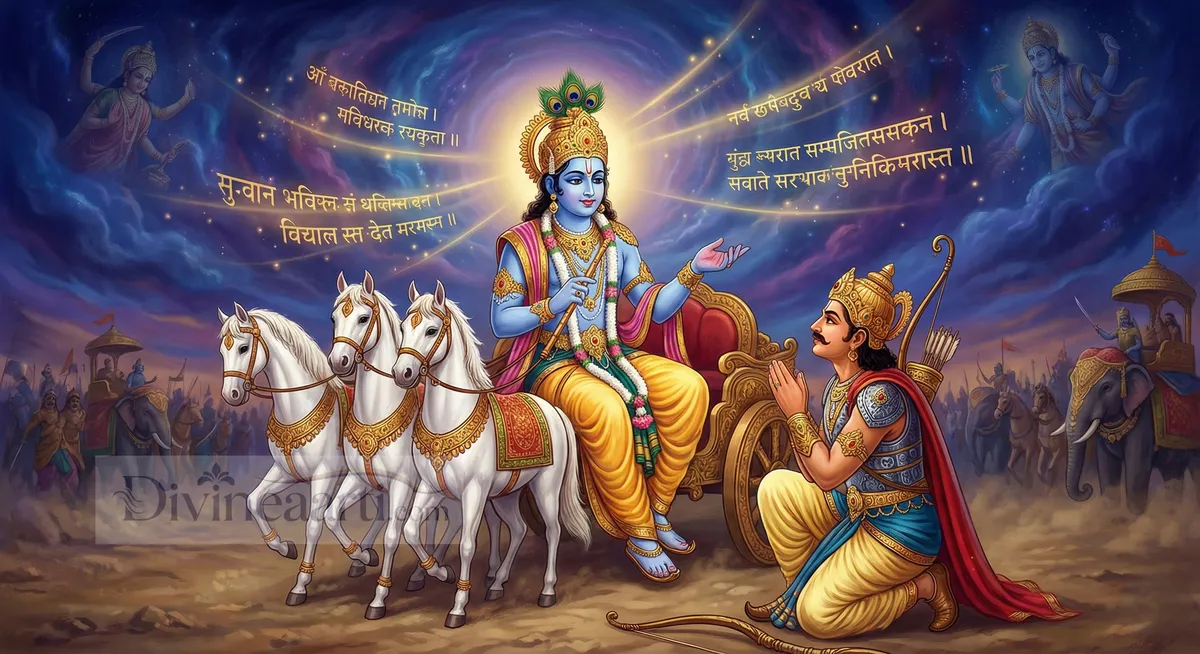
Imagine standing on a battlefield, surrounded by family and friends on both sides, knowing you must fight them to uphold justice. This is exactly where Prince Arjuna found himself over 5,000 years ago. His charioteer? Lord Krishna himself. Their conversation that followed—the Bhagavad Gita—became one of humanity's most profound spiritual texts.
Whether you're a spiritual seeker, a philosophy enthusiast, or simply curious about Eastern wisdom, this guide will walk you through every chapter of the Gita in plain, accessible language. No prior knowledge of Hinduism required.
📖 What You'll Learn in This Guide:
- ✅ Summary of all 18 chapters with key teachings
- ✅ Sanskrit terms with pronunciation guides
- ✅ Historical and cultural context
- ✅ Practical life applications for today
- ✅ Famous verses with translations
- ✅ How to start reading the Gita yourself
🔤 Quick Pronunciation Guide
Before we begin, here's how to pronounce key Sanskrit terms:
Krishna = "KRISH-nuh" (The divine teacher)
Arjuna = "AR-joo-nuh" (The warrior prince)
Yoga = "YO-guh" (Union/discipline)
Dharma = "DHAR-muh" (Righteous duty)
Karma = "KAR-muh" (Action and its consequences)
Atman = "AAT-mun" (The eternal soul)
Brahman = "BRUH-mun" (The ultimate reality)
📑 Table of Contents
- What is the Bhagavad Gita?
- Historical Context
- Chapter 1: Arjuna's Despair
- Chapter 2: Knowledge of the Soul
- Chapter 3: Path of Action
- Chapter 4: Divine Knowledge
- Chapter 5: Renunciation
- Chapter 6: Meditation
- Chapter 7: Divine Wisdom
- Chapter 8: Eternal Brahman
- Chapter 9: Royal Knowledge
- Chapter 10: Divine Glories
- Chapter 11: Universal Form
- Chapter 12: Path of Devotion
- Chapter 13: Field and Knower
- Chapter 14: Three Gunas
- Chapter 15: Supreme Person
- Chapter 16: Divine & Demonic
- Chapter 17: Three Faiths
- Chapter 18: Liberation
- Key Concepts Summary
- How to Read the Gita
- Frequently Asked Questions
🕉️ What is the Bhagavad Gita?
The Bhagavad Gita (Sanskrit: भगवद्गीता, literally "Song of God") is a 700-verse Hindu scripture that forms part of the ancient Indian epic, the Mahabharata. Composed approximately between 500 BCE and 200 BCE, it's a philosophical and spiritual masterpiece that has influenced thinkers worldwide for millennia.
The text is structured as a conversation between Prince Arjuna, a skilled warrior facing a moral crisis, and Lord Krishna, his charioteer who reveals himself to be the Supreme Being. Their dialogue takes place on the battlefield of Kurukshetra (KOO-roo-KSHE-tra), just before a great war.
📊 Quick Facts
- Verses: 700 (in 18 chapters)
- Language: Sanskrit
- Date: ~500-200 BCE
- Part of: Mahabharata
- Format: Dialogue
🎭 Main Characters
- Krishna: Divine teacher
- Arjuna: Warrior prince
- Sanjaya: Narrator
- Dhritarashtra: Blind king
🧘 Core Paths (Yogas)
- Karma Yoga: Action
- Bhakti Yoga: Devotion
- Jnana Yoga: Knowledge
- Dhyana Yoga: Meditation
📜 Historical Context: Why This Conversation Happened
To understand the Gita, you need to know the backstory. The Mahabharata tells of a royal family divided: the Pandavas (five brothers including Arjuna) and their cousins the Kauravas (100 brothers led by Duryodhana). After years of injustice, deceit, and failed peace negotiations, war became inevitable.
As the two armies face each other, Arjuna asks Krishna to drive his chariot between them so he can see who he must fight. When he recognizes teachers, uncles, cousins, and friends on both sides, he's overwhelmed with grief and moral confusion. Should he fight and kill his own family, even for a righteous cause?
कार्पण्यदोषोपहतस्वभावः पृच्छामि त्वां धर्मसम्मूढचेताः।
यच्छ्रेयः स्यान्निश्चितं ब्रूहि तन्मे शिष्यस्तेऽहं शाधि मां त्वां प्रपन्नम्॥
"My heart is overcome by weakness, my mind is confused about my duty. I ask You: tell me clearly what is best for me. I am Your disciple. Teach me, for I have taken refuge in You."
— Bhagavad Gita 2.7
This moment of crisis—Arjuna's complete breakdown—sets the stage for Krishna's teachings. The entire Gita is Krishna's response to help Arjuna (and by extension, all of humanity) understand life, death, duty, and liberation.
📚 Chapter-by-Chapter Summary
1 Arjuna Vishada Yoga — The Yoga of Arjuna's Despair
The Crisis PointVerses: 47 | Sanskrit Name: अर्जुनविषादयोग (Arjuna-Vishada-Yoga)
The Gita opens with King Dhritarashtra (DHRI-tuh-RAASH-tra), the blind king and father of the Kauravas, asking his minister Sanjaya to describe the battle. Sanjaya has been granted divine vision to see and narrate the events.
When Arjuna surveys the battlefield, he sees grandfathers, teachers, uncles, brothers, sons, and friends arrayed for battle. Overcome with sorrow, his body trembles, his mouth dries, his bow slips from his hand, and his skin burns. He tells Krishna he cannot fight and refuses to pick up his weapons.
Key Points:
- Arjuna's emotional and moral crisis represents the human condition—we all face moments of profound confusion
- His grief comes from attachment to relationships and fear of consequences
- This chapter sets up the problem that the rest of the Gita solves
💡 Modern Application
When facing difficult decisions—changing careers, ending relationships, standing up for principles—we often experience Arjuna's paralysis. The Gita teaches that clarity comes not from avoiding the crisis but from seeking deeper understanding.
2 Sankhya Yoga — The Yoga of Knowledge
Jnana Yoga (Knowledge)Verses: 72 | Sanskrit Name: सांख्ययोग (Sankhya-Yoga)
This is the most important chapter—often called the summary of the entire Gita. Krishna begins his teachings by addressing Arjuna's grief and confusion.
Krishna explains the fundamental nature of the soul (Atman): it is eternal, indestructible, and merely inhabits temporary bodies. Just as a person discards old clothes and wears new ones, the soul discards old bodies and takes new ones at death.
वासांसि जीर्णानि यथा विहाय नवानि गृह्णाति नरोऽपराणि।
तथा शरीराणि विहाय जीर्णान्यन्यानि संयाति नवानि देही॥
"Just as a person discards worn-out clothes and puts on new ones, the soul discards worn-out bodies and takes on new ones."
— Bhagavad Gita 2.22
Krishna then introduces Karma Yoga—the path of selfless action. The key teaching: You have the right to perform your duties, but not to the fruits (results) of your actions. Don't be attached to inaction either.
कर्मण्येवाधिकारस्ते मा फलेषु कदाचन।
मा कर्मफलहेतुर्भूर्मा ते सङ्गोऽस्त्वकर्मणि॥
"You have the right to work, but never to its fruits. Let not the fruit of action be your motive, nor let your attachment be to inaction."
— Bhagavad Gita 2.47 (Most famous verse)
Key Concepts Introduced:
- Atman: The eternal, indestructible soul
- Karma Yoga: Selfless action without attachment to results
- Sthitaprajna: One of steady wisdom, equanimous in all situations
- Equanimity: Remaining balanced in success and failure
💡 Modern Application
Focus on doing your best work without obsessing over promotions, likes, or recognition. When you write, write for the love of writing. When you help, help without expecting gratitude. This doesn't mean ignore results—it means don't let anticipated results corrupt your actions.
3 Karma Yoga — The Yoga of Action
Karma Yoga (Action)Verses: 43 | Sanskrit Name: कर्मयोग (Karma-Yoga)
Arjuna is confused: If knowledge is superior to action, why should he engage in terrible warfare? Krishna clarifies that action is unavoidable—even maintaining the body requires action. What matters is how you act.
Krishna explains that he himself, though having nothing to achieve, constantly acts for the welfare of the world. If the divine acts, how can humans justify inaction? He also explains that selfish desire and anger, born of rajas (passion), are the enemies of wisdom.
Key Teachings:
- Action is superior to inaction—you cannot avoid action
- Perform actions as offerings, not for personal gain
- Leaders must set examples—others follow their actions
- Desire and anger cloud judgment; control them through knowledge
💡 Modern Application
Retirement doesn't mean doing nothing—it means choosing meaningful action. Work isn't just for salary; it's how we contribute to society. Lead by example: your children and colleagues learn more from what you do than what you say.
4 Jnana Karma Sanyasa Yoga — The Yoga of Renunciation through Knowledge
Jnana Yoga (Knowledge)Verses: 42 | Sanskrit Name: ज्ञानकर्मसंन्यासयोग
Krishna reveals that he taught this eternal wisdom to the sun god long ago. When Arjuna questions how this is possible (Krishna appears to be of his generation), Krishna reveals a crucial truth: while ordinary beings are compelled to be reborn by karma, the divine incarnates by choice to protect righteousness.
यदा यदा हि धर्मस्य ग्लानिर्भवति भारत।
अभ्युत्थानमधर्मस्य तदात्मानं सृजाम्यहम्॥
"Whenever there is a decline in righteousness and rise of unrighteousness, I manifest myself."
— Bhagavad Gita 4.7
Krishna explains that knowledge transforms action—when you truly understand, you see inaction in action and action in inaction. The wise see all actions as offerings into the fire of knowledge.
Key Teachings:
- Divine incarnation (avatara) occurs to restore dharma
- Knowledge burns away the binding effects of karma like fire burns fuel
- Seek teachers and gain knowledge through humble inquiry
- True renunciation is mental—renouncing attachment, not action
💡 Modern Application
Seek teachers and mentors with humility. Ask questions. True education isn't about degrees but about transformative understanding that changes how you live. Knowledge is not just information—it's wisdom that frees you from reactive patterns.
5 Karma Sanyasa Yoga — The Yoga of Renunciation of Action
Karma Yoga + Jnana YogaVerses: 29 | Sanskrit Name: कर्मसंन्यासयोग
Arjuna asks which is better: renouncing actions or performing them selflessly? Krishna answers that both lead to liberation, but selfless action is superior to renunciation for most people. One who has mastered the mind and senses is unaffected by actions, just as a lotus leaf remains unwetted by water.
Key Teachings:
- True renunciation is giving up selfish desire, not avoiding action
- The wise see all beings equally—a learned priest, a cow, an elephant, a dog
- Peace comes from within, not from external circumstances
- One who knows the divine as the enjoyer of all sacrifices finds peace
💡 Modern Application
You don't need to quit your job to be spiritual. Transform your work by doing it without selfish motives. A nurse healing patients, a teacher educating children, a farmer growing food—all can be paths to liberation when done as service.
6 Dhyana Yoga — The Yoga of Meditation
Dhyana Yoga (Meditation)Verses: 47 | Sanskrit Name: ध्यानयोग (Dhyana-Yoga)
This chapter provides practical instructions for meditation. Krishna describes the ideal conditions, posture, and mental attitudes for practice. The mind, he acknowledges, is restless and difficult to control—like the wind. But through practice (abhyasa) and detachment (vairagya), it can be mastered.
योगिनामपि सर्वेषां मद्गतेनान्तरात्मना।
श्रद्धावान्भजते यो मां स मे युक्ततमो मतः॥
"Of all yogis, the one with great faith who always abides in Me, thinks of Me within, and worships Me with loving service is the most intimately united with Me in yoga."
— Bhagavad Gita 6.47
Meditation Instructions from the Gita:
- Find a clean, quiet spot with a seat that is neither too high nor too low
- Sit with body, head, and neck erect and still, gazing at the tip of the nose
- Be serene and fearless, with mind controlled and thoughts on the divine
- Practice moderation in eating, sleeping, work, and recreation
💡 Modern Application
Start with 5-10 minutes of daily meditation. Don't expect instant bliss—the goal is gradual training of attention. When the mind wanders (it will), gently bring it back without self-criticism. Consistency matters more than duration.
7 Jnana Vijnana Yoga — The Yoga of Knowledge and Wisdom
Jnana Yoga + Bhakti YogaVerses: 30 | Sanskrit Name: ज्ञानविज्ञानयोग
Krishna now reveals his divine nature more directly. He explains that he is the source of everything—the taste in water, the light in the sun and moon, the sacred syllable Om, the ability in humans, the original fragrance of earth. Everything rests on him like pearls on a thread.
Four types of people worship the divine: those in distress, those seeking knowledge, those seeking wealth, and the wise who know the divine essence. Of these, the wise are dearest—they see Krishna everywhere.
Key Teachings:
- The divine has two natures: material (earth, water, fire, air, ether, mind, intellect, ego) and spiritual (the life force in all beings)
- The divine is both transcendent and immanent—beyond the world yet present in everything
- Maya (illusion) makes it difficult to perceive the divine, but those who surrender can cross it
💡 Modern Application
Practice seeing the sacred in ordinary things—the miracle of a flower blooming, the intelligence in a single cell, the vastness of the night sky. When you see the extraordinary in the ordinary, every moment becomes worship.
8 Akshara Brahma Yoga — The Yoga of the Imperishable Brahman
Jnana YogaVerses: 28 | Sanskrit Name: अक्षरब्रह्मयोग
Arjuna asks several fundamental questions: What is Brahman? What is the self? What is karma? What are material and divine manifestations? And how can one know the divine at the time of death?
Krishna explains that one's thoughts at the moment of death determine their next destination. Those who think of him with unwavering mind reach him. He describes the cycles of cosmic creation and dissolution—vast periods called days and nights of Brahma, each lasting billions of years.
Key Teachings:
- Whatever one thinks of at death, that state one attains
- Beyond the manifest and unmanifest is the eternal supreme abode
- Those who reach it never return to the cycle of birth and death
- Practice remembering the divine throughout life, not just at death
💡 Modern Application
Your habitual thoughts shape your life. If you cultivate negativity, you'll die with negativity. If you cultivate gratitude, love, and awareness of the sacred, these will be your companions at life's end. What you practice daily becomes your default state.
9 Raja Vidya Raja Guhya Yoga — The Yoga of Royal Knowledge and Royal Secret
Bhakti Yoga (Devotion)Verses: 34 | Sanskrit Name: राजविद्याराजगुह्ययोग
Krishna calls this the king of knowledge and the deepest secret—easy to practice, imperishable, and directly experienced. He pervades the entire universe yet remains unattached, like the mighty wind that blows everywhere yet rests in the sky.
He accepts all offerings made with devotion—even a leaf, a flower, a fruit, or water. What matters is not the material value but the love with which it is offered.
पत्रं पुष्पं फलं तोयं यो मे भक्त्या प्रयच्छति।
तदहं भक्त्युपहृतमश्नामि प्रयतात्मनः॥
"Whoever offers Me with devotion a leaf, a flower, a fruit, or water—that offering of love from a pure heart I accept."
— Bhagavad Gita 9.26
Key Teachings:
- The divine is equally present in all beings—none are favored or rejected
- Even those of "low birth" or sinners can reach the supreme through devotion
- Whatever you do, eat, offer, or give—do it as an offering to the divine
💡 Modern Application
Make every act an offering. Before eating, pause in gratitude. When helping others, see it as service to the divine. This transforms mundane activities into spiritual practice without requiring special rituals or locations.
10 Vibhuti Yoga — The Yoga of Divine Glories
Bhakti YogaVerses: 42 | Sanskrit Name: विभूतियोग
Krishna describes his divine manifestations (vibhutis) in the world. He is the source of everything—among lights, the radiant sun; among stars, the moon; among Vedas, the Sama Veda; among weapons, the thunderbolt; among rivers, the Ganges; among seasons, spring.
This chapter reveals that wherever we see extraordinary power, beauty, or glory, we glimpse a spark of the divine. The purpose is not to memorize a list but to recognize the sacred in all forms of excellence.
Selected Divine Manifestations:
The inner self (Atman)
The lion
The sacred fig (Ashvattha)
The letter 'A'
Flower-bearing spring
Silence
💡 Modern Application
When you witness excellence—a stunning sunset, a brilliant scientific discovery, a moving piece of music, an act of profound kindness—recognize it as a glimpse of the infinite. This practice fills life with wonder and gratitude.
11 Vishvarupa Darshana Yoga — The Yoga of the Universal Form
Bhakti YogaVerses: 55 | Sanskrit Name: विश्वरूपदर्शनयोग
This is the most dramatic chapter. Arjuna requests to see Krishna's divine form, and Krishna grants him celestial vision. What Arjuna sees is overwhelming—countless faces, mouths, and eyes; the entire universe with all its beings contained within one cosmic body; brilliant like a thousand suns rising simultaneously.
Arjuna sees all the warriors of both armies rushing into Krishna's flaming mouths like moths into fire. Terrified yet awestruck, he asks who this terrible form is. Krishna reveals: "I am Time, the destroyer of all worlds, and I have come to consume all people."
कालोऽस्मि लोकक्षयकृत्प्रवृद्धो लोकान्समाहर्तुमिह प्रवृत्तः।
"I am Time, the mighty destroyer of the world, engaged in destroying the worlds."
— Bhagavad Gita 11.32 (Quote used by Oppenheimer after the atomic bomb)
Unable to bear the sight, Arjuna begs Krishna to return to his human form. Krishna complies, explaining that this vision is extremely rare—it cannot be attained through study, rituals, or austerities, but only through single-minded devotion.
Key Teachings:
- The divine contains all of creation—past, present, and future
- Ultimate reality is both beautiful and terrifying, creative and destructive
- Human forms of the divine are given out of compassion for limited human perception
- Devotion alone grants access to the deepest mysteries
💡 Modern Application
Contemplate the scale of the universe—billions of galaxies, the birth and death of stars, the vast sweep of evolution. This can evoke the same awe Arjuna felt. Such contemplation puts our personal dramas in perspective and awakens humility.
12 Bhakti Yoga — The Yoga of Devotion
Bhakti YogaVerses: 20 | Sanskrit Name: भक्तियोग (Bhakti-Yoga)
After the cosmic vision, Arjuna asks a practical question: Which is better—devotion to the personal form of the divine or meditation on the formless absolute? Krishna answers that both paths lead to him, but the path of devotion is easier for embodied beings. Meditating on the abstract formless is extremely difficult.
Krishna then describes the qualities of the ideal devotee—one dear to him. This beautiful description has inspired millions:
Qualities of the Ideal Devotee:
- Free from malice toward all beings, friendly and compassionate
- Without possessiveness or ego, equal in joy and sorrow
- Forgiving, ever content, self-controlled, with firm resolve
- Mind and intellect dedicated to the divine
- Neither disturbing others nor disturbed by others
- Free from elation, fear, anxiety, and agitation
- Neither rejoicing, nor hating, nor grieving, nor craving
- Same toward friend and foe, honor and dishonor, heat and cold
💡 Modern Application
Use this list as a self-assessment. You don't need to achieve perfection—just move toward these qualities. Ask yourself: Am I easily disturbed? Do I hold grudges? Can I treat praise and criticism equally? Honest self-reflection guides growth.
13 Kshetra Kshetrajna Vibhaga Yoga — The Yoga of the Field and the Knower
Jnana YogaVerses: 35 | Sanskrit Name: क्षेत्रक्षेत्रज्ञविभागयोग
Krishna introduces an important distinction: the kshetra (field/body) and the kshetrajna (knower of the field/soul). The body, senses, mind, intellect, and ego constitute the field. The consciousness that knows this field is the knower—the true self.
He describes twenty values that constitute true knowledge, including humility, non-violence, patience, sincerity, service to teacher, purity, steadfastness, and self-control.
Key Teachings:
- You are not your body—you are the awareness that observes the body
- Material nature (Prakriti) is the cause of bodily activities; the soul experiences pleasure and pain
- The supreme Self dwells in all beings as the witness, permitter, sustainer, and enjoyer
- Those who understand the distinction between field and knower attain liberation
💡 Modern Application
Practice self-observation. When angry, notice: "There is anger arising in the body. There is tightness in the chest. There are angry thoughts." This is different from "I AM angry." This distinction between the observer and the observed is the essence of mindfulness and the key to emotional freedom.
14 Gunatraya Vibhaga Yoga — The Yoga of the Three Gunas
Jnana YogaVerses: 27 | Sanskrit Name: गुणत्रयविभागयोग
Krishna explains the three fundamental qualities (gunas) that constitute all of material nature:
☀️ Sattva (Purity)
Pronunciation: "SUTT-vuh"
- Illuminating, free from disease
- Creates attachment to happiness and knowledge
- Results in wisdom, clarity, upward movement
🔥 Rajas (Passion)
Pronunciation: "RUH-jus"
- Characterized by passion, desire
- Creates attachment to action and its fruits
- Results in greed, restlessness, attachment
🌑 Tamas (Inertia)
Pronunciation: "TUH-mus"
- Born of ignorance, deluding
- Creates attachment to laziness and sleep
- Results in darkness, negligence, delusion
All beings are bound by these three gunas. Liberation comes from transcending all three through devotion to the divine.
💡 Modern Application
Observe your states throughout the day. Feeling energetic, clear, and kind? That's sattva. Feeling driven, ambitious, restless? That's rajas. Feeling lazy, confused, procrastinating? That's tamas. Adjust your food, activities, and environment to cultivate sattva: fresh foods, early mornings, nature, good company.
15 Purushottama Yoga — The Yoga of the Supreme Person
Jnana Yoga + Bhakti YogaVerses: 20 | Sanskrit Name: पुरुषोत्तमयोग
Krishna uses the metaphor of an inverted tree—the ashvattha (sacred fig tree) with roots above and branches below—to represent the material world. Its roots are in the transcendent; its branches spread into the world of name and form. One must cut this tree of attachment with the strong axe of detachment.
He explains three categories: the perishable (all material beings), the imperishable (the eternal soul), and the Supreme Person who transcends both and sustains the worlds.
Key Teachings:
- The material world is like an inverted tree—we mistake the reflection for reality
- The divine is the life-giving sap in all beings
- The Supreme Person (Purushottama) is beyond both the perishable and imperishable
- One who knows this without delusion knows all that is to be known
💡 Modern Application
Consider what you're truly attached to—money, status, relationships, possessions. These are like the branches of the tree of worldly existence. To find peace, you must gradually loosen your grip. This doesn't mean abandoning responsibility but holding it lightly.
16 Daivasura Sampad Vibhaga Yoga — The Yoga of Divine and Demonic Natures
Ethics & PsychologyVerses: 24 | Sanskrit Name: दैवासुरसम्पद्विभागयोग
Krishna describes two fundamental orientations: the divine nature (daivi sampat) and the demonic nature (asuri sampat). These are not about good vs. evil people but tendencies present in all of us.
✨ Divine Qualities
- Fearlessness
- Purity of heart
- Self-control
- Sacrifice, study, austerity
- Non-violence, truthfulness
- Absence of anger
- Renunciation, peace
- Compassion, modesty
- Forgiveness, fortitude
- Absence of malice and pride
🔻 Demonic Qualities
- Hypocrisy, arrogance
- Self-conceit, anger
- Harshness, ignorance
- Not knowing what to do and what not to do
- No purity, no good conduct
- No truth
- Insatiable desire
- Convinced "I am the enjoyer"
- Bound by hundreds of expectations
- Contempt for others
Krishna warns that lust, anger, and greed are the three gates to hell—they destroy the self. One should abandon all three.
💡 Modern Application
Use this chapter for honest self-examination. Which qualities predominate in you? This isn't about judgment but awareness. With awareness comes the possibility of change. Focus on cultivating one divine quality at a time—perhaps starting with truthfulness or compassion.
17 Shraddhatraya Vibhaga Yoga — The Yoga of the Three Kinds of Faith
Psychology of FaithVerses: 28 | Sanskrit Name: श्रद्धात्रयविभागयोग
Arjuna asks: What about those who worship with faith but don't follow scriptural rules? Krishna explains that everyone's faith corresponds to their dominant guna. Sattvic people worship the gods, rajasic people worship power and wealth, tamasic people worship ghosts and spirits.
This principle extends to food, sacrifice, austerity, and charity:
| Category | Sattvic | Rajasic | Tamasic |
|---|---|---|---|
| Food | Fresh, nourishing, wholesome | Bitter, sour, salty, hot | Stale, tasteless, putrid |
| Charity | Given without expectation | Given for return or reluctantly | Given contemptuously |
| Austerity | Without attachment to results | For prestige or honor | With self-torture or harmful intent |
The chapter concludes with the sacred formula Om Tat Sat—the three-word designation of the ultimate reality used to sanctify actions.
💡 Modern Application
Examine your motivations. When you give, is it from genuine care or for recognition? When you practice self-discipline, is it for growth or to impress others? When you eat, do you choose foods that nourish or merely satisfy cravings? The same action can be sattvic, rajasic, or tamasic based on intention.
18 Moksha Sanyasa Yoga — The Yoga of Liberation through Renunciation
Synthesis & ConclusionVerses: 78 | Sanskrit Name: मोक्षसंन्यासयोग
The final chapter is the longest and synthesizes all previous teachings. Arjuna asks about the nature of true renunciation. Krishna explains that abandoning duties is not renunciation—true renunciation is giving up attachment to results while continuing to perform one's duties.
Krishna summarizes the five factors for any action: the body, the doer, the senses, the various functions, and divine providence. Understanding this removes the ego's false ownership of actions.
The Four Social Orders (Varna):
Krishna describes duties according to one's nature (not birth):
- Brahmanas: Teaching, study, worship, austerity, truthfulness, wisdom
- Kshatriyas: Courage, vigor, leadership, generosity, not fleeing from battle
- Vaishyas: Agriculture, cow protection, trade
- Shudras: Service and support of others
Each person should follow their own nature's calling, even if imperfectly, rather than perfectly follow another's path.
सर्वधर्मान्परित्यज्य मामेकं शरणं व्रज।
अहं त्वा सर्वपापेभ्यो मोक्षयिष्यामि मा शुचः॥
"Abandon all varieties of dharma and surrender unto Me alone. I shall deliver you from all sinful reactions. Do not fear."
— Bhagavad Gita 18.66 (The final and supreme teaching)
This verse is considered the essence of the entire Gita—complete surrender to the divine. After delivering this teaching, Krishna asks Arjuna if his delusion is destroyed. Arjuna confirms his confusion is gone and he will act according to Krishna's word.
The Gita concludes with Sanjaya's reflection: Wherever there is Krishna (the divine) and Arjuna (the sincere seeker), there will be fortune, victory, happiness, and righteousness.
💡 Modern Application
Find your own dharma—your unique contribution to the world based on your talents, inclinations, and circumstances. Don't try to be someone else. A sincere teacher following their path serves better than someone forcing themselves into finance for prestige. Do your duty with skill, offer the results, and trust the process.
🔑 Key Concepts Summary
Core Philosophy
- Atman: Eternal, unchanging soul
- Brahman: Ultimate reality
- Maya: Illusion that veils truth
- Dharma: Righteous duty
- Karma: Action and consequence
- Moksha: Liberation
The Four Yogas
- Karma Yoga: Selfless action
- Bhakti Yoga: Loving devotion
- Jnana Yoga: Knowledge/wisdom
- Dhyana Yoga: Meditation
These are complementary, not competing paths.
The Three Gunas
- Sattva: Purity, light, harmony
- Rajas: Passion, activity, desire
- Tamas: Inertia, darkness, delusion
Everything in nature is composed of these three in varying proportions.
📖 How to Read the Bhagavad Gita
Recommended Approach for Beginners
1. Choose a Good Translation
For first-time readers, consider:
- Eknath Easwaran's translation — Beautiful, accessible, with helpful introductions
- Stephen Mitchell's translation — Poetic, modern English
- Swami Satchidananda's translation — Clear commentary for Western readers
- Barbara Stoler Miller's translation — Scholarly yet readable
2. Reading Strategies
- First reading: Read straight through to get the overall narrative and feel
- Second reading: One chapter per week, with journaling and reflection
- Daily practice: One verse per day for deep contemplation
- Study groups: Discussing with others reveals new perspectives
3. Journaling Prompts
- What resonated with me in today's reading? Why?
- What confused me or seemed contradictory?
- How can I apply this teaching in my life today?
- What attachments does this chapter challenge?
❓ Frequently Asked Questions
Is the Bhagavad Gita a religious text or a philosophical text?
Both. It's a core Hindu scripture that's also studied as philosophy worldwide. You can approach it devotionally (as a revelation from God) or philosophically (as profound insights about human nature and reality). Many non-religious people find its psychological and ethical teachings valuable.
Does the Gita promote violence since it takes place on a battlefield?
This is a common misconception. The battlefield setting is literal (it's part of the Mahabharata story) but also metaphorical—representing life's moral struggles. Krishna doesn't encourage violence generally; he teaches Arjuna about duty in his specific situation as a warrior facing injustice after all peaceful options failed. The Gita's primary teachings are about self-knowledge, right action, and spiritual liberation—not warfare.
What's the difference between Bhagavad Gita and the Vedas or Upanishads?
Vedas: The oldest Hindu scriptures (1500-500 BCE), containing hymns, rituals, and early philosophy.
Upanishads: Later portions of the Vedas focusing on philosophical inquiry and meditation.
Bhagavad Gita: Part of the epic Mahabharata (not the Vedas), synthesizing ideas from Upanishads, Samkhya philosophy, and Yoga into a practical dialogue. The Gita is more accessible and is often called "the Upanishads in action."
Do I need to be Hindu to benefit from the Gita?
No. The Gita's teachings on self-knowledge, duty, emotional regulation, and finding meaning transcend religious boundaries. Famous non-Hindu readers include Ralph Waldo Emerson, Henry David Thoreau, Aldous Huxley, Albert Einstein, and many contemporary thinkers. Approach it as universal wisdom about the human condition.
Which chapter should I start with?
Read Chapter 1 and 2 together—they set up the problem and introduce core solutions. If you want a single chapter that captures the essence, Chapter 12 (Bhakti Yoga) is short and beautiful. Chapter 2 is often called the summary of the entire Gita.
How is the Gita relevant to modern life?
Its teachings apply to contemporary challenges: stress management (equanimity), work-life balance (detachment from results), leadership (leading by example), decision-making (following dharma), dealing with conflict (right action over popularity), finding purpose (one's unique calling), and mental health (self-awareness and meditation).
🙏 Conclusion: The Eternal Relevance of the Gita
The Bhagavad Gita isn't just an ancient text to be studied academically—it's a living guide for navigating life's challenges with wisdom and grace. Arjuna's crisis on the battlefield mirrors our own moments of confusion, fear, and moral uncertainty. Krishna's guidance offers a path through.
Whether you're drawn to selfless service (Karma Yoga), devotion (Bhakti Yoga), philosophical inquiry (Jnana Yoga), or meditation (Dhyana Yoga), the Gita honors your unique path while pointing to the same ultimate truth. As Krishna says, all paths, sincerely followed, lead to him.
Start where you are. Read one chapter. Contemplate one verse. Apply one teaching. The Gita has transformed millions of lives over millennia. Let it work on you slowly, like water shaping stone—not through force, but through persistent presence.
यत्र योगेश्वरः कृष्णो यत्र पार्थो धनुर्धरः।
तत्र श्रीर्विजयो भूतिर्ध्रुवा नीतिर्मतिर्मम॥
"Wherever there is Krishna, the lord of yoga, and Arjuna, the archer, there will be fortune, victory, happiness, and firm righteousness. This is my conviction."
— Bhagavad Gita 18.78 (Final verse)
📤 Share This Guide
Found this helpful? Share it with someone who might benefit from the Gita's wisdom.