
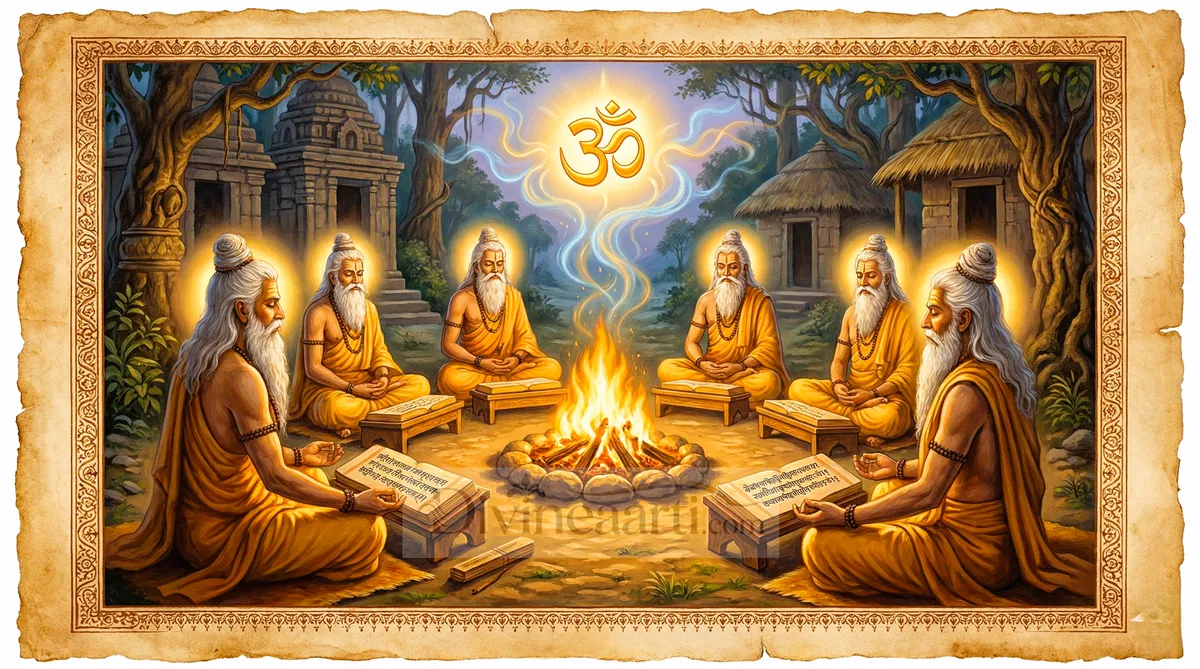
Hidden within the Vedas lies their most precious treasure—the Upanishads (उपनिषद्). These ancient Sanskrit texts contain the distilled philosophical essence of Hindu thought, answering humanity's deepest questions: Who am I? What is reality? What happens after death? How do I achieve lasting peace?
The word Upanishad comes from "upa" (near) + "ni" (down) + "shad" (to sit)—literally, "sitting down near" a teacher to receive secret knowledge. These aren't texts for casual reading; they are revelations meant to be contemplated, meditated upon, and ultimately lived.
📜 What You'll Learn in This Guide:
- ✅ What the Upanishads are and their place in the Vedas
- ✅ Core concepts: Brahman, Atman, Maya, and Moksha
- ✅ The 13 principal Upanishads summarized
- ✅ The Four Mahavakyas (Great Sayings)
- ✅ How to study and apply Upanishadic wisdom
- ✅ Famous verses with translations
🔤 Pronunciation Guide for Key Terms
Brahman = "BRUH-mun" (Ultimate Reality - NOT Brahma the god)
Atman = "AAT-mun" (The Self, Soul)
Vedanta = "Vay-DAAN-tuh" (End of the Vedas)
Maya = "MAA-yaa" (Illusion, Cosmic Power)
Moksha = "MOK-shuh" (Liberation)
Jnana = "GYAA-nuh" (Knowledge, Wisdom)
Mahavakya = "Muh-HAA-VAAK-yuh" (Great Saying)
📑 Table of Contents
🕉️ What Are the Upanishads?
The Upanishads are ancient Sanskrit philosophical texts that form the concluding portion of the Vedas. They are considered Shruti—divinely revealed knowledge, not human compositions. While earlier Vedic literature focuses on rituals and hymns, the Upanishads focus on Jnana (knowledge) and Moksha (liberation).
There are over 200 Upanishads, but tradition recognizes 108 as authentic (listed in the Muktika Upanishad). Of these, 13 are considered "principal" (Mukhya Upanishads) because the great teacher Adi Shankaracharya wrote commentaries on them.
📖 Texts by Numbers
- 200+ total Upanishads
- 108 in the Muktika list
- 13 principal Upanishads
- 10 with major commentaries
- 4 attached to each Veda
🎯 Central Focus
- Nature of Brahman (Reality)
- Nature of Atman (Self)
- Their identity
- Path to Moksha (Liberation)
- Transcending Maya (Illusion)
⏳ Historical Context
- Composed ~800-200 BCE
- Oral tradition much older
- Pre-date Buddha and Mahavira
- Foundation of all Hindu philosophy
- Influenced global thought
📚 Structure Within the Vedas
The Upanishads are not separate texts but the final portion of each Veda. This is why they're called Vedanta—"end of the Vedas." Understanding this structure helps place them in context:
| Veda Part | Sanskrit Name | Content | Purpose |
|---|---|---|---|
| Hymns | Samhita | Mantras, prayers, hymns to deities | Devotion & invocation |
| Rituals | Brahmana | Ritual procedures, explanations | Correct ritual performance |
| Forest Texts | Aranyaka | Symbolic interpretations of rituals | Inner meaning of rituals |
| Philosophy | Upanishad | Philosophical teachings on Brahman-Atman | Self-knowledge & liberation |
Each of the four Vedas—Rig, Yajur, Sama, and Atharva—has Upanishads associated with it. The principal Upanishads are distributed across all four Vedas.
🧘 Core Philosophical Concepts
ब्रह्मन् — Brahman (Ultimate Reality)
Brahman is not a god but the ultimate, unchanging reality underlying all existence. It is:
- Infinite — Without boundaries or limits
- Eternal — Beyond time, never created or destroyed
- Formless — Not an object but pure existence
- Conscious — Pure awareness itself
- Blissful — The source of all joy
Brahman is described as Sat-Chit-Ananda: Existence-Consciousness-Bliss. It is both the material and efficient cause of the universe—everything emerges from it, exists in it, and returns to it.
आत्मन् — Atman (The Self)
Atman is your true Self—not your body, mind, or personality, but the unchanging witness behind all experience. It is:
- Eternal — Never born, never dies
- Pure — Untouched by actions or karma
- Witness — Observes but doesn't participate
- Identical to Brahman — The drop is the ocean
The great revelation of the Upanishads: Atman IS Brahman. Your deepest Self is not separate from ultimate reality—they are one. Liberation comes from realizing this identity directly, not merely believing it.
माया — Maya (Cosmic Illusion)
Maya is the power by which Brahman appears as the manifold world. It is not that the world is "unreal"—rather, it is relatively real, like a dream that seems real while dreaming.
- Maya is Brahman's creative power
- It makes the One appear as many
- It hides our true nature from us
- It can be transcended through knowledge
Maya is neither existence nor non-existence (anirvachaniya). The world is real at the practical level; only from the ultimate perspective is it seen as appearance.
मोक्ष — Moksha (Liberation)
Moksha is liberation from the cycle of birth and death (samsara). It is not going somewhere but realizing what you already are.
- Freedom from ignorance (avidya)
- End of suffering and limitation
- Recognition of Brahman-Atman identity
- Can be achieved in this life (jivanmukti)
Moksha is not a future event but a present recognition. The Upanishads declare: You are already free; only ignorance makes you think otherwise.
🔱 The Three-Part Teaching
The Upanishads use three approaches to point to Brahman:
- Sravana — Hearing the teaching from a qualified teacher
- Manana — Reflecting on it until all doubts are resolved
- Nididhyasana — Deep meditation until direct realization occurs
🌟 The Four Mahavakyas (Great Sayings)
The essence of Upanishadic teaching is distilled into four Mahavakyas—"Great Sayings"—one from each Veda. These are not mere statements but pointers to direct experience.
All four Mahavakyas point to the same truth from different angles: the individual Self (Atman) is identical with universal Reality (Brahman). This is not a metaphor or analogy—it is a statement of absolute identity.
📚 The 13 Principal Upanishads
These are the Mukhya Upanishads—the principal Upanishads on which Adi Shankaracharya wrote authoritative commentaries. They are the foundation of Vedantic study.
1 Isha Upanishad Shukla Yajur Veda
Verses: 18 | Theme: Action in Renunciation
The shortest and yet one of the most profound Upanishads. Its famous opening verse declares that everything is pervaded by the Divine—therefore, enjoy the world without attachment. It reconciles action (karma) and knowledge (jnana), showing they're not opposed.
तेन त्यक्तेन भुञ्जीथा मा गृधः कस्य स्विद्धनम्॥"
"All this is pervaded by the Lord. Enjoy through renunciation. Do not covet anyone's wealth."
Best for: Beginners; understanding spiritual life in the world
2 Kena Upanishad Sama Veda
Verses: 35 | Theme: The Power Behind Powers
"Kena" means "by whom"—the Upanishad opens by asking: By whose power does the mind think? By whose power do the eyes see? It reveals that behind all faculties is Brahman—the unknown knower that can never become an object of knowledge.
Contains the famous story of the gods discovering that their powers come not from themselves but from Brahman, through the mysterious Yaksha (spirit).
Best for: Understanding that Brahman transcends mind and senses
3 Katha Upanishad Krishna Yajur Veda
Verses: 120 | Theme: Death Teaches About Immortality
The story of young Nachiketa, who is sent to Death (Yama) by his father. Yama, impressed by Nachiketa's spiritual resolve, grants him three boons. For his third boon, Nachiketa asks: "What happens after death? Does the self exist or not?"
Yama initially refuses—"Even the gods debated this!"—but Nachiketa persists. Yama then teaches the complete science of Atman and Brahman. Contains the famous chariot metaphor for the self.
क्षुरस्य धारा निशिता दुरत्यया दुर्गं पथस्तत्कवयो वदन्ति॥"
"Arise! Awake! Approach the great teachers and learn. The path is like a razor's edge—difficult to cross. The wise declare it hard to traverse."
Best for: Understanding death, the self, and the path to liberation
4 Prashna Upanishad Atharva Veda
Verses: 67 | Theme: Six Questions
Six seekers approach the sage Pippalada with six fundamental questions: the origin of beings, the life force (prana), its distribution in the body, dreams and sleep, meditation on Om, and the sixteen aspects of the person.
Especially valuable for understanding Prana—the vital force—and meditation on Om.
Best for: Understanding the life force and practical meditation
5 Mundaka Upanishad Atharva Veda
Verses: 64 | Theme: Higher vs. Lower Knowledge
Distinguishes between Para Vidya (higher knowledge of Brahman) and Apara Vidya (lower knowledge of rituals, arts, sciences). Contains the famous image of two birds on a tree—one eating fruits (the individual self), one watching (the Supreme Self).
तयोरन्यः पिप्पलं स्वाद्वत्त्यनश्नन्नन्यो अभिचाकशीति॥"
"Two birds, companions forever united, cling to the same tree. One eats the sweet fruit; the other looks on without eating."
Best for: Understanding the witness-self and the goal of knowledge
6 Mandukya Upanishad Atharva Veda
Verses: 12 | Theme: The Four States of Consciousness & Om
The shortest Upanishad—only 12 verses—yet considered the most concentrated. It analyzes consciousness through four states:
- Vaishvanara/Jagrat — Waking state (A of Om)
- Taijasa/Svapna — Dream state (U of Om)
- Prajna/Sushupti — Deep sleep (M of Om)
- Turiya — The Fourth—pure consciousness (Silence after Om)
Gaudapada's commentary (Mandukya Karika) on this Upanishad is foundational to Advaita Vedanta.
Best for: Advanced students; understanding consciousness and Om
7 Taittiriya Upanishad Krishna Yajur Veda
Verses: 3 chapters | Theme: The Five Sheaths & Bliss
Famous for its teaching on the Pancha Kosha—five sheaths or layers of human existence:
- Annamaya — Physical body (food sheath)
- Pranamaya — Vital energy (breath sheath)
- Manomaya — Mind (mental sheath)
- Vijnanamaya — Intellect (knowledge sheath)
- Anandamaya — Bliss (bliss sheath)
Beyond all five is the Atman. Also contains the famous convocation address to graduating students about truth, dharma, and proper conduct.
Best for: Understanding the layers of self; ethical living
8 Aitareya Upanishad Rig Veda
Verses: 33 | Theme: Creation & the Self
Begins with a creation account—how the Self created the world and entered it. Contains the Mahavakya "Prajnanam Brahma" (Consciousness is Brahman).
Explains how consciousness progressively identifies with body, senses, and mind, and how this identification can be reversed through knowledge.
Best for: Understanding creation from a Vedantic perspective
9 Chandogya Upanishad Sama Veda
Verses: 8 chapters | Theme: Om, Meditation, Tat Tvam Asi
One of the largest and oldest Upanishads. Contains the famous teaching of sage Uddalaka to his son Shvetaketu—repeated nine times: "Tat Tvam Asi" (You Are That).
Uses beautiful analogies: the rivers returning to the ocean, the bees making honey from many flowers, the banyan seed containing the invisible essence. Also contains teachings on Om, meditation, and the inner light.
"That which is the finest essence—this whole world has That as its soul. That is Reality. That is the Self. That you are, Shvetaketu."
Best for: Understanding the teaching "Tat Tvam Asi" in depth
10 Brihadaranyaka Upanishad Shukla Yajur Veda
Verses: 6 chapters (largest Upanishad) | Theme: Comprehensive Vedantic Teaching
The largest and most comprehensive Upanishad. Contains the teachings of the great sage Yajnavalkya to King Janaka and to his wife Maitreyi.
Famous dialogues include Yajnavalkya's "Neti Neti" (not this, not this) method of understanding Brahman, and his teaching that "everything is dear for the sake of the Self."
"Truly, the Self should be seen, heard, reflected upon, and meditated upon."
Best for: Advanced study; complete Vedantic understanding
11 Shvetashvatara Upanishad Krishna Yajur Veda
Verses: 113 | Theme: Personal God & Devotion
Unique among Upanishads for its theistic approach. While teaching the same Brahman-Atman identity, it emphasizes devotion to God (particularly Rudra/Shiva) as a means to liberation.
Bridges Vedantic knowledge with bhakti (devotion). Important for understanding how non-dual philosophy and personal theism coexist in Hinduism.
Best for: Understanding devotional Vedanta; Shaiva tradition
12 Kaushitaki Upanishad Rig Veda
Verses: 4 chapters | Theme: Prana & Consciousness
Focuses on Prana (life force) as identical with consciousness. Contains teachings on the path after death and the dialogue of Pratardana with Indra.
Less commonly studied but contains important teachings on how consciousness operates through prana in all beings.
Best for: Understanding prana as consciousness
13 Maitri Upanishad Krishna Yajur Veda
Verses: 7 chapters | Theme: Meditation & Yoga
One of the later principal Upanishads, containing detailed instructions on meditation, including focus on the heart, breath control, and meditation on Om.
Bridges Upanishadic philosophy with practical yoga techniques. Important for understanding the development of yogic practices.
Best for: Meditation techniques; integrating philosophy with practice
📿 Key Verses with Translations
"सत्यं ज्ञानमनन्तं ब्रह्म"
"Satyam Jnanam Anantam Brahma"
"Brahman is Truth, Knowledge, and Infinity."
"न जायते म्रियते वा कदाचित् नायं भूत्वा भविता वा न भूयः।
अजो नित्यः शाश्वतोऽयं पुराणो न हन्यते हन्यमाने शरीरे॥"
"The Self is never born, never dies. It did not come from anywhere, will not become anything. Unborn, eternal, everlasting, ancient—it is not killed when the body is killed."
"ॐ पूर्णमदः पूर्णमिदं पूर्णात्पूर्णमुदच्यते।
पूर्णस्य पूर्णमादाय पूर्णमेवावशिष्यते॥"
"That is full; this is full. From fullness, fullness comes. Taking fullness from fullness, fullness alone remains."
"असतो मा सद्गमय। तमसो मा ज्योतिर्गमय। मृत्योर्मामृतं गमय॥"
"Lead me from the unreal to the Real. Lead me from darkness to Light. Lead me from death to Immortality."
🌱 Practical Wisdom for Today
The Upanishads aren't just philosophy—they offer practical guidance for living with clarity and peace:
🧘 Practice Self-Inquiry
Ask "Who am I?" not expecting an answer in words, but to shift attention from thoughts to the awareness behind thoughts. This is the essence of Upanishadic meditation.
🌊 Reduce Attachment
"Enjoy through renunciation"—use the world's gifts without clutching them. The Isha Upanishad teaches that true enjoyment comes when we don't grasp.
👁️ Be the Witness
Practice observing your thoughts, emotions, and sensations without identifying with them. You are the unchanging awareness, not the changing content.
🕉️ Meditate on Om
Om represents Brahman. Chant it, meditate on its meaning, trace it to its source in silence. The Mandukya Upanishad provides the complete teaching.
🔍 Question Assumptions
The Upanishads constantly question: Who sees? Who hears? By whose power does the mind think? This inquiry dissolves false identifications.
🙏 Find a Teacher
The Upanishads emphasize learning from a qualified teacher (guru). The texts are meant to be studied, not just read. Seek guidance.
📖 How to Study the Upanishads
Recommended Study Path
For Beginners:
- Start with Isha Upanishad — Short, beautiful, complete
- Then Katha Upanishad — Narrative format, accessible
- Then Mundaka Upanishad — Clear distinction between higher and lower knowledge
- Then Taittiriya Upanishad — Five sheaths model, practical ethics
For Intermediate Students:
- Chandogya Upanishad — "Tat Tvam Asi" teaching in full
- Mandukya Upanishad with Gaudapada's Karika — States of consciousness
- Shvetashvatara Upanishad — Theistic Vedanta
For Advanced Study:
- Brihadaranyaka Upanishad with Shankaracharya's commentary
- Compare commentaries: Shankara (Advaita), Ramanuja (Vishishtadvaita), Madhva (Dvaita)
Recommended Translations:
- Swami Gambhirananda — Advaita Ashrama editions (scholarly, with Shankara's commentary)
- Eknath Easwaran — Accessible to modern readers
- Patrick Olivelle — Academic translation with good notes
- Swami Chinmayananda — Practical application focus
❓ Frequently Asked Questions
Are the Upanishads atheistic or theistic?
Neither exclusively. The Upanishads present Brahman—ultimate reality—which transcends the theist/atheist distinction. Some Upanishads (like Shvetashvatara) emphasize a personal God; others focus on impersonal absolute. Both approaches ultimately point to the same reality beyond concepts.
How do the Upanishads relate to the Bhagavad Gita?
The Bhagavad Gita is called the "essence of the Upanishads" (Upanishad-sara). It synthesizes Upanishadic teachings with yoga, devotion, and action. The Gita makes Vedantic wisdom accessible and applicable. Together with the Upanishads and Brahma Sutras, it forms the Prasthana Traya (Three Foundational Texts) of Vedanta.
Can anyone study the Upanishads?
Yes! Unlike the Vedic Samhitas which traditionally had restrictions, the Upanishads have always been available to sincere seekers regardless of background. The only requirements are: an earnest desire for truth, willingness to question assumptions, and ideally, guidance from a qualified teacher.
What is the relationship between Upanishads and Buddhism?
The Buddha lived in the Upanishadic milieu and used similar terms (dharma, nirvana, karma). However, Buddhism generally rejects the concept of permanent Atman. Some scholars see Buddhism as a reformation of Upanishadic ideas; others see key differences. Both traditions share the goal of liberation from suffering.
Do the Upanishads support any particular lifestyle?
The Upanishads support multiple lifestyles. The Isha Upanishad explicitly endorses householder life with detachment. Other Upanishads praise renunciation. The key is not external lifestyle but internal orientation—freedom from attachment while fulfilling one's duties.
🙏 Conclusion: The Living Wisdom
The Upanishads are not museum pieces from an ancient past—they are living wisdom that has been continuously taught, debated, and realized for over 3,000 years. Their message is startlingly simple yet infinitely deep: You are already what you seek.
The suffering of human life comes from misidentification—taking ourselves to be the body, mind, or ego when we are the eternal Atman. The Upanishads don't ask us to become something new but to recognize what we already are.
"Brahman alone is real; the world is appearance; the individual self is Brahman, not other."
May your study of the Upanishads lead you from the unreal to the Real, from darkness to Light, from death to Immortality.