
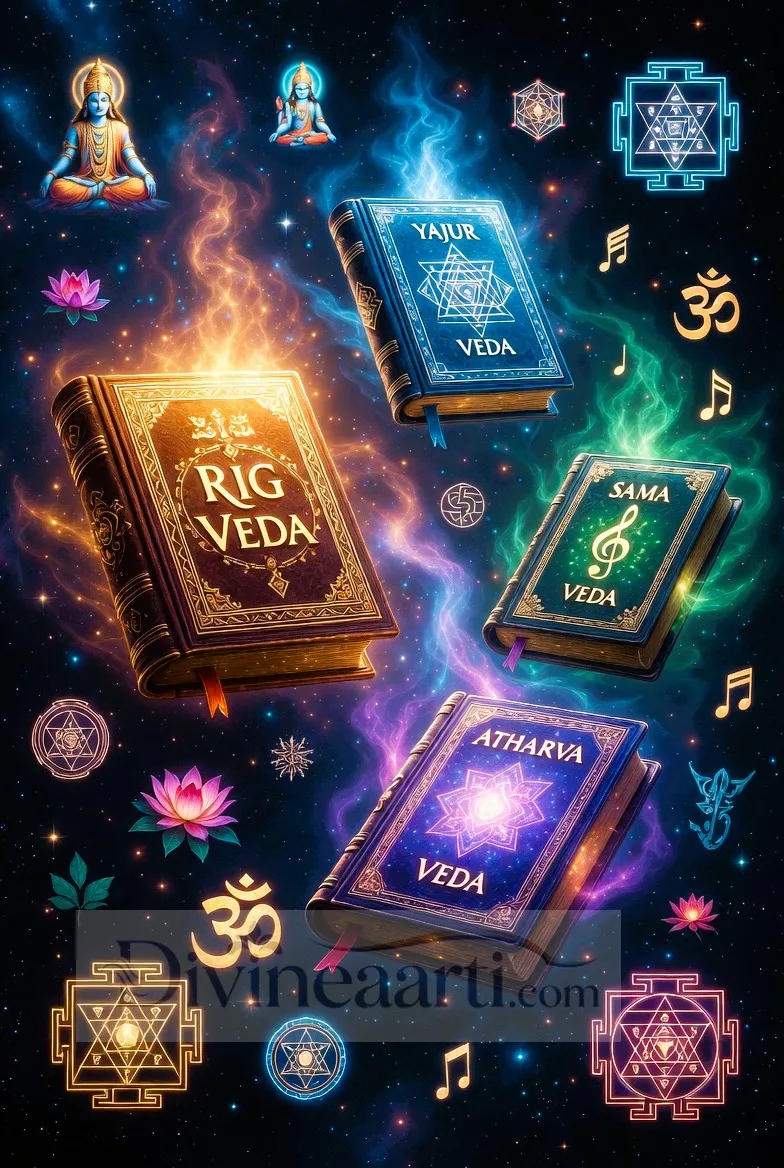
The Vedas (वेद) are the oldest, most authoritative, and most sacred scriptures of Hinduism. The word "Veda" comes from the Sanskrit root vid—"to know"—making the Vedas literally "Knowledge" itself. For over 3,500 years, these texts have been the foundation of Indian philosophy, ritual, medicine, mathematics, astronomy, and spirituality.
Unlike other religious scriptures attributed to specific authors, the Vedas are considered Apaurusheya—"not of human origin." They are Shruti—divine knowledge that ancient sages (rishis) "heard" in deep meditation and transmitted through an unbroken oral tradition that continues to this day.
📜 What You'll Learn in This Guide:
- ✅ What the Vedas are and their divine origin
- ✅ The four-part structure of Vedic literature
- ✅ Each of the Four Vedas in detail
- ✅ Key mantras with translations (including Gayatri)
- ✅ The Vedic gods and their significance
- ✅ How the Vedas are preserved and transmitted
- ✅ Practical relevance of Vedas today
🔤 Pronunciation Guide for Key Terms
Rig Veda = "Rig VAY-duh" (Veda of Hymns)
Yajur Veda = "YUH-joor VAY-duh" (Veda of Rituals)
Sama Veda = "SAA-muh VAY-duh" (Veda of Melodies)
Atharva Veda = "Uh-THAR-vuh VAY-duh" (Veda of Atharvan)
Samhita = "Sum-HI-taa" (Collection of Mantras)
Brahmana = "BRAAH-muh-nuh" (Ritual Explanations)
Aranyaka = "Aa-RUN-yuh-kuh" (Forest Texts)
Shruti = "SHROO-tee" (That Which is Heard)
📑 Table of Contents
- What Are the Vedas?
- Origin & Transmission
- Four-Part Structure
- Rig Veda: Hymns of Knowledge
- Yajur Veda: Ritual Knowledge
- Sama Veda: Melodic Knowledge
- Atharva Veda: Everyday Knowledge
- The Vedic Deities
- Key Mantras & Translations
- How the Vedas Are Preserved
- Vedas in Modern Life
- Frequently Asked Questions
🕉️ What Are the Vedas?
The Vedas are a vast body of religious literature comprising hymns, philosophical discussions, ritual instructions, and mystical formulas. They form the bedrock of Sanatana Dharma (Hinduism) and are considered the highest scriptural authority.
"Vedo 'khilo dharmamūlam"
"The Vedas are the root of all dharma (righteousness)."
🔥 Rig Veda
Knowledge of Hymns
The oldest Veda, containing 1,028 hymns to the gods. Foundation of Vedic literature.
🙏 Yajur Veda
Knowledge of Rituals
Prose formulas for conducting sacrificial ceremonies. The priest's manual.
🎵 Sama Veda
Knowledge of Melodies
Rig Vedic verses set to musical notation. Origin of Indian classical music.
🌿 Atharva Veda
Knowledge of Daily Life
Spells, charms, medicine, philosophy. The Veda closest to ordinary life.
Two Categories of Scripture
Hindu scriptures are classified into two categories:
श्रुति — Shruti (Revealed)
"That which is heard"
Direct divine revelation to the rishis. The Vedas are Shruti—eternal truths, not human compositions. They have highest authority and cannot be questioned.
स्मृति — Smriti (Remembered)
"That which is remembered"
Human compositions based on Shruti. Includes the Epics (Ramayana, Mahabharata), Puranas, Dharmasutras, etc. Important but secondary to Shruti.
Why This Matters
When there's a conflict between Shruti and Smriti, Shruti prevails. This hierarchy keeps Hindu thought anchored to its eternal source while allowing flexibility in application.
📿 Origin & Transmission
Divine Origin (Apaurusheya)
Unlike other scriptures attributed to prophets or founders, the Vedas are considered Apaurusheya—"not of human authorship." They are eternal truths that exist independently of human creation. The rishis did not compose them; they received them.
According to tradition, at the beginning of each cosmic cycle, the Vedas are revealed anew. Lord Brahma, the creator, receives them and transmits them to the sages. Different mantras were revealed to different rishis, whose names are preserved in the texts (e.g., Vishvamitra revealed the Gayatri Mantra).
Ved Vyasa: The Compiler
In the Dvapara Yuga (the age before our current Kali Yuga), the sage Ved Vyasa (Veda Vyasa) organized the one eternal Veda into the four Vedas we know today. His name literally means "compiler of the Vedas." He also taught each Veda to a specific disciple:
- Paila received the Rig Veda
- Vaishampayana received the Yajur Veda
- Jaimini received the Sama Veda
- Sumantu received the Atharva Veda
Dating the Vedas
Hindu tradition considers the Vedas eternal and timeless. Academic scholarship proposes various dates:
- Rig Veda: ~1500-1200 BCE (earliest hymns possibly older)
- Yajur & Sama Vedas: ~1200-900 BCE
- Atharva Veda: ~1000-900 BCE
- Brahmanas: ~900-700 BCE
- Upanishads: ~800-200 BCE
These dates are estimates based on linguistic analysis. The oral tradition predates any written form by many centuries.
🏛️ The Four-Part Structure of Each Veda
Each Veda is divided into four layers, representing a progression from action to knowledge:
| Part | Sanskrit | Content | Purpose | Audience |
|---|---|---|---|---|
| 1. Samhita | संहिता | Core collection of mantras, hymns, and prayers | Invocation of deities, praise, petition | All practitioners |
| 2. Brahmana | ब्राह्मण | Prose explanations of rituals and their meanings | How to perform yajnas (sacrifices) correctly | Priests (Brahmins) |
| 3. Aranyaka | आरण्यक | "Forest texts"—symbolic interpretations of rituals | Internalization of ritual; bridge to philosophy | Forest-dwelling hermits |
| 4. Upanishad | उपनिषद् | Philosophical discussions on Brahman, Atman, Moksha | Self-knowledge and liberation | Seekers of liberation |
🔱 Understanding the Progression
The four parts represent a journey from external ritual to internal realization:
- Samhita: What to chant and to whom
- Brahmana: How to perform the ritual and why
- Aranyaka: What the ritual means symbolically
- Upanishad: The ultimate truth beyond all ritual
Rig Veda — The Knowledge of Hymns
The Rig Veda (ऋग्वेद) is the oldest and most important Veda. "Rig" comes from Ric—a stanza of praise. It is a collection of 1,028 hymns (suktas) composed in praise of various deities, organized into 10 books (mandalas).
| Characteristic | Details |
|---|---|
| Hymns (Suktas) | 1,028 |
| Verses (Mantras) | 10,552 |
| Books (Mandalas) | 10 |
| Primary Deities | Indra (250 hymns) Agni (200 hymns) Soma (100+ hymns) |
| Associated Priest | Hotr (the invoker, reciter of hymns) |
| Principal Upanishad | Aitareya Upanishad |
The 10 Mandalas (Books)
- Mandalas 2-7: The oldest "family books," each attributed to a specific rishi lineage
- Mandala 1 & 10: Later additions, more diverse in content
- Mandala 8: Associated with the Kanva family
- Mandala 9: Entirely devoted to Soma (the sacred drink)
Famous Hymns
- Gayatri Mantra (3.62.10) — Most sacred prayer in Hinduism
- Purusha Sukta (10.90) — Cosmic man sacrifice, origin of society
- Nasadiya Sukta (10.129) — Creation hymn ("There was neither existence nor non-existence...")
- Hiranyagarbha Sukta (10.121) — Golden womb of creation
Yajur Veda — The Knowledge of Rituals
The Yajur Veda (यजुर्वेद) is the Veda of Yajus—prose mantras used during sacrificial rituals. It serves as the manual for priests conducting ceremonies, providing the formulas they recite while performing ritual actions.
The Yajur Veda exists in two major recensions:
- Krishna (Black) Yajur Veda: Contains an unsystematic mixture of mantras and explanations. Includes the Taittiriya Samhita.
- Shukla (White) Yajur Veda: Contains only mantras, with explanations in separate Brahmanas. Includes the Vajasaneyi Samhita.
| Characteristic | Details |
|---|---|
| Content Type | Prose formulas for ritual actions |
| Primary Function | Conducting yajnas (fire sacrifices) |
| Associated Priest | Adhvaryu (the priest who performs actions) |
| Major Recensions | Krishna Yajur Veda, Shukla Yajur Veda |
| Principal Upanishads | Brihadaranyaka, Isha, Taittiriya, Katha, Shvetashvatara, Maitri |
Key Features
- Instructions for building fire altars (agni)
- Formulas for offering oblations
- Mantras synchronized with ritual movements
- Explanations of the meaning behind each action
Associated Texts
- Shatapatha Brahmana — One of the largest and most important Brahmanas, attached to Shukla Yajur Veda. Contains the Brihadaranyaka Upanishad.
- Taittiriya Brahmana — Attached to Krishna Yajur Veda
Sama Veda — The Knowledge of Melodies
The Sama Veda (सामवेद) is the Veda of Saman—melodies or songs. It takes verses primarily from the Rig Veda and sets them to musical notation for chanting during rituals. It is considered the origin of Indian classical music.
Lord Krishna declares in the Bhagavad Gita: "Among the Vedas, I am the Sama Veda" (10.22), highlighting its special status.
| Characteristic | Details |
|---|---|
| Verses | 1,875 (most from Rig Veda) |
| Original Verses | Only 75 unique to Sama Veda |
| Content Type | Rig Vedic verses set to melodic notation |
| Associated Priest | Udgatr (the singer of hymns) |
| Principal Upanishads | Chandogya, Kena |
Musical Elements
- Uses a system of svaras (notes) that evolved into the classical raga system
- Original notation indicates pitch variations, prolongations, and repetitions
- Chanting patterns preserve the mathematical relationships underlying music
- The seven notes (Sa-Re-Ga-Ma-Pa-Dha-Ni) derive from Sama Vedic chanting
Structure
The Sama Veda Samhita is organized into two main sections:
- Purvarchika — The first part, containing verses for the opening of rituals
- Uttararchika — The latter part, with verses for concluding rituals
Atharva Veda — The Knowledge of Everyday Life
The Atharva Veda (अथर्ववेद) is named after the sage Atharvan, who is credited with discovering fire worship. Unlike the other three Vedas which focus primarily on ritual sacrifice, the Atharva Veda addresses the practical concerns of daily life.
It was initially not considered part of the "Trayi" (triple Vedic knowledge) but was later accepted as the fourth Veda due to its valuable content.
| Characteristic | Details |
|---|---|
| Hymns | ~730 hymns |
| Verses | ~6,000 |
| Books | 20 kandas (sections) |
| Content Type | Spells, medicine, philosophy, daily rites |
| Associated Priest | Brahman (the supervising priest) |
| Principal Upanishads | Mundaka, Mandukya, Prashna |
Unique Content Areas
- Medicine & Healing: Treatments for diseases, herbal remedies, surgical references (foundation of Ayurveda)
- Protection Charms: Against enemies, diseases, demons, and misfortune
- Love & Marriage: Hymns for attracting love, ensuring happy marriage
- Prosperity: Prayers for success, wealth, and well-being
- Royal Ceremonies: Coronation rituals, governance principles
- Philosophical Hymns: Some of the deepest metaphysical speculations
🔱 The "People's Veda"
While the other three Vedas focus on formal ritual, the Atharva Veda speaks to everyday concerns: healing illness, protecting family, ensuring good harvests, finding love. It's the most "practical" Veda, showing that Vedic knowledge encompasses all of life, not just temple rituals.
🌟 The Vedic Deities
The Vedas invoke numerous deities (devas). These are not arbitrary gods but cosmic powers representing natural forces and philosophical concepts. The most important Vedic deities are:
🔥 Agni — Fire
Second most invoked deity (200+ hymns)
The divine fire, messenger between humans and gods. Every yajna begins and ends with Agni. He exists in three forms: fire on earth, lightning in sky, sun in heaven.
⚡ Indra — King of Gods
Most invoked deity (250+ hymns)
God of thunder, rain, and war. Slayer of Vritra (drought demon). Represents power, courage, and victory. Drinks Soma to gain strength.
🍯 Soma — Sacred Drink
Entire Mandala 9 dedicated to him
The divine plant and its pressed juice, consumed in rituals. Represents immortality, ecstasy, and divine inspiration. Also the Moon god.
🌊 Varuna — Cosmic Order
Guardian of Rita (cosmic law)
Lord of the waters and moral order. Sees all actions, punishes wrongdoing, forgives the repentant. One of the oldest Vedic deities.
☀️ Surya — Sun
The visible face of the divine
The sun, source of light, life, and consciousness. Associated with truth and wisdom. The Gayatri Mantra invokes Surya (Savitr).
🔱 Rudra — The Howler
Proto-form of Shiva
God of storms, healing, and destruction. Feared and worshipped. Father of the Maruts (storm gods). Evolves into the great god Shiva in later tradition.
Other important deities include: Vayu (wind), Mitra (friend, contracts), Ushas (dawn), Vishnu (the pervader, later elevated to supreme deity), Brahmanaspati/Brihaspati (lord of prayer), and the Ashvins (divine physicians, twin horsemen).
🔱 Understanding Vedic Polytheism
The Vedas appear to invoke many gods, but a deeper reading reveals henotheism—each deity, when being praised, is treated as supreme. As the Rig Veda declares: "They call him Indra, Mitra, Varuna, Agni... the Reality is One; the wise call it by many names" (1.164.46). This points to an underlying unity that the Upanishads later explicitly articulate as Brahman.
📿 Key Mantras with Translations
Gayatri Mantra (Rig Veda 3.62.10)
ॐ भूर्भुवः स्वः
तत्सवितुर्वरेण्यं
भर्गो देवस्य धीमहि
धियो यो नः प्रचोदयात्॥
Om Bhur Bhuvah Svah
Tat Savitur Varenyam
Bhargo Devasya Dhimahi
Dhiyo Yo Nah Prachodayat
"We meditate on the glorious light of the divine Savitri (Sun). May that light illuminate our intellect."
Mahamrityunjaya Mantra (Rig Veda 7.59.12)
ॐ त्र्यम्बकं यजामहे
सुगन्धिं पुष्टिवर्धनम्।
उर्वारुकमिव बन्धनान्
मृत्योर्मुक्षीय मामृतात्॥
"We worship the three-eyed Lord (Shiva), fragrant and nourishing. As a cucumber is released from its stem, may we be liberated from death, not from immortality."
Shanti Mantras (Peace Invocations)
ॐ सह नाववतु। सह नौ भुनक्तु।
सह वीर्यं करवावहै।
तेजस्विनावधीतमस्तु मा विद्विषावहै॥
ॐ शान्तिः शान्तिः शान्तिः॥
"Om. May we both (teacher and student) be protected. May we both be nourished. May we work together with great energy. May our study be illuminating. May we not hate each other. Om, Peace, Peace, Peace."
Nasadiya Sukta — Hymn of Creation (Rig Veda 10.129)
नासदासीन्नो सदासीत्तदानीं
नासीद्रजो नो व्योमा परो यत्।
किमावरीवः कुह कस्य शर्मन्
अम्भः किमासीद्गहनं गभीरम्॥
"There was neither existence nor non-existence then. There was neither space nor the sky beyond. What stirred? Where? In whose protection? Was there water, deep and unfathomable?"
🏛️ How the Vedas Are Preserved
The Vedas have been transmitted orally for over 3,500 years with remarkable accuracy. This is achieved through elaborate memorization techniques:
Pathas — Methods of Recitation
Vakya Patha
Continuous recitation of sentences as they naturally occur.
Pada Patha
Word-by-word recitation, pausing between each word.
Krama Patha
Pairs of words: 1-2, 2-3, 3-4, etc.
Jata Patha
Complex pattern: 1-2-2-1-1-2, 2-3-3-2-2-3, etc.
Ghana Patha
Even more complex: 1-2-2-1-1-2-3-3-2-1-1-2-3, etc.
Others
Mala, Shikha, Rekha, Dhvaja, Danda, Ratha, and more...
These methods create multiple redundant encoding, making transmission errors virtually impossible. A Vedic reciter (Shrotriya) who has mastered all pathas is called Ghanapathi.
Vedic Schools (Shakhas)
Each Veda was preserved in different shakhas (branches or schools). Thousands once existed; about 10 survive today:
- Rig Veda: Shakala shakha (primary surviving tradition)
- Yajur Veda: Taittiriya, Maitrayani (Krishna); Kanva, Madhyandina (Shukla)
- Sama Veda: Kauthuma, Ranayaniya, Jaiminiya
- Atharva Veda: Shaunaka, Paippalada
🔱 UNESCO Recognition
In 2003, UNESCO proclaimed the tradition of Vedic chanting a "Masterpiece of the Oral and Intangible Heritage of Humanity." It recognized the Vedic oral tradition as the oldest unbroken oral tradition in the world, preserved with "textual and phonetic accuracy" for millennia.
🌱 Vedas in Modern Life
The Vedas are not museum pieces—they remain central to Hindu religious practice today:
🙏 Daily Worship
The Gayatri Mantra is recited by millions daily at dawn. Temple priests perform daily pujas using Vedic mantras. The Om sound opens virtually every prayer.
👶 Life Ceremonies
The 16 samskaras (life ceremonies)—from naming to marriage to death—all employ Vedic mantras. The wedding fire ritual uses Yajur Vedic formulas.
🔥 Yajnas & Havans
Fire rituals continue to be performed for everything from house blessings to rain invocation. Large-scale Vedic yajnas are still conducted following ancient prescriptions.
🧘 Meditation & Yoga
Many meditation practices use Vedic mantras. The Upanishadic teachings underlie most Hindu spiritual paths. Yoga's philosophical framework comes from Vedic thought.
🌿 Ayurveda
Traditional Indian medicine traces its origins to the Atharva Veda. Many Ayurvedic mantras and treatments are Vedic in origin.
🎓 Vedic Studies
Traditional Vedic schools (pathashalas) continue to train students in complete Vedic recitation and ritual. Modern universities offer Vedic studies programs.
❓ Frequently Asked Questions
Who can study the Vedas?
In ancient times, there were restrictions based on caste and gender. Modern Hindu teachers overwhelmingly hold that anyone with sincere interest can study the Vedas. Many organizations now teach Vedic chanting to all seekers regardless of background. The spirit of the Vedas—knowledge leading to liberation—is universal.
What language are the Vedas written in?
The Vedas are composed in Vedic Sanskrit, an archaic form of Sanskrit older than the "Classical Sanskrit" of later literature. Vedic Sanskrit has unique grammatical forms, vocabulary, and accents not found in Classical Sanskrit. Proper Vedic recitation requires training in the specific accent system (svara).
Do the Vedas promote animal sacrifice?
The Brahmana portions describe various yajnas, some involving animal offerings. However: (1) These were highly regulated ceremonial acts, not casual killing; (2) Many offerings were vegetarian (grains, ghee, soma); (3) The Upanishads and later tradition increasingly emphasized symbolic and internalized sacrifice; (4) Most Hindu traditions today interpret these as allegory or have abandoned the practice entirely.
What is the relationship between Vedas and Hinduism?
The Vedas are the foundational scriptures of Hinduism. All Hindu philosophical schools claim to be based on them (even when interpretations differ). The Upanishads provide the philosophical basis for all Hindu thought. Even schools that emphasize devotion to a particular deity ultimately trace authority back to the Vedas.
How do I begin studying the Vedas?
Start with translations of the Upanishads (try Eknath Easwaran or Patrick Olivelle). For the Samhitas, Ralph T.H. Griffith's translations are freely available online. For deeper study, find a qualified teacher or organization like Arsha Vidya Gurukulam, Chinmaya Mission, or a traditional Veda Pathashala. Audio recordings of Vedic chanting are also widely available.
🙏 Conclusion: The Living Vedas
The Vedas are not relics of a dead past but living wisdom that continues to guide millions of people in their spiritual lives. From the Gayatri Mantra chanted at dawn to the Upanishadic truths contemplated in meditation, the Vedic tradition remains vibrantly alive.
Whether you approach the Vedas as sacred scripture, philosophical literature, or cultural heritage, they offer profound insights into the nature of reality, the purpose of human life, and the path to lasting peace.