
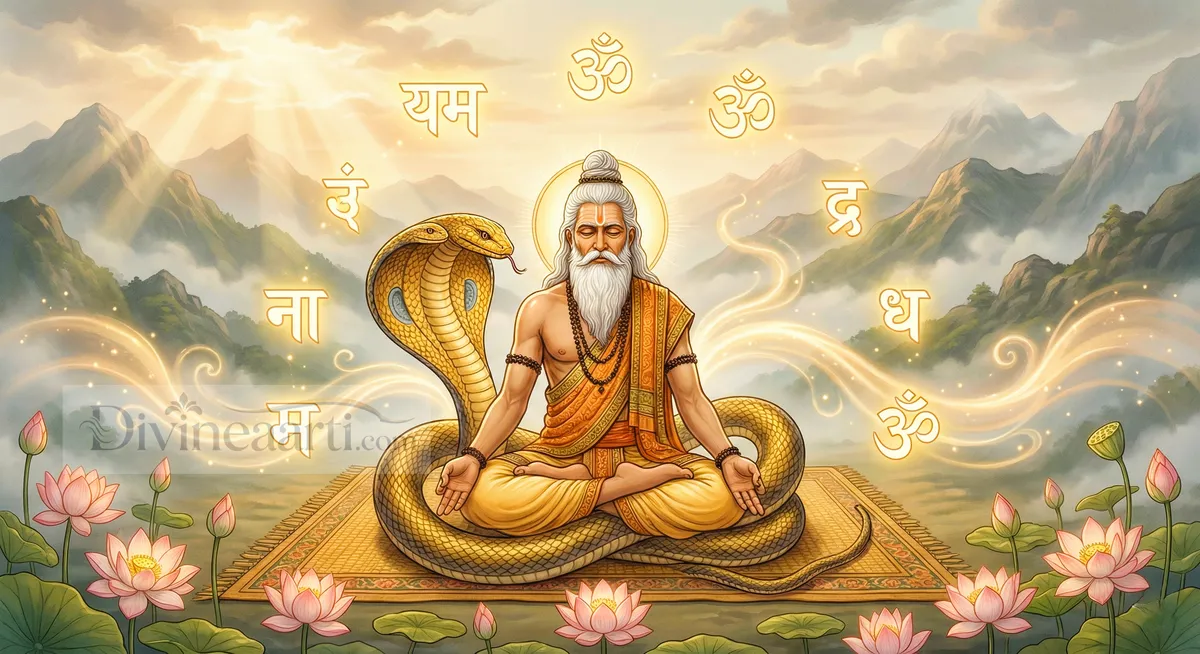
In 196 precise aphorisms, the sage Patanjali systematized the ancient science of yoga into a practical path for liberating the mind. The Yoga Sutras (योग सूत्र) are not about physical postures—they are a manual for mastering the mind, transcending suffering, and attaining the ultimate freedom called Kaivalya.
While modern yoga often emphasizes flexibility and fitness, Patanjali's yoga is Raja Yoga—the "royal path"—focused on meditation, mental discipline, and spiritual awakening. This guide will walk you through the complete Yoga Sutras, making this profound wisdom accessible whether you're a yoga practitioner, meditator, or spiritual seeker.
📜 What You'll Learn in This Guide:
- ✅ Who Patanjali was and when he lived
- ✅ The four chapters (padas) of the Yoga Sutras
- ✅ The complete Eight Limbs of Yoga (Ashtanga)
- ✅ Key sutras with translations and explanations
- ✅ The nature of the mind and its fluctuations
- ✅ The stages of samadhi and liberation
- ✅ How to apply these teachings in daily life
🔤 Pronunciation Guide for Key Terms
Sutra = "SOO-truh" (Thread, Aphorism)
Patanjali = "Puh-TUN-juh-lee" (The compiler)
Ashtanga = "Uhsh-TAAN-guh" (Eight Limbs)
Chitta = "CHIT-tuh" (Mind-stuff, Consciousness)
Vritti = "VRIT-tee" (Fluctuation, Wave)
Nirodha = "Nee-ROH-dhuh" (Cessation, Restraint)
Samadhi = "Suh-MAA-dhee" (Absorption, Enlightenment)
Kaivalya = "Kai-VULL-yuh" (Absolute Freedom)
📑 Table of Contents
🕉️ What Are the Yoga Sutras?
The Yoga Sutras (Sanskrit: योगसूत्र, Yogasūtra) is a collection of 196 aphorisms that codify the philosophy and practice of yoga. The word sutra means "thread"—each aphorism is a condensed thread of wisdom meant to be unpacked through study and practice.
These sutras weren't invented by Patanjali—yoga existed long before him. What Patanjali did was systematize the scattered teachings into a coherent, practical framework. Think of him as a master compiler, organizing ancient wisdom into a teachable system.
📊 Text Statistics
- 196 sutras (aphorisms)
- 4 chapters (padas)
- ~1,200 words total
- Highly compressed format
- Requires commentary to understand
🎯 Central Purpose
- Define what yoga is
- Explain why we suffer
- Describe the mind's nature
- Provide the path to freedom
- Attain Kaivalya (liberation)
📚 Key Commentaries
- Vyasa Bhashya (oldest)
- Tattva Vaisharadi (Vachaspati)
- Raja Martanda (Bhoja)
- Yoga Varttika (Vijnanabhikshu)
- Modern: Vivekananda, Satchidananda
👤 Who Was Patanjali?
Patanjali is one of the most mysterious figures in Indian intellectual history. We know almost nothing about him with certainty. Tradition holds that he was:
- An incarnation of Ananta Shesha, the serpent on whom Vishnu reclines
- Author of three great works: Yoga Sutras, Mahabhashya (Sanskrit grammar), and a text on Ayurveda
- A master who "fell from heaven" (Patanjali = "pata" + "anjali" = falling + folded hands)
Modern scholars debate whether these three works were by the same person or different authors with the same name. The Yoga Sutras are typically dated to around 400 CE, though some place them earlier (200 BCE - 200 CE).
🔱 Traditional Invocation to Patanjali
"योगेन चित्तस्य पदेन वाचां मलं शरीरस्य च वैद्यकेन।
योऽपाकरोत्तं प्रवरं मुनीनां पतञ्जलिं प्राञ्जलिरानतोऽस्मि॥"
"I bow with folded hands to Patanjali, the best of sages, who removed impurity of mind through yoga, of speech through grammar, and of body through medicine."
🧘 The Definition of Yoga
The Yoga Sutras begin with one of the most important definitions in spiritual literature:
"Yoga is the cessation of the fluctuations of the mind."
Let's unpack each word:
- Yoga — Union, discipline, the practice
- Chitta — The mind-stuff (includes intellect, ego, and subconscious)
- Vritti — Fluctuations, waves, modifications, thoughts
- Nirodha — Cessation, restraint, stilling
Notice what yoga is not defined as: it's not about postures, flexibility, or physical exercise. The essence of yoga is mastering the mind. The physical practices support this goal but aren't the goal itself.
"Then the Seer abides in its own true nature."
When the mind's waves are stilled, pure consciousness (Purusha, the Seer, the true Self) rests in its own nature—peaceful, luminous, and free.
📖 The Four Chapters (Padas)
The Yoga Sutras are divided into four chapters, each addressing a specific aspect of the path:
1 Samadhi Pada — On Contemplation
Sutras: 51 | Focus: What is yoga? What is samadhi?
The first chapter defines yoga, describes the five types of mental fluctuations, introduces the two paths (practice and detachment), and outlines the various stages of samadhi. It's the most philosophical chapter, addressing the nature of consciousness and the goal of yoga.
Key topics: Definition of yoga, vrittis, vairagya (detachment), Ishvara (God), obstacles, stages of samadhi.
2 Sadhana Pada — On Practice
Sutras: 55 | Focus: How to practice yoga
The practical chapter. It introduces Kriya Yoga (the yoga of action) and the famous Eight Limbs of Yoga (Ashtanga). It also describes the kleshas (afflictions) that cause suffering and how to overcome them.
Key topics: Kleshas, karma, Kriya Yoga, Ashtanga Yoga (first 5 limbs detailed).
3 Vibhuti Pada — On Powers
Sutras: 56 | Focus: The inner limbs and supernatural powers
Describes the final three limbs of yoga (Dharana, Dhyana, Samadhi) and the siddhis—supernatural powers that arise through advanced practice. Patanjali warns that attachment to these powers is an obstacle to liberation.
Key topics: Samyama (perfect discipline), siddhis, warning against attachment to powers.
4 Kaivalya Pada — On Liberation
Sutras: 34 | Focus: The nature of liberation
The final chapter discusses the nature of absolute freedom (Kaivalya), where pure consciousness is forever separate from matter. It includes discussions on karma, the nature of time, and the ultimate goal of yoga.
Key topics: Nature of mind, karma, gunas, final liberation, nature of the Seer.
🌟 The Eight Limbs of Yoga (Ashtanga)
The most famous teaching of the Yoga Sutras is the Ashtanga (अष्टाङ्ग)—the eight limbs or steps of yoga. These form a progressive path from external discipline to inner realization:
"The eight limbs of yoga are: restraints, observances, posture, breath control, sense withdrawal, concentration, meditation, and absorption."
Yama
यम
Ethical Restraints
What NOT to do
Niyama
नियम
Personal Observances
What TO do
Asana
आसन
Steady Posture
Physical stability
Pranayama
प्राणायाम
Breath Control
Energy mastery
Pratyahara
प्रत्याहार
Sense Withdrawal
Turning inward
Dharana
धारणा
Concentration
Single-pointed focus
Dhyana
ध्यान
Meditation
Unbroken flow
Samadhi
समाधि
Absorption
Total union
🔱 External vs. Internal Limbs
The first five limbs (Yama through Pratyahara) are called bahiranga—external limbs. They prepare the body and energy for inner work. The last three limbs (Dharana, Dhyana, Samadhi) are antaranga—internal limbs, dealing directly with the mind. Together, the last three are called Samyama—perfect discipline.
⚖️ Yama & Niyama Explained
The Five Yamas (Ethical Restraints)
The Yamas are universal ethical principles—what we should refrain from doing:
1. Ahimsa — Non-Violence
Non-harming in thought, word, and deed toward all living beings. The foundation of all other yamas. From ahimsa flows compassion, love, and peace.
2. Satya — Truthfulness
Speaking and living truth. But truth should never violate ahimsa—if truth would cause harm, maintain silence or speak kindly.
3. Asteya — Non-Stealing
Not taking what isn't freely given—material goods, time, ideas, credit, or opportunities. Contentment with what is rightfully yours.
4. Brahmacharya — Moderation
Control of sensual desires. Traditionally celibacy; more broadly, directing energy toward spiritual growth rather than dissipating it in pleasure.
5. Aparigraha — Non-Possessiveness
Not grasping, hoarding, or accumulating beyond need. Freedom from greed. Holding things lightly, including relationships and outcomes.
The Five Niyamas (Personal Observances)
The Niyamas are personal practices—what we should cultivate:
1. Saucha — Purity
Cleanliness of body, mind, and environment. Includes physical hygiene, pure food, and mental clarity through practice.
2. Santosha — Contentment
Acceptance of the present moment. Being at peace with what is, while still working toward improvement. Freedom from constant wanting.
3. Tapas — Discipline
Burning enthusiasm, austerity, self-discipline. The fire that purifies—willingness to endure difficulty for spiritual growth.
4. Svadhyaya — Self-Study
Study of scriptures and study of oneself. Includes chanting, reading sacred texts, and introspection. Knowing thyself.
5. Ishvara Pranidhana — Surrender to God
Devotion to the Divine, surrender of ego, offering all actions to a higher power. Trust in the cosmic order.
🌈 Stages of Samadhi
Patanjali describes a progression of increasingly subtle states of absorption:
Samprajnata Samadhi
"Cognitive absorption"
Samadhi with an object of meditation. Has four stages based on the subtlety of the object:
- Savitarka: Gross object with reasoning
- Nirvitarka: Gross object, no reasoning
- Savichara: Subtle object with reflection
- Nirvichara: Subtle object, no reflection
Asamprajnata Samadhi
"Non-cognitive absorption"
Samadhi without any object. The mind has completely stilled. Only latent impressions (samskaras) remain. This is the gateway to liberation.
"When even these impressions are dissolved, there remains no seed for future affliction."
Kaivalya
"Absolute Liberation"
The final goal. Pure consciousness (Purusha) realizes it was never actually bound. It rests eternally in its own nature—pure, free, and complete.
"The gunas (qualities of nature) having fulfilled their purpose, return to their source. This is liberation—the aloneness of seeing."
📿 Key Sutras with Translations
"Now, the teaching of yoga begins."
The word "now" (atha) indicates that the student is ready—having completed preliminary preparation and having developed the desire for liberation.
"The cessation [of mental fluctuations] is attained through practice and detachment."
Abhyasa (practice) and Vairagya (detachment) are the twin pillars of yoga. Practice is persistent effort; detachment is freedom from craving for results.
"Practice becomes firmly grounded when continued for a long time, without interruption, and with sincere devotion."
Three requirements for success: long duration, consistency, and reverent attitude. No shortcuts.
"Asana is a steady and comfortable position."
This is Patanjali's entire teaching on asana. The goal isn't complex postures but a position stable enough to meditate for extended periods.
"From that, one is no longer disturbed by dualities."
When asana is mastered, the pairs of opposites—heat/cold, pain/pleasure, praise/blame—no longer disturb the mind.
"Future suffering is to be avoided."
We cannot change past suffering, but future suffering can be prevented through yoga practice—by removing the causes of suffering now.
"Then the Seer abides in its own true nature."
The goal of yoga: when mental fluctuations cease, pure awareness recognizes itself as eternal, unchanging, and free.
🚧 Obstacles on the Path
Patanjali identifies nine obstacles (antarayas) that scatter the mind and hinder progress:
1. Vyadhi — Disease
Physical illness that disturbs practice. The body must be healthy enough to sit for meditation.
2. Styana — Dullness
Mental heaviness, inertia, lack of motivation. The mind feels foggy and resistant to practice.
3. Samshaya — Doubt
Uncertainty about the path, the teacher, or one's own ability. "Will this really work?"
4. Pramada — Carelessness
Negligence, not taking practice seriously. Knowing what to do but not doing it.
5. Alasya — Laziness
Lethargy, unwillingness to exert effort. "I'll practice tomorrow."
6. Avirati — Attachment
Craving for sensory pleasures. The mind keeps running toward worldly enjoyments.
7. Bhrantidarshana — False Perception
Delusion, wrong understanding. Thinking one has attained when one hasn't.
8. Alabdhabhumikatva — Inability to Progress
Failure to attain a stage despite effort. Feeling stuck.
9. Anavasthitatva — Instability
Gaining a stage but not maintaining it. Progress followed by regression.
Symptoms of Scattered Mind
These obstacles produce four symptoms (Sutra 1.31): Duhkha (suffering), Daurmanasya (depression), Angamejayatva (physical trembling), and Shvasa-Prashvasa (irregular breathing).
Remedies
Patanjali offers several remedies for overcoming obstacles (Sutras 1.32-39):
- Eka-tattva-abhyasa: One-pointed practice on a single principle
- Cultivating friendliness, compassion, joy, and equanimity toward all beings
- Pranayama: Breath control calms the mind
- Focusing on inner light or on a realized soul
- Meditation on the state of dreamless sleep or on anything that is uplifting
🌱 Practical Application
🧘 Daily Practice
- Begin with Yama-Niyama—ethical living
- Practice steady, comfortable sitting
- Add pranayama (breath awareness)
- Practice pratyahara (withdrawing senses)
- Focus on one object (dharana)
- Let focus deepen into meditation
📖 Study Approach
- Read one sutra per day
- Use a good translation with commentary
- Memorize key sutras
- Reflect on meaning before sleeping
- Apply teachings during the day
- Study with a teacher if possible
📚 Recommended Editions
- Edwin Bryant — Most comprehensive
- Swami Satchidananda — Accessible
- B.K.S. Iyengar — Practical insights
- T.K.V. Desikachar — Clear translation
- Swami Vivekananda — Raja Yoga
❓ Frequently Asked Questions
Do I need to be Hindu to study the Yoga Sutras?
No. While the Yoga Sutras emerge from the Indian philosophical tradition, their teachings on the mind, concentration, and liberation are universal. Patanjali's yoga is a practical science, not a religion. People of all backgrounds—including atheists—have benefited from these teachings.
What's the relationship between Yoga Sutras and Hatha Yoga?
Patanjali's Raja Yoga (the Yoga Sutras) emphasizes meditation and mental discipline. Hatha Yoga (physical postures, pranayama, kriyas) developed later as a preparation for Raja Yoga. Modern postural yoga is primarily derived from Hatha traditions, not directly from Patanjali, though both share the ultimate goal of samadhi.
Does Patanjali's yoga require belief in God?
Not necessarily. Patanjali mentions Ishvara (God) as one of many methods for attaining samadhi, but it's presented as an option, not a requirement. The Yoga Sutras can be practiced from a theistic, atheistic, or agnostic perspective—the focus is on the practical work of stilling the mind.
How long does it take to attain samadhi?
Patanjali says practice must continue for a long time (1.14). He doesn't specify how long because it varies by individual. Success depends on intensity of practice, past preparation (including previous lives, according to tradition), and grace. The focus should be on consistent practice, not timeline expectations.
Are the supernatural powers (siddhis) real?
Patanjali describes various siddhis attainable through samyama (perfect discipline on various objects). Whether these are literally supernatural or represent heightened ordinary capacities is debated. Critically, Patanjali warns against attachment to these powers—they can become obstacles to liberation if pursued for their own sake.
🙏 Conclusion: The Living Teaching
The Yoga Sutras offer a complete map of consciousness—from the restless, suffering mind to the liberated Seer resting in eternal peace. Whether you practice physical yoga, meditation, or simply seek greater mental clarity, Patanjali's teachings provide timeless guidance.
The path is simple to understand but requires effort to walk: practice with detachment, discipline the mind, transcend the fluctuations, and realize your true nature—pure, free, and complete.