
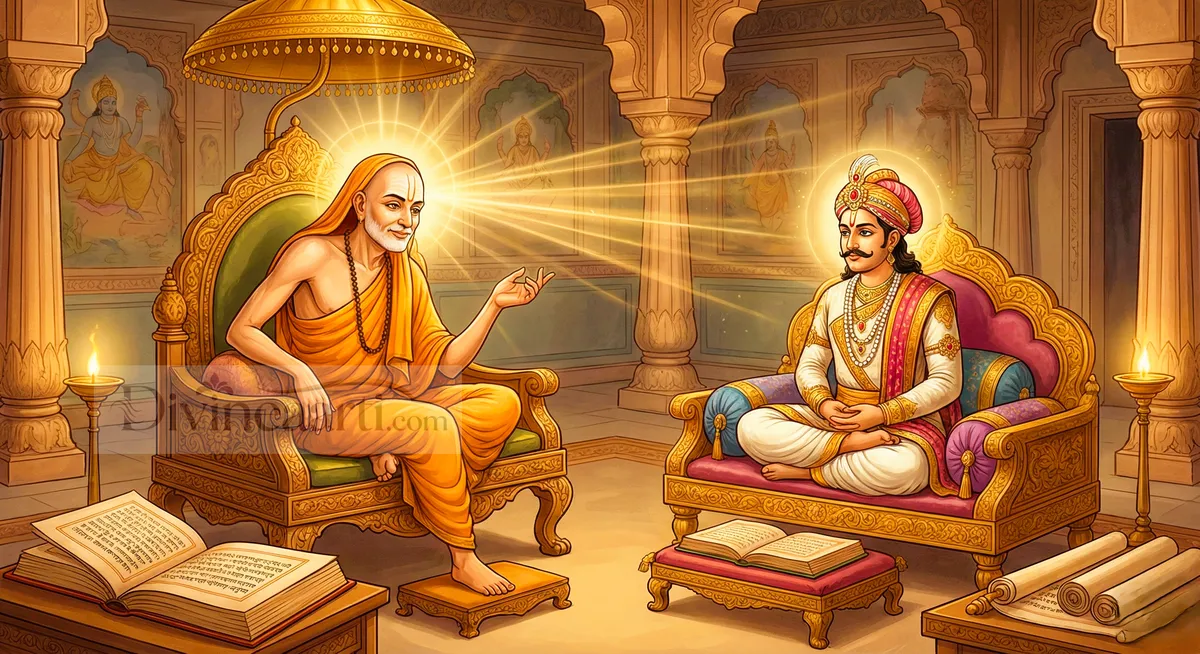
If the Bhagavad Gita is a gentle teacher leading you step by step toward truth, the Ashtavakra Gita is a thunderbolt. It doesn't prescribe practices or paths—it declares that you are already free, and only the illusion of ignorance makes you think otherwise.
This extraordinary text presents a dialogue between the physically deformed but supremely wise sage Ashtavakra and King Janaka of Mithila (the father of Sita from the Ramayana). In just 20 chapters, it delivers the most direct, uncompromising teaching of Advaita Vedanta—pure non-duality.
किंवदन्तीह सत्येयं या मतिः सा गतिर्भवेत्॥
— Ashtavakra Gita 1.11
📜 What You'll Learn in This Guide:
- ✅ Who Ashtavakra was and his remarkable story
- ✅ The core teaching: You are pure awareness
- ✅ Summary of all 20 chapters
- ✅ Key verses with translations
- ✅ How this differs from other scriptures
- ✅ Why this text is considered "advanced"
- ✅ How to approach this teaching
🔤 Pronunciation Guide
Janaka = "JUH-nuh-kuh" (The king)
Advaita = "Ud-VYE-tuh" (Non-duality)
Atman = "AAT-muhn" (The Self)
Sakshi = "SAAK-shee" (Witness)
Chaitanya = "Chai-TUN-yuh" (Pure consciousness)
Mukti = "MUK-tee" (Liberation)
📑 Table of Contents
🕉️ What Is the Ashtavakra Gita?
The Ashtavakra Gita (also called Ashtavakra Samhita) is a classical Sanskrit text of Advaita Vedanta—the philosophy of non-duality. It consists of 298 verses across 20 chapters, presenting a dialogue between the sage Ashtavakra and King Janaka.
📊 Text Details
- Verses: 298 shlokas
- Chapters: 20
- Language: Sanskrit
- Period: Unknown (est. 500 BCE - 500 CE)
- Speakers: Ashtavakra & Janaka
🎯 Central Message
- You are pure awareness
- The world is an appearance
- Liberation is recognizing what you already are
- No practice can make you free—you ARE free
- Bondage is only a thought
📚 Unique Features
- No rituals prescribed
- No gradual path
- No devotional worship
- Direct pointing only
- For "ready" seekers
Unlike other scriptures that offer methods, the Ashtavakra Gita is purely descriptive—it describes the truth of your nature and leaves you to recognize it. There are no instructions because instructions imply you need to become something you're not. The text says: you are already That.
👤 The Story of Sage Ashtavakra
Ashtavakra means "bent in eight places." According to the Mahabharata, his remarkable story reveals how wisdom transcends the body:
📜 The Birth of Ashtavakra
Ashtavakra's father, Kahola, was a great scholar. While his wife Sujata was pregnant, Kahola would recite the Vedas daily. One day, the unborn child spoke from the womb: "Father, you are making mistakes in your recitation!"
Embarrassed and angry, Kahola cursed his son: "You who criticize from the womb—be born bent in eight places!" Thus Ashtavakra was born with severe physical deformities—his body crooked at eight points.
📜 The Debate at Janaka's Court
When Ashtavakra was still a youth, he learned that his father had been defeated in scholarly debate by Bandhi, a court scholar of King Janaka. By the rules of the debate, losers were drowned. Kahola was presumed dead.
Young Ashtavakra journeyed to Janaka's court. When the courtiers laughed at his twisted body, Ashtavakra responded: "I see you are all cobblers—judging leather (skin) rather than the substance within!" Impressed, Janaka allowed him to debate Bandhi.
Ashtavakra defeated the great scholar and demanded his father's release. It was revealed that Bandhi was the son of the ocean god Varuna, and all the "drowned" scholars had been taken to Varuna's realm for a great ceremony. All were released, including Kahola. Father and son were reunited, and Kahola lifted the curse—Ashtavakra's body became straight.
This story powerfully illustrates the text's teaching: the body is not the Self. Ashtavakra's deformed body housed infinite wisdom. Those who saw only the body missed the sage; those who recognized the consciousness within found the truth.
👑 King Janaka's Transformation
Janaka was not an ordinary king. He was called Videha—"beyond the body"—and Rajarshi—a royal sage. Despite ruling a vast kingdom, he lived in perfect detachment. His daughter Sita married Lord Rama.
The Ashtavakra Gita captures Janaka at the moment of his awakening. In Chapter 1, he asks Ashtavakra three questions:
वैराग्यं च कथं प्राप्तमेतद्ब्रूहि मम प्रभो॥
Ashtavakra's response in the first chapter is so powerful that by Chapter 2, Janaka declares his realization. The dialogue then continues as Ashtavakra deepens and stabilizes Janaka's understanding—and Janaka expresses his awakened state.
💎 The Core Teaching
The Ashtavakra Gita's teaching can be summarized in these core points:
The Five Essential Teachings
2️⃣ The world is an appearance in consciousness, like a dream
3️⃣ There is nothing to do—you are already liberated
4️⃣ Bondage exists only as a thought—drop the thought, be free
5️⃣ The enlightened one is neither attached nor detached—just IS
1. You Are Pure Awareness
अविद्यापि न किंचित्सा का बुभुत्सा तथापि ते॥
2. The World Is Appearance
तथैव विश्वमात्मनो न पृथग्भाति तत्त्वतः॥
3. Nothing to Do
अहो मयि स्थितं विश्वं वस्तुतो न मयि स्थितम्॥
4. Bondage Is Only Thought
कृतकृत्योऽपि मूढोऽयं पश्यत्येव करोति च॥
5. Beyond Attachment and Detachment
शीतलाशयसंतुष्टः सदागतमतिर्भव॥
📖 Summary of All 20 Chapters
1 Sakshi — The Witness
Verses: 20 | Speaker: Ashtavakra
Janaka asks his three questions. Ashtavakra responds with the fundamental teaching: You are the witness—not the body, not the mind. Recognize yourself as pure, infinite consciousness. Liberation isn't something to attain; it's recognizing what you already are.
Key verse (1.17): "You are unattached, action-less, self-luminous, without blemish. Bondage is only this: seeing yourself as a doer."
2 Ascharyam — The Marvel
Verses: 25 | Speaker: Janaka
Janaka speaks after hearing Chapter 1. He exclaims in wonder (ascharya—marvel) at his realization: "I am boundless like the ocean! Where can waves of the world arise except in Me?" This is the expression of immediate awakening.
Key verse (2.1): "Oh, I am spotless, peaceful, pure awareness, beyond nature! All this time I have been fooled by illusion."
3 Atma-Advaita — Self in All
Verses: 14 | Speaker: Ashtavakra
Ashtavakra confirms and deepens Janaka's understanding. The Self alone exists everywhere, in all beings. Realize this and be free from sorrow. One who knows the Self has nothing more to do.
4 Sarva-Atma — All Is Self
Verses: 6 | Speaker: Janaka
Janaka expresses his understanding: seeing the Self in all, the wise one never feels "I do this" or "I don't do that." Equanimity arises naturally.
5 Laya — Dissolution
Verses: 4 | Speaker: Ashtavakra
Brief chapter on how the enlightened one is not disturbed by sense objects. Like a pot containing the sky, he knows himself as the infinite space—unaffected by the container.
6 Prakriteh-Parah — Beyond Nature
Verses: 4 | Speaker: Janaka
Janaka declares: "I am infinite like space. The world is a pot (appearing in me). This is knowledge—there is nothing to accept, reject, or dissolve."
7 Shanta — Peace
Verses: 5 | Speaker: Janaka
The boundlessness of awareness. "In me, the limitless ocean, the ship of the universe moves with the wind of its own nature." Complete peace.
8 Moksha — Liberation
Verses: 4 | Speaker: Ashtavakra
Bondage is only the desire for sense pleasures. Liberation is freedom from desire. See the world as illusory and live peacefully.
9 Nirveda — Indifference
Verses: 8 | Speaker: Ashtavakra
Doing or not doing—both belong to the body. You are neither bound by actions nor freed by renunciation. Rest in your natural state.
10 Vairagya — Dispassion
Verses: 8 | Speaker: Ashtavakra
Sensory pleasures breed suffering. Renounce them mentally and be happy. True dispassion arises from knowing yourself as awareness.
11 Chidrupata — Nature as Awareness
Verses: 8 | Speaker: Ashtavakra
All experiences arise in awareness and dissolve in awareness. You are that awareness—unchanging, formless, free.
12 Svabhava — Own Nature
Verses: 8 | Speaker: Janaka
Janaka describes his stabilized state: "Neither attachment nor aversion exists for me. Whatever comes, comes. Whatever goes, goes."
13 Yathashukham — Happiness
Verses: 7 | Speaker: Janaka
True happiness. "Some seek renunciation, some seek enjoyment. Rare is the one who desires nothing and attains supreme peace."
14 Ishvara — The Lord
Verses: 4 | Speaker: Janaka
The wise one sees no difference between emptiness and fullness, good and evil, knowledge and ignorance. He is truly free.
15 Tattvam — The Truth
Verses: 20 | Speaker: Ashtavakra
Describing the rare, free soul. "As one in deep sleep—this is how the sage lives. Like the sky unaffected by clouds."
16 Sva-Sthanam — Abiding in Self
Verses: 11 | Speaker: Ashtavakra
Merely knowing scriptures doesn't liberate. Direct realization does. Know yourself as the witness—not the thinker, not the doer.
17 Kaivalya — Aloneness
Verses: 20 | Speaker: Ashtavakra
The absolute solitude of the Self. "He who has realized this is not touched by karma. He lives free, doing or not doing."
18 Jivanmukti — Living Liberation
Verses: 100 | Speaker: Ashtavakra
The longest chapter, describing the jivanmukta—one liberated while alive. Beyond concepts, beyond qualities, the sage simply IS. Neither seeking nor avoiding.
19 Svamahima — Self-Glory
Verses: 8 | Speaker: Janaka
Janaka's final expression: "I have no teacher, no teaching, no student. Only infinite consciousness remains."
20 Akinchanya — Beyond All
Verses: 14 | Speaker: Janaka
The culmination. "Where is scripture? Where is Self-knowledge? Where is no-mind? For me who abides in the Self, there is nothing at all."
💫 Key Verses Explained
एषां साक्षिणमात्मानं चिद्रूपं विद्धि मुक्तये॥
Commentary: The five elements compose everything physical. By knowing you are the witness of these elements—not the elements themselves—you recognize your true nature as pure consciousness. This single recognition is liberation.
एतावन्तमहं कालं मोहेनैव विडम्बितः॥
Commentary: Janaka's awakening exclamation. The word "Aho!" expresses marvel—suddenly seeing what was always true. Moha (delusion) made him think he was limited; now he sees he was always infinite.
ज्ञानादेव हि कैवल्यं चित्तस्य मन्दधीर-पि॥
Commentary: Actions—done or avoided—don't liberate because actions belong to the body-mind. Liberation is recognizing you are not the body-mind. This recognition (jnana) alone frees.
⚖️ Comparison with Other Texts
| Aspect | Bhagavad Gita | Ashtavakra Gita |
|---|---|---|
| Approach | Gradual, progressive teaching | Direct, immediate pointing |
| Paths Offered | Karma, Bhakti, Jnana, Raja Yoga | Jnana only—direct recognition |
| Practices | Meditation, action, devotion | None prescribed—you're already free |
| Student Level | All levels—especially Arjuna's confusion | Ready seeker—Janaka already prepared |
| Setting | Battlefield—crisis situation | Court—philosophical inquiry |
| Tone | Encouraging, guiding | Stark, uncompromising |
| Action | Act without attachment | You are not the actor |
| World | Real enough to act in | Illusory appearance in consciousness |
🔱 Why Both Texts Are Valid
The Bhagavad Gita and Ashtavakra Gita aren't contradictory—they address students at different stages. Most seekers need practice, guidance, and gradual development (Bhagavad Gita). A rare few are ready for direct recognition (Ashtavakra Gita).
The tradition says: "First live the Gita, then be the Ashtavakra." Yet some may find the direct teaching resonates immediately—for them, Ashtavakra's words cut through lifetimes of seeking.
🧘 How to Approach This Teaching
❌ Not Recommended
- Using it to avoid spiritual practice
- Intellectualizing without direct investigation
- Pretending you understand what you don't
- Using non-dual philosophy to bypass emotions
✅ Recommended
- Read slowly, one verse at a time
- Sit with each teaching, feel its truth
- Let verses work on you over time
- Ask: "Is this pointing true in my experience?"
📚 Study Suggestions
- Prepare with Upanishads/Bhagavad Gita
- Use a good translation with commentary
- Find a teacher if teachings confuse you
- Balance study with silent contemplation
❓ Frequently Asked Questions
If I'm already free, why don't I feel free?
The teaching is that you ARE free—but you don't recognize it because you identify with thoughts, emotions, and the body. The "feeling of bondage" is itself a thought appearing in the free awareness that you are. Look at who is aware of the feeling. That awareness is never bound.
Does this mean I shouldn't do spiritual practices?
The Ashtavakra Gita doesn't prescribe or prohibit practice. It points out that practice can reinforce the sense that "I am not yet free" if you believe practice will make you free. If practice is happening, let it happen. If it stops, let it stop. You are the awareness in which all of this arises.
Is the world real or unreal?
The text says the world is like waves on the ocean. Waves are real as water but not as separate things. Similarly, the world is real as consciousness but not as a separate, independent reality. This isn't saying the world doesn't exist—it's saying it doesn't exist apart from awareness.
How is this different from nihilism?
Nihilism says "nothing matters." Advaita says "what appears matters as appearance—but it isn't fundamentally separate from the One awareness." The sage is not cold or indifferent; they may feel great love and compassion, but without the confusion of separate self. Love flows without a lover separate from the beloved.
What does it mean that "there is no doer"?
Actions happen—this is obvious. But the sense of a separate "I" who does them is an illusion. Look carefully: thoughts arise unbidden, decisions emerge from unknown depths, the body moves by itself. The "doer" is a thought after the fact, claiming ownership. See through this, and freedom dawns.
🙏 Conclusion: The Invitation
The Ashtavakra Gita is not a book to be believed but a mirror to look into. It doesn't ask you to adopt a philosophy; it invites you to see what you already are—before thought, before concept, before "I am this" or "I am that."
Whether you find these teachings immediately liberating or puzzling, they have a way of working on consciousness. Let the words settle. Return to them. Ask: "Who is reading? Who is aware?"
ब्रह्मादिस्तम्बपर्यन्तं जगन्नाशेऽपि तिष्ठतः॥
— Ashtavakra Gita 2.11