
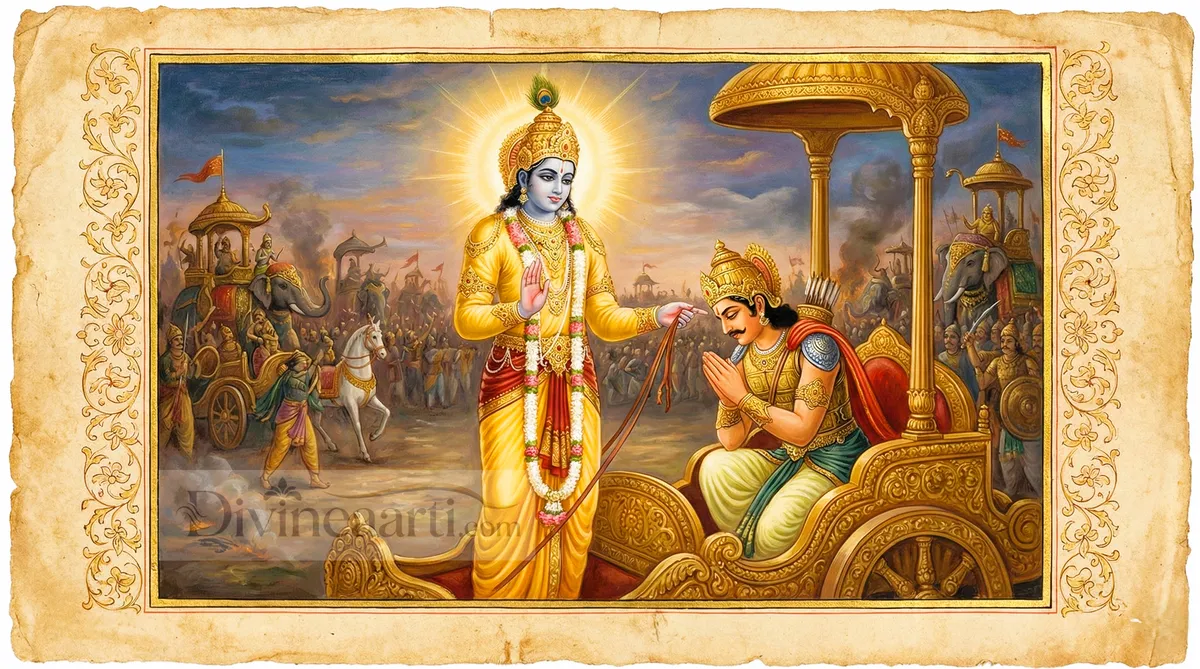
With 100,000 verses spanning 18 books, the Mahabharata is not just the world's longest poem—it is an encyclopedia of dharma (righteousness), containing within it philosophy, law, devotion, statecraft, and the crown jewel of Hindu scripture: the Bhagavad Gita. As the text itself declares: "What is found here may be found elsewhere; what is not found here exists nowhere."
This guide will walk you through the epic composed by Ved Vyasa—the story of cousins divided, kingdoms contested, and a war that reshaped the world. More importantly, you'll discover why this ancient text remains profoundly relevant for navigating life's moral complexities today.
📜 What You'll Learn in This Guide:
- ✅ The complete Mahabharata story (all 18 Parvas summarized)
- ✅ Key characters—Pandavas, Kauravas, and their roles
- ✅ Lord Krishna's divine presence throughout the epic
- ✅ The deeper teachings on dharma and karma
- ✅ Historical and spiritual significance
- ✅ How to study the Mahabharata
🔤 Pronunciation Guide for Key Names
Pandava = "PAAN-duh-vuh" (Sons of Pandu)
Kaurava = "KOW-ruh-vuh" (Descendants of Kuru)
Yudhishthira = "Yoo-DHISH-thi-ruh" (Firm in battle)
Arjuna = "AR-joo-nuh" (Bright, shining)
Bhima = "BHEE-muh" (The terrible/mighty one)
Draupadi = "DROW-puh-dee" (Daughter of Drupada)
Duryodhana = "Door-YOH-dhuh-nuh" (Hard to conquer)
Bhishma = "BHEESH-muh" (The terrible vow-taker)
Kurukshetra = "Koo-roo-KSHE-truh" (Field of the Kurus)
📑 Table of Contents
🕉️ What is the Mahabharata?
The Mahabharata (Sanskrit: महाभारत, "Great Epic of the Bharata Dynasty") is one of the two major Sanskrit epics of ancient India, alongside the Ramayana. Composed by the sage Ved Vyasa, it is classified as Itihasa—meaning "thus it happened," indicating its historical nature in Hindu tradition.
यदिहास्ति तदन्यत्र यन्नेहास्ति न तत्क्वचित्॥"
"Whatever is here regarding dharma, artha, kama, and moksha may be found elsewhere; but what is not here exists nowhere else."
The epic tells the story of a great dynastic war between two groups of cousins—the five Pandavas and the hundred Kauravas—for the throne of Hastinapura. But this war story is merely the framework for exploring every aspect of human existence: politics, ethics, philosophy, devotion, relationships, and ultimately, the nature of dharma itself.
📊 Epic Statistics
- Verses: ~100,000 shlokas
- Books: 18 Parvas
- Chapters: ~2,000
- Words: ~1.8 million
- Length: 10x Iliad + Odyssey
📚 Contains Within It
- Bhagavad Gita (Divine Song)
- Vishnu Sahasranama (1000 Names)
- Anugita (Subsequent Song)
- Sanatsujatiya (Philosophy)
- Countless dharmic narratives
🎯 Central Themes
- Dharma: Righteous duty
- Karma: Action and consequence
- Kshatriya Dharma: Warrior ethics
- Raj Dharma: Kingly duty
- Moksha: Liberation
✍️ Author & Divine Composition
Ved Vyasa: The Divine Compiler
Ved Vyasa (also called Krishna Dvaipayana Vyasa) is one of the most revered figures in Hindu tradition. His name means "compiler of the Vedas"—he organized the one Veda into the four Vedas we know today. He is also the author of the 18 major Puranas and the Brahma Sutras.
Remarkably, Vyasa is also a character within the Mahabharata. He is the biological father of Dhritarashtra and Pandu (through niyoga), making him the grandfather of both the Pandavas and Kauravas. He appears at crucial moments throughout the narrative, offering guidance and boons.
Ganesha as the Scribe
According to tradition, Vyasa needed a scribe who could keep pace with his divine recitation. He approached Lord Ganesha, who agreed on one condition: Vyasa must recite without pause. Vyasa counter-stipulated that Ganesha must fully understand each verse before writing. This allowed Vyasa to compose complex verses that required Ganesha to pause and contemplate, giving the sage time to compose ahead.
🔱 Scriptural Significance
The Mahabharata is considered the fifth Veda (Panchama Veda) because it makes Vedic wisdom accessible to all, regardless of caste or gender. While the four Vedas had restrictions on who could study them, the Mahabharata—as Itihasa—was open to everyone, including women and those outside the brahminical tradition.
👥 Main Characters Guide
The Five Pandavas — Sons of Pandu
Yudhishthira
Born of Yama/Dharma (god of righteousness and death). Known as Dharmaraja. Never speaks untruth. His one lie ("Ashwatthama hathaha") haunts him. Master of spear and governance.
Bhima
Born of Vayu (wind god). Possesses the strength of 10,000 elephants. Wields the mace. Kills all 100 Kauravas in battle. Known for his appetite and fierce loyalty.
Arjuna
Born of Indra (king of gods). Greatest archer of his age. Recipient of the Bhagavad Gita. Won Draupadi. Obtained divine weapons from Shiva (Pashupatastra).
Nakula
Twin of Sahadeva. Most handsome man of his time. Expert swordsman and horse trainer. Known for his self-control and devotion to his elder brothers.
Sahadeva
Twin of Nakula. Wisest of the Pandavas. Possessed knowledge of past, present, and future. Expert in astrology and cattle-rearing. Youngest but deeply insightful.
Key Kaurava Figures — Sons of Dhritarashtra
Duryodhana
Primary antagonist whose jealousy and ambition drive the conflict. Skilled mace fighter. Despite his flaws, died a warrior's death and attained veergati (heroic afterlife).
Dushasana
Infamous for attempting to disrobe Draupadi. Bhima vowed to drink his blood—which he fulfilled in the war. Symbol of unchecked cruelty enabled by power.
Dhritarashtra
Father of 100 Kauravas. Born blind, he was bypassed for the throne. His attachment to his sons blinded him morally. His indulgence enabled Duryodhana's crimes.
Gandhari
Blindfolded herself for life to share her husband's blindness. Mother of 100 sons. Her curse on Krishna—that his Yadava clan would destroy itself—came true 36 years after the war.
Divine & Other Key Characters
Lord Krishna
The Eighth Avatar of Vishnu. Arjuna's charioteer. Delivers the Bhagavad Gita. Orchestrates dharma's victory without lifting weapons (as promised). The true hero of the Mahabharata.
Draupadi
Born from sacred fire. Her humiliation in court becomes the direct cause of the war. Avatar of Goddess Shachi. Symbol of feminine strength, dignity, and devotion to Krishna.
Bhishma
Took a terrible vow of celibacy for his father. Blessed with death at will (iccha mrityu). Greatest warrior, yet fought for the wrong side due to his oath to the throne.
Dronacharya
Teacher of both Pandavas and Kauravas in warfare. His favoritism toward Arjuna created rivalries. Fought for Kauravas despite loving the Pandavas. Killed through a half-truth.
Karna
Eldest Pandava by birth (Kunti's first son), raised as a charioteer's son. Greatest rival of Arjuna. Allied with Duryodhana out of loyalty. Tragic hero who died due to accumulated curses.
Abhimanyu
Learned warfare in his mother's womb. Knew how to enter the Chakravyuha but not exit. His heroic death at 16, fighting alone against great warriors, is one of the epic's most poignant moments.
📖 Complete Story Summary
The Origins: A Divided Dynasty
King Shantanu of Hastinapura married the river goddess Ganga, who bore him Bhishma. Later, Shantanu fell in love with Satyavati, a fisherman's daughter. Her father agreed to the marriage only if her sons would inherit the throne. Bhishma, to fulfill his father's desire, took a terrible vow: he would remain celibate for life and never claim the throne. This vow—Bhishma Pratigya—earned him his name ("the one who took a terrible vow").
Satyavati's sons died young. Through niyoga (an ancient practice of surrogate fatherhood), sage Ved Vyasa fathered three sons with the widows:
- Dhritarashtra — Born blind
- Pandu — Born pale (due to mother's fear during conception)
- Vidura — Born of a maid, became the wisest counselor
Pandu became king (as Dhritarashtra's blindness disqualified him). However, Pandu was cursed to die if he had marital relations. His wives used divine boons to invoke gods, producing the five Pandavas. Meanwhile, Dhritarashtra's wife Gandhari gave birth to 100 sons (the Kauravas) and one daughter.
Growing Rivalry
When Pandu died (the curse was triggered), Dhritarashtra became regent. The Pandavas and Kauravas grew up together, trained by Dronacharya. Arjuna emerged as Drona's favorite and the finest archer. This sparked Duryodhana's intense jealousy.
Duryodhana's envy led to multiple attempts on the Pandavas' lives—most notably the Lakshagriha (house of lac) plot, where he tried to burn them alive. The Pandavas escaped through a secret tunnel, warned by their uncle Vidura.
Draupadi's Swayamvara & Marriage
In hiding, the Pandavas heard of Draupadi's swayamvara (self-choice ceremony). King Drupada had set an impossible archery test. Arjuna, disguised as a brahmin, succeeded. When the brothers returned home and announced they had won a "prize," their mother Kunti—without looking—said, "Share it equally among yourselves." To honor her word, Draupadi became wife to all five brothers.
🔱 Divine Arrangement
According to the Mahabharata itself, Draupadi was destined to marry five husbands due to a boon granted in a previous life. She had prayed to Lord Shiva for a husband with five qualities; Shiva said no single man possessed all five, so she would have five husbands who together embodied them. Each Pandava represented one divine quality.
The Kingdom Divided
Dhritarashtra, to avoid conflict, divided the kingdom. The Pandavas received Khandavaprastha—a barren land. Through their efforts and with Krishna's help, they transformed it into the magnificent Indraprastha. Yudhishthira performed the Rajasuya Yajna, declaring himself emperor.
At the ceremony, Duryodhana fell into a pool (mistaking its crystal floor for water), and Draupadi's maids laughed. Humiliated, Duryodhana's resentment intensified.
The Dice Game: The Great Injustice
Shakuni, Duryodhana's maternal uncle and master gambler, proposed a dice game. Yudhishthira, bound by kshatriya dharma to accept a challenge, agreed. Using loaded dice, Shakuni won everything: the Pandavas' wealth, kingdom, themselves as slaves, and finally Draupadi.
Dushasana dragged Draupadi into the court and attempted to disrobe her. In her desperation, she called upon Lord Krishna, surrendering completely. The Lord protected her honor—her sari became endless. Bhima took terrible vows: to kill all 100 Kauravas and drink Dushasana's blood.
"O Govinda! O Lord of Dwaraka! O Krishna! Protect me!"
This public humiliation of Draupadi—while elders like Bhishma, Drona, and Dhritarashtra remained silent—became the moral turning point. Dhritarashtra, fearing consequences, freed the Pandavas and returned their kingdom. But a second dice game resulted in 12 years of forest exile plus 1 year incognito (agyatavasa).
Exile & Return
During the 13 years, the Pandavas faced numerous trials, gained powerful allies, and acquired divine weapons. Arjuna obtained the Pashupatastra from Lord Shiva himself. In the 13th year, they hid in the kingdom of Virata.
Upon completing exile, the Pandavas requested their kingdom back. Duryodhana refused even five villages—"not even land enough to place a needle." War became inevitable.
Preparations for War
Both sides gathered allies. Lord Krishna offered a choice: his mighty Narayani army on one side, or himself (unarmed, as advisor) on the other. Arjuna chose Krishna; Duryodhana happily took the army—not understanding who Krishna truly was.
Krishna went to Hastinapura as peace envoy, but Duryodhana refused all terms. When Duryodhana tried to capture Krishna, the Lord revealed his Vishvarupa (cosmic form)—terrifying Duryodhana but not changing his decision.
📚 The 18 Parvas (Books)
The Mahabharata is divided into 18 parvas (books). Here is a summary of each:
1 Adi Parva — Book of Beginnings
Chapters: 227 | Focus: Origins and early story
Covers the ancestry of the Bharata dynasty, Bhishma's vow, birth of Pandavas and Kauravas, their education, Draupadi's swayamvara, and the founding of Indraprastha. Contains the famous story of the Khandava forest burning.
2 Sabha Parva — Book of the Assembly
Chapters: 81 | Focus: The dice game tragedy
Yudhishthira's Rajasuya yajna, the magnificent assembly hall, Duryodhana's humiliation, the fateful dice game, and Draupadi's public humiliation. The moral failure of the elders. The exile begins.
3 Vana Parva — Book of the Forest
Chapters: 315 (longest parva) | Focus: Exile adventures
The Pandavas' 12-year forest exile. Contains numerous sub-stories including Nala-Damayanti, Savitri-Satyavan, and Arjuna's pilgrimage to obtain divine weapons. Stories of dharma told to console the Pandavas.
4 Virata Parva — Book of Virata
Chapters: 72 | Focus: Year of incognito exile
The 13th year in disguise at King Virata's court. Arjuna as dance teacher Brihannala, Bhima as cook Ballava, Draupadi as queen's handmaid. Arjuna defeats the Kaurava army single-handedly. The exile ends successfully.
5 Udyoga Parva — Book of Effort
Chapters: 199 | Focus: War preparations
Failed peace negotiations. Krishna's embassy to Hastinapura. Alliance-building by both sides. Contains the Sanatsujatiya—deep philosophical discourse. Both armies assemble at Kurukshetra.
6 Bhishma Parva — Book of Bhishma
Chapters: 122 | Focus: First 10 days of war; contains the BHAGAVAD GITA
The war begins. Bhagavad Gita (chapters 25-42): Krishna's divine teaching to Arjuna. Bhishma's terrifying prowess. On day 10, Arjuna (with Shikhandi as shield) brings Bhishma down. Bhishma lies on a bed of arrows, waiting for auspicious death.
7 Drona Parva — Book of Drona
Chapters: 203 | Focus: Days 11-15
Drona becomes commander. Abhimanyu's heroic death in the Chakravyuha. The deception of "Ashwatthama hathaha" (killed)—when Yudhishthira's half-truth leads Drona to drop his weapons. Drona is killed while meditating.
8 Karna Parva — Book of Karna
Chapters: 96 | Focus: Days 16-17
Karna becomes commander. His tragic backstory revealed. His chariot wheel sinks in mud (a curse fulfilled). Arjuna, guided by Krishna, kills the unarmed Karna. Karna's generosity even in death—he donated his divine armor.
9 Shalya Parva — Book of Shalya
Chapters: 65 | Focus: Day 18
Shalya's brief command and death. Sahadeva kills Shakuni (the gambler who caused the dice game tragedy). Duryodhana flees, hides in a lake. The Pandavas find him, and the final duel is arranged.
10 Sauptika Parva — Book of the Sleeping Warriors
Chapters: 18 | Focus: Night massacre
After Duryodhana's defeat, Ashwatthama (Drona's son) commits the war's greatest atrocity—slaughtering the Pandava camp at night, killing Draupadi's five sons. He launches the Brahmastra at the Pandavas; Krishna protects them. Ashwatthama is cursed to wander eternally.
11 Stri Parva — Book of the Women
Chapters: 27 | Focus: Grief and lament
Women lament their dead. Gandhari curses Krishna that his Yadava clan will destroy itself in 36 years (which comes true). Funeral rites for the fallen. The devastating human cost of war is revealed.
12 Shanti Parva — Book of Peace
Chapters: 365 (second longest) | Focus: Governance and philosophy
Yudhishthira's grief and reluctance to rule. Bhishma, dying on his arrow-bed, teaches him Raj Dharma (kingly duty), Apad Dharma (emergency ethics), and Moksha Dharma (liberation). Contains deep philosophical teachings.
13 Anushasana Parva — Book of Instructions
Chapters: 168 | Focus: Final teachings
Bhishma's continued teachings on dharma, charity, and proper conduct. Contains the Vishnu Sahasranama (Thousand Names of Vishnu). Bhishma finally dies on Uttarayana (winter solstice, auspicious for departure).
14 Ashvamedhika Parva — Book of the Horse Sacrifice
Chapters: 103 | Focus: Ashwamedha Yajna
Yudhishthira performs the Ashwamedha (horse sacrifice) to establish his authority and absolve war sins. Arjuna follows the horse, fighting kings who challenge. Contains the Anugita—Krishna's subsequent teachings.
15 Ashramvasika Parva — Book of the Hermitage
Chapters: 46 | Focus: Retirement of elders
Dhritarashtra, Gandhari, and Kunti retire to the forest. Vidura dies, merging with Yudhishthira (both being aspects of Dharma). The elders die in a forest fire, attaining liberation.
16 Mausala Parva — Book of the Clubs
Chapters: 9 | Focus: Destruction of Yadavas
Thirty-six years after the war, Gandhari's curse manifests. The Yadavas, quarreling, destroy each other with clubs made from a cursed iron pestle. Balarama dies. Krishna, shot by a hunter's arrow, departs for Vaikuntha.
17 Mahaprasthanika Parva — Book of the Great Journey
Chapters: 3 | Focus: Final pilgrimage
The Pandavas renounce the kingdom and walk toward Mount Meru. One by one, Draupadi and the brothers fall—each due to a flaw. Only Yudhishthira and a devoted dog (actually Dharma in disguise) reach the top.
18 Svargarohanika Parva — Book of the Ascent to Heaven
Chapters: 6 | Focus: The final test and liberation
Yudhishthira is tested one last time—told to abandon the dog to enter heaven, he refuses. The dog reveals himself as Dharma. Yudhishthira sees his family in both heaven and hell, learning a final lesson about the illusory nature of both. Ultimately, all attain liberation.
⚔️ The Kurukshetra War: 18 Days That Changed the World
The great war was fought at Kurukshetra (in modern-day Haryana, India) over 18 days. Here is a day-by-day overview:
| Day | Kaurava Commander | Key Events |
|---|---|---|
| 1 | Bhishma | War begins. Arjuna receives the Bhagavad Gita. Uttara (Virata's son) killed. |
| 2-9 | Bhishma | Devastating battles. Bhishma slaughters Pandava forces. Iravan (Arjuna's son) killed. |
| 10 | Bhishma | Bhishma falls. Shikhandi (whom Bhishma won't fight) shields Arjuna. Bhishma lies on arrow-bed. |
| 11-13 | Drona | Drona's fierce attacks. Day 13: Abhimanyu dies heroically in the Chakravyuha. |
| 14 | Drona | Arjuna fulfills vow to kill Jayadratha (who trapped Abhimanyu) by sunset. Krishna hides the sun. |
| 15 | Drona | Drona killed after hearing "Ashwatthama hathaha" (the elephant named Ashwatthama was killed—a half-truth). |
| 16-17 | Karna | Karna's command. Day 17: Karna killed by Arjuna when his chariot wheel sinks. |
| 18 | Shalya | Shalya killed. Shakuni killed by Sahadeva. Duryodhana defeated by Bhima in mace combat. |
Aftermath
The war ended with only 12 major warriors surviving: the five Pandavas, Krishna, Satyaki, and Yuyutsu on the Pandava side; Kritavarma, Ashwatthama, and Kripacharya on the Kaurava side. An estimated 4 million soldiers died (as per the text's numbers).
🙏 Lord Krishna's Divine Role
While the Pandavas are the nominal heroes, Lord Krishna is the true protagonist of the Mahabharata. His role reveals the nature of divine intervention in human affairs.
Key Interventions
- Saving Draupadi: When she surrendered completely, Krishna provided the infinite sari
- The Bhagavad Gita: Transforming Arjuna from despair to clarity
- Strategic Guidance: Advising the Pandavas on every crucial decision
- Vishvarupa: Revealing his cosmic form to Arjuna and later in Duryodhana's court
- Hiding the Sun: Allowing Arjuna to fulfill his vow to kill Jayadratha
- Protecting from Brahmastra: Saving the Pandavas from Ashwatthama's weapon
- Accepting Gandhari's Curse: Taking upon himself the destruction of his own clan
धर्मसंस्थापनार्थाय सम्भवामि युगे युगे॥"
"For the protection of the good, for the destruction of the wicked, and for the establishment of dharma, I manifest in every age."
Why Didn't Krishna Fight?
Before the war, Krishna promised not to lift weapons. This wasn't a limitation but a teaching: Dharma must be established by humans, not imposed by God. Krishna provided guidance, removed obstacles, but the Pandavas had to fight their own battles. This is the model of divine grace—God helps those who help themselves.
📿 Key Dharmic Teachings
⚖️ Dharma is Subtle
The Mahabharata repeatedly shows that dharma isn't simple rule-following. Yudhishthira lies once; Arjuna kills an unarmed Karna; Bhima strikes below the belt. Context matters. Even the righteous face impossible choices.
🔄 Karma is Inescapable
Every action has consequences. Karna's accumulated curses caught up with him. Gandhari's curse destroyed Krishna's clan. Ashwatthama's atrocity earned him eternal suffering. Nothing is forgotten.
🙏 Surrender to the Divine
Draupadi's surrender saved her honor. Arjuna's surrender to Krishna brought victory. The Mahabharata teaches that human effort combined with divine grace achieves the impossible.
👥 Silence is Complicity
Bhishma, Drona, and others remained silent during Draupadi's humiliation. Their inaction made them complicit. The Mahabharata condemns those who witness injustice and do nothing.
💔 War Has No Winners
The Pandavas won, but lost their sons, their youth, their innocence. Victory brought only grief. The Mahabharata is ultimately anti-war—showing its devastating cost.
🌟 Truth Ultimately Prevails
Despite the Kauravas' political power, military strength, and cunning, they lost. "Yato dharma tato jaya"—where there is dharma, there is victory. Righteousness may suffer temporarily but prevails eternally.
📖 Famous Sub-Stories (Upakhyanas)
The Mahabharata contains numerous sub-stories told to illustrate dharmic principles:
💑 Nala and Damayanti
A king loses everything in a dice game, is separated from his wife, but ultimately reunites through her devotion. Told to console Yudhishthira in exile.
🙏 Savitri and Satyavan
Savitri's devotion defeats Yama (Death) himself, winning back her husband's life. A tale of wifely devotion and determination.
🦅 Yaksha Prashna
A Yaksha (spirit) asks philosophical questions; those who answer wrongly die. Only Yudhishthira answers correctly, showing wisdom over strength.
🪷 Shakuntala
King Dushyanta marries Shakuntala in the forest, forgets her due to a curse, but later recognizes his son Bharata—ancestor of the Bharata dynasty.
👑 Harishchandra
A king gives up everything to keep his word, even selling his wife and son. His integrity is finally rewarded by the gods.
🐦 Yayati's Tale
King Yayati borrows his son's youth to enjoy pleasures, learns that desire only grows with indulgence, and finally renounces.
🔍 Historical Evidence
Hindu tradition treats the Mahabharata as Itihasa—actual history. Various studies have examined its historicity:
Astronomical Dating
The Mahabharata contains detailed astronomical references. Scholars have used these to propose dates:
- 3139 BCE — Traditional date based on the beginning of Kali Yuga
- 3067 BCE — Based on planetary positions at war's start
- 1793-1443 BCE — Based on other astronomical references
Archaeological Sites
- Hastinapura: Excavated by B.B. Lal (Archaeological Survey of India). Showed habitation from ~1100 BCE and evidence of flooding (mentioned in the text).
- Kurukshetra: Iron arrowheads and other artifacts found.
- Dwarka: Underwater archaeology has found structural remains off the Gujarat coast.
Textual References
The Mahabharata is referenced in numerous later texts, inscriptions, and Greek accounts (Megasthenes mentions Heracles=Krishna and Dionysus=Indra). The Arthashastra (c. 300 BCE) references Mahabharata incidents.
📖 How to Study the Mahabharata
Recommended Approach for Beginners
1. Start with a Good Retelling
- C. Rajagopalachari's "Mahabharata" — Classic, accessible summary
- Ramesh Menon's "The Mahabharata" — Beautiful prose, two-volume set
- Bibek Debroy's Translation — Complete, scholarly, 10 volumes
- Kamala Subramaniam's "Mahabharata" — Devotional retelling
2. Reading Strategy
- First: Read a complete summary to understand the full story
- Then: Study the Bhagavad Gita deeply
- Next: Read Shanti Parva and Anushasana Parva for philosophical teachings
- Finally: Explore the complete text parva by parva
3. Supplementary Resources
- B.R. Chopra's TV serial "Mahabharat" (1988-90) — Faithful adaptation
- Amar Chitra Katha comics — Great for visual learning
- Gita Press translations — Authentic and affordable
❓ Frequently Asked Questions
Why did Bhishma, Drona, and other good people fight for the Kauravas?
They were bound by different obligations. Bhishma had sworn loyalty to the throne of Hastinapura (not a particular king). Drona was indebted to Duryodhana for resources. Karna was bound by friendship and gratitude. The Mahabharata shows how even good people can end up on the wrong side due to misplaced loyalties—a warning about the complexity of dharma.
Why did Krishna allow the war to happen?
Krishna tried peace first—his embassy to Hastinapura was a genuine attempt. Duryodhana refused all reasonable terms. War became necessary because adharma (Duryodhana's tyranny) had to be stopped. Non-violence in the face of such injustice would itself be adharma. Sometimes, protecting dharma requires destruction of its violators.
What happened to the Pandavas after the war?
Yudhishthira ruled for 36 years, then renounced. All five brothers and Draupadi walked toward Mount Meru. Each fell on the journey due to subtle flaws. Only Yudhishthira reached the summit with his physical body. After a final test, all were reunited in heaven and eventually attained moksha (liberation).
How is the Mahabharata different from the Ramayana?
The Ramayana presents ideal conduct—Rama is the "maryada purushottam" (ideal man). The Mahabharata is more complex—even heroes have flaws; even villains have virtues. The Ramayana shows how to live; the Mahabharata shows how complex living actually is. Together, they offer complementary wisdom.
Why is Draupadi married to five husbands?
This was divinely ordained due to a boon in her previous life. She had asked Lord Shiva for a husband with five ideal qualities; Shiva said no one man possessed all five, so she would have five husbands embodying them: Yudhishthira (dharma), Bhima (strength), Arjuna (skill), Nakula (beauty), and Sahadeva (wisdom). Kunti's inadvertent instruction simply fulfilled the divine plan.
Is Karna a hero or villain?
Karna is the Mahabharata's most tragic figure—a hero on the wrong side. He was the greatest giver (donating even his armor), a loyal friend, and a warrior equal to Arjuna. Yet his choice to ally with Duryodhana, his humiliation of Draupadi, and his role in Abhimanyu's death make him complicit in adharma. He represents how virtue and vice can coexist in the same person.
🙏 Conclusion: The Eternal Relevance of the Mahabharata
The Mahabharata is more than ancient history—it is a mirror reflecting our own times. Family conflicts, political corruption, the tension between personal desire and social duty, the question of when to fight and when to compromise—these issues remain as relevant today as they were 5,000 years ago.
As Ved Vyasa himself declared:
Study the Mahabharata not as a story of the past but as a guide for the present. In its vast expanse, you will find wisdom for every situation, answers to every question, and ultimately, the path to liberation itself.