
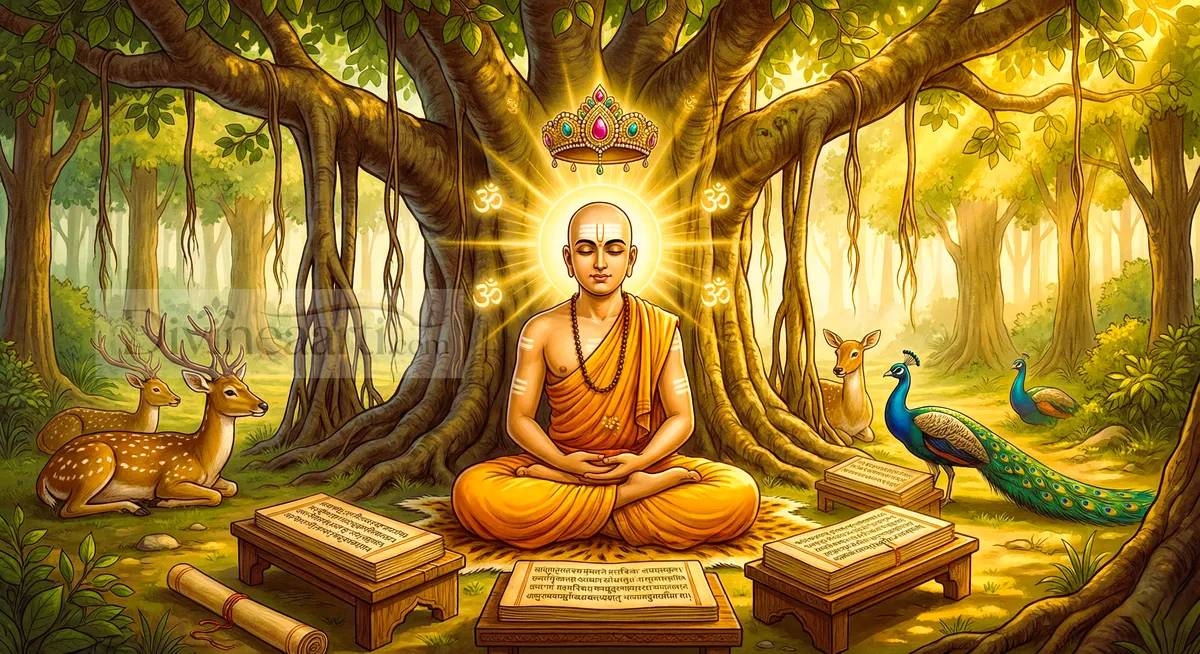
The Viveka Chudamani (विवेकचूडामणि) is a crown jewel among spiritual texts. Written by Adi Shankaracharya—the great philosopher-saint who revived Vedanta in the 8th century—this poem of 580 verses is a complete manual for moksha (liberation). It teaches the seeker how to distinguish the eternal Self from the temporary world and realize the ultimate truth: You are Brahman.
The title itself reveals the teaching: Viveka means discrimination or discernment, Chudamani means crest-jewel (the gem worn on the crown of the head). Just as the crest-jewel is the most precious ornament, discrimination between the Real and unreal is the most precious quality for spiritual liberation.
— The essential teaching of Advaita Vedanta
📜 What You'll Learn in This Guide:
- ✅ What is Viveka Chudamani and who was Adi Shankaracharya
- ✅ The four qualifications for spiritual seeking
- ✅ The five sheaths (Pancha Koshas) covering the Self
- ✅ The nature of bondage and liberation
- ✅ Key verses with translations
- ✅ The stages from seeker to realized being
- ✅ How to approach this text practically
🔤 Pronunciation Guide
Chudamani = "Choo-DAA-muh-nee" (Crest-jewel)
Shankaracharya = "Shun-kuh-RAACH-aar-yuh" (Teacher Shankara)
Brahman = "BRUH-mun" (Ultimate Reality)
Atman = "AAT-mun" (The Self)
Moksha = "MOHK-shuh" (Liberation)
Vairagya = "Vai-RAAG-yuh" (Dispassion)
📑 Table of Contents
🙏 Adi Shankaracharya: The Author
Adi Shankaracharya (788-820 CE) is one of the most influential philosophers in Hindu history. Born in Kerala, South India, he is said to have shown extraordinary spiritual wisdom from childhood. He took sannyasa (renunciation) at age eight and, by age 32, had:
📚 Commentaries
- Brahma Sutra Bhashya
- Commentaries on major Upanishads
- Bhagavad Gita Bhashya
- Established Advaita Vedanta
🛕 Institutions
- Four Mathas (monasteries)
- Sringeri, Dwarka, Puri, Joshimath
- Ten orders of Sannyasa
- Temple restoration across India
📖 Original Works
- Viveka Chudamani
- Atma Bodha (Self-Knowledge)
- Upadesa Sahasri
- Many devotional hymns
Shankara revived the Advaita Vedanta philosophy—the non-dual understanding that the individual self (Atman) and the ultimate reality (Brahman) are one. Though he lived only 32 years, his influence continues to shape Hindu philosophy.
📖 Structure of the Text
The Viveka Chudamani consists of 580 verses in a flowing dialogue format:
🎭 The Dialogue
A sincere seeker, bound by worldly suffering, approaches a realized master and asks: "I am bound—how can I become free?" The guru systematically teaches him the nature of bondage, the Self, and liberation. By the end, the seeker realizes his true nature and exclaims his freedom.
The text can be divided into major sections:
- Verses 1-71: The qualifications for seeking (Sadhana Chatushtaya)
- Verses 72-120: The seeker's question and the nature of bondage
- Verses 121-200: Analysis of the five sheaths (Pancha Kosha)
- Verses 201-350: The nature of the Self and Brahman
- Verses 351-450: The cause and cure of ignorance
- Verses 451-520: The liberated being (Jivanmukta)
- Verses 521-580: Final teachings and the disciple's realization
🎯 The Four Qualifications (Sadhana Chatushtaya)
Shankara begins by describing who is qualified for this knowledge. Not everyone is ready for Vedantic inquiry—certain inner preparations are needed:
1️⃣ Viveka (विवेक)
Discrimination
The ability to distinguish between:
- Eternal (nitya) and temporary (anitya)
- Self (Atman) and non-Self (anatman)
- Reality and appearance
2️⃣ Vairagya (वैराग्य)
Dispassion
Turning away from:
- Sense pleasures
- Desire for heavenly rewards
- Worldly accomplishments
3️⃣ Shat-Sampat (षट्सम्पत्)
Six Virtues
- Shama: Mind control
- Dama: Sense control
- Uparati: Withdrawal
- Titiksha: Endurance
- Shraddha: Faith in scriptures/guru
- Samadhana: One-pointedness
4️⃣ Mumukshutva (मुमुक्षुत्व)
Burning Desire for Liberation
An intense longing for moksha that:
- Overrides all other desires
- Drives consistent seeking
- Enables sacrifice for truth
मनुष्यत्वं मुमुक्षुत्वं महापुरुषसंश्रयः॥
manuṣyatvaṃ mumukṣutvaṃ mahāpuruṣasaṃśrayaḥ ||
👨🏫 The Seeker Meets the Guru
The seeker approaches a realized master with this heart-wrenching appeal:
जाने न किञ्चित्कृपयाव मां प्रभो संसारदुःखक्षतिमातनुष्व॥
The guru responds with compassion, assuring the seeker that liberation is possible. The teaching that follows is a systematic unfolding of Self-knowledge.
🔑 The Guru's First Teaching
"You are already free. Bondage is an illusion caused by ignorance of your true nature. You are not the body, not the mind, not the intellect—you are the eternal, unchanging Witness-Consciousness. The path is to remove ignorance, not to gain something new."
🧅 The Five Sheaths (Pancha Kosha)
The guru teaches that the Self is hidden beneath five layers or "sheaths" (koshas), like an onion has layers. Each must be understood and transcended:
1. Annamaya Kosha (अन्नमयकोश) — Food Sheath
What it is: The physical body, made from food and returning to food.
Why it's not the Self: The body changes constantly (from birth to death), can be observed by you, and depends on external factors. The Self must be unchanging and independent.
"This gross body, produced by the mingling of the parents' elements, composed of food, is but an instrument of experience."
2. Pranamaya Kosha (प्राणमयकोश) — Vital Air Sheath
What it is: The life force (prana) that animates the body—breathing, digestion, circulation.
Why it's not the Self: It fluctuates (we breathe differently in different states), it can be observed, and it ceases in deep sleep yet we continue to exist.
3. Manomaya Kosha (मनोमयकोश) — Mental Sheath
What it is: The mind with its thoughts, emotions, desires, and doubts.
Why it's not the Self: The mind changes every moment, can be observed by a deeper "you" watching thoughts, and disappears in deep sleep. It's an object, not the subject.
4. Vijnanamaya Kosha (विज्ञानमयकोश) — Intellect Sheath
What it is: The discriminating intellect (buddhi)—the capacity for judgment, decision, and understanding.
Why it's not the Self: Though subtler, the intellect also changes (opinions shift, understanding deepens). It too is observed and absent in dreamless sleep.
5. Anandamaya Kosha (आनन्दमयकोश) — Bliss Sheath
What it is: The experience of happiness and peace, especially in deep sleep or moments of fulfilled desire.
Why it's not the Self: This bliss is conditional—it comes and goes, is stronger or weaker. The Self is unconditional, changeless bliss that doesn't fluctuate.
🔮 The Teaching
Behind all five sheaths is the Atman—pure Consciousness that illumines all these layers but is itself untouched by them. Just as a lamp lights up objects but doesn't become the objects, the Self illumines body, prana, mind, intellect, and bliss but remains ever-pure.
✨ The Nature of the Self (Atman)
Having negated what the Self is not, Shankara describes what the Self is:
🔮 Sat (Existence)
The Self simply is—pure existence that cannot not-be. All things exist in it and by it. While bodies and minds come and go, the Self that knows them remains.
🔮 Chit (Consciousness)
The Self is pure awareness—not aware of something, but awareness itself. It is the light by which all experiences are known, the witness of all states.
🔮 Ananda (Bliss)
The Self is unconditional fullness—not happiness caused by objects, but the source of all peace. When desires cease, this inherent bliss shines.
⛓️ The Cause of Bondage
If we are already the free, eternal Self, why do we experience suffering and limitation? Shankara explains:
Avidya (Ignorance)
Beginningless ignorance of our true nature. We don't know we are the Self.
Adhyasa (Superimposition)
Due to ignorance, we superimpose the properties of non-Self (body, mind) onto the Self.
Ahankara (Ego)
"I am this body, I am this mind"—the false identification that creates the bound individual.
अपवादो जगन्मिथ्या ब्रह्म सत्यं निरूपितम्॥
🔗 The Snake and Rope Analogy
A classic Vedantic example: In dim light, you see a rope and mistake it for a snake. Fear arises, you suffer—yet there never was a snake. When light comes, the "snake" disappears; only the rope remains. Similarly, in the light of knowledge, the bondage caused by ignorance is seen to have never existed.
You don't destroy the snake—you realize it never was. Liberation is not achieving something new but recognizing what has always been true.
🌅 The Path to Liberation
Shankara prescribes a three-fold path for removing ignorance:
1. Shravana (श्रवण)
Hearing the Teaching
Listening to the scriptures and guru's explanations. Not casual hearing, but attentive listening that creates the first understanding of "I am Brahman."
2. Manana (मनन)
Reflection
Intellectually examining the teaching, resolving doubts, seeing how it applies. The teaching must become logically convincing to the seeker.
3. Nididhyasana (निदिध्यासन)
Deep Meditation
Continuous contemplation until the knowledge becomes direct experience. The teaching moves from intellectual understanding to lived reality.
The Four Mahavakyas
The teaching culminates in the great statements (Mahavakyas) from the Upanishads that declare the identity of Self and Brahman:
प्रज्ञानं ब्रह्म
Prajnanam Brahma
"Consciousness is Brahman"
— Aitareya Upanishad
अहं ब्रह्मास्मि
Aham Brahmasmi
"I am Brahman"
— Brihadaranyaka Upanishad
तत् त्वम् असि
Tat Tvam Asi
"You are That"
— Chandogya Upanishad
अयम् आत्मा ब्रह्म
Ayam Atma Brahma
"This Self is Brahman"
— Mandukya Upanishad
👤 The Liberated One (Jivanmukta)
One who realizes the Self while still living is called a Jivanmukta—liberated while alive. Shankara describes such a being:
Characteristics of a Jivanmukta:
🧘 Inner State
- Permanently established in Self-knowledge
- Free from identification with body-mind
- Experiences unchanging peace
- No longer bound by karma
🌍 Outer Appearance
- May appear ordinary
- Body continues by residual karma
- Acts without doership
- Compassionate to all beings
🔮 Relationship to World
- Sees Brahman everywhere
- Not affected by praise or blame
- Equal in pleasure and pain
- Lives spontaneously, naturally
📜 Key Verses from Viveka Chudamani
स्थूलं प्राणैः सह इन्द्रियैश्च॥
चरत्यत्र न गच्छन्तु साधवो ये मुमुक्षवः॥
अनन्तं सर्वगं नित्यं ब्रह्म तत्त्वमसि स्वयम्॥
नित्यशुद्धविमुक्तैकमखण्डानन्दमद्वयम्॥
📚 How to Study This Text
📖 Recommended Approach
- Study with a qualified teacher if possible
- Use a good commentary translation
- Read slowly—a few verses per sitting
- Contemplate each teaching before moving on
- Keep a journal of insights and questions
📚 Recommended Commentaries
- Swami Chinmayananda's commentary
- Swami Paramarthananda's lectures
- Swami Ranganathananda's exposition
- Swami Dayananda Saraswati's teachings
🧘 Complementary Practices
- Regular meditation
- Study of Upanishads (especially Mandukya)
- Self-inquiry (Atma Vichara)
- Ethical living (reduces mental agitation)
⚠️ Common Misunderstandings
- "The world is an illusion to be rejected" — No, the world is not false in itself; the error is taking it to be ultimate reality and source of happiness.
- "Just saying 'I am Brahman' is enough" — Intellectual understanding must mature into direct realization through sustained inquiry.
- "This path is only for renunciates" — While renunciation helps, sincere householders can pursue this knowledge with proper guidance.
❓ Frequently Asked Questions
What's the difference between Viveka Chudamani and Bhagavad Gita?
The Bhagavad Gita teaches multiple paths (karma, bhakti, jnana yoga) for different temperaments and situations (war context). Viveka Chudamani focuses exclusively on jnana yoga—the path of knowledge—for those ready to pursue direct Self-realization. It's more systematic and technical in its Vedantic analysis.
How is this different from Ashtavakra Gita?
Both teach Advaita. The Ashtavakra Gita is more radical and direct—for those who can immediately "get it." Viveka Chudamani is more systematic and gradual—it addresses doubts, provides multiple analyses, and leads the student step by step. It's often recommended as a more accessible introduction to Advaita.
Do I need to renounce the world?
Not necessarily. What must be renounced is attachment to the world and identification with the body-mind. Many have realized the Self while living ordinary lives. However, inner renunciation (vairagya) is essential—the understanding that worldly objects cannot provide lasting fulfillment.
What if I don't understand everything?
That's normal! These teachings operate on multiple levels. On first reading, grasp what you can. With repeated study and reflection, deeper layers reveal themselves. A qualified teacher can resolve doubts. Even partial understanding purifies the mind and prepares it for fuller realization.
Is devotion (bhakti) compatible with this path?
Absolutely. Shankara himself composed beautiful devotional hymns. In Advaita, devotion culminates in realizing that the beloved God is none other than your own Self. "Bhakti is para-jnana"—devotion is supreme knowledge. The love that flows toward God is the same consciousness recognizing itself.
🙏 Conclusion: The Crown Jewel
The Viveka Chudamani is called a "crest-jewel" because discrimination between Real and unreal is the highest ornament a human being can possess. Without this discrimination, we mistake the temporary for permanent, the painful for pleasant, the non-Self for Self—and suffer accordingly.
With this discrimination, we cut through layer after layer of false identification until we stand naked as pure Consciousness—ever-free, ever-blissful, ever-full. This is not a distant goal but our present reality, veiled only by ignorance.
ब्रह्माहमस्मि निश्चित्य मुच्यते भवबन्धनात्॥
— Viveka Chudamani (closing teaching)
📤 Share This Guide
Help others discover the crest-jewel of discrimination.