
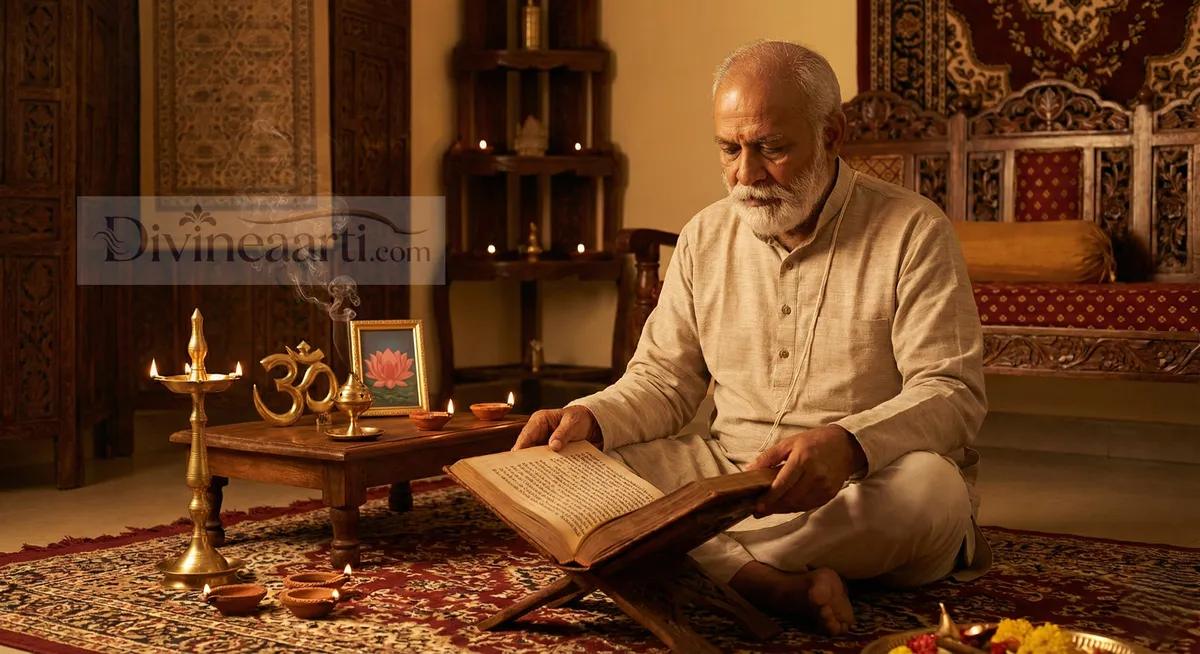
Hindu scriptures form the largest body of religious literature in the world—spanning thousands of years, millions of verses, and covering everything from cosmology to cooking. For a beginner, this vast ocean can seem overwhelming. Where do I start? What should I read first? How do I understand texts written thousands of years ago?
This guide will help you navigate the sacred literature of Sanatan Dharma (Hinduism). Whether you're completely new or have some background, you'll learn the categories of texts, the recommended order for beginners, and practical tips for getting the most from your reading.
📜 What You'll Learn:
- ✅ The two main categories: Shruti and Smriti
- ✅ The major texts in each category
- ✅ Recommended reading order for beginners
- ✅ Different paths based on your interests
- ✅ Tips for understanding ancient wisdom
- ✅ Common mistakes to avoid
- ✅ Best translations and commentaries
📑 Table of Contents
🌐 The Big Picture
Hindu scriptures are traditionally divided into two main categories based on their origin and authority:
📖 Shruti (श्रुति)
"That which is heard"
Divine revelation received by ancient sages (rishis) in deep meditation. These are considered eternal truths, not composed by humans.
Includes: Vedas and Upanishads
Authority: Highest—all other texts must align with Shruti
📚 Smriti (स्मृति)
"That which is remembered"
Texts composed by sages to elaborate, explain, and apply Shruti teachings for different times and audiences.
Includes: Epics, Puranas, Dharma Shastras, Agamas
Authority: High, but secondary to Shruti
🔑 Key Insight
Think of Shruti as the constitution and Smriti as the laws and interpretations. The constitution (Shruti) provides the fundamental principles; the laws (Smriti) apply those principles to practical situations. If there's ever a conflict, Shruti takes precedence.
🕉️ Shruti: The Revealed Texts
📖 The Four Vedas
The Vedas are the oldest Hindu scriptures, composed between 1500-500 BCE. Each Veda has four parts:
| Veda | Primary Focus | Contents |
|---|---|---|
| Rig Veda | Hymns & Praise | 1,028 hymns to the gods (Agni, Indra, Varuna, etc.) |
| Sama Veda | Melodies & Chanting | Musical arrangements of Rig Vedic verses |
| Yajur Veda | Rituals & Procedures | Prose formulas for yajna (ritual sacrifice) |
| Atharva Veda | Practical Life | Hymns for healing, protection, daily life |
Each Veda has four layers:
- Samhita — The core hymns and mantras
- Brahmana — Ritual explanations and procedures
- Aranyaka — Forest texts for spiritual seekers
- Upanishad — Philosophical teachings on ultimate reality
🧘 The Upanishads
The Upanishads (also called Vedanta—"end of the Vedas") are the philosophical heart of Hindu thought. There are over 200 Upanishads, but 10-13 are considered principal:
Isha
Shortest, complete teaching
Kena
What powers the senses?
Katha
Nachiketa & Death (Yama)
Prashna
Six questions on reality
Mundaka
Higher vs. lower knowledge
Mandukya
AUM and consciousness states
Taittiriya
Five sheaths of the self
Aitareya
Creation and the Self
Chandogya
"Tat Tvam Asi" teaching
Brihadaranyaka
Longest, most comprehensive
Central Teaching: The individual self (Atman) and the ultimate reality (Brahman) are one. Liberation comes from realizing this truth.
📚 Smriti: The Remembered Texts
⚔️ The Itihasas (Epics)
The two great epics that every Hindu knows:
Ramayana Beginner-Friendly
Author: Sage Valmiki
Verses: ~24,000
Theme: The ideal life—dharma in action through Lord Rama's story
Best For: Understanding righteousness, family duties, devotion
Mahabharata Longer Journey
Author: Sage Vyasa
Verses: ~100,000 (world's longest epic)
Theme: Dharma in complex situations; contains the Bhagavad Gita
Best For: Understanding moral complexity, politics, philosophy
🌺 The Puranas
Encyclopedic texts on cosmology, genealogies, and devotional practices. There are 18 Maha Puranas (great Puranas) and many Upa Puranas (minor Puranas).
| Category | Deity | Major Puranas |
|---|---|---|
| Sattvic | Vishnu | Vishnu, Bhagavata, Narada, Garuda, Padma, Varaha |
| Rajasic | Brahma | Brahma, Brahmanda, Brahma Vaivarta, Markandeya, Bhavishya, Vamana |
| Tamasic | Shiva | Shiva, Linga, Skanda, Agni, Matsya, Kurma |
Note: The "Sattvic/Rajasic/Tamasic" classification is traditional but shouldn't be taken as hierarchy—all Puranas are sacred. The Bhagavata Purana is often considered the supreme among Puranas.
📜 The Dharma Shastras
Texts on law, ethics, and social conduct:
- Manu Smriti — Laws of Manu (controversial, context-dependent)
- Yajnavalkya Smriti — More practical, widely used in dharma
- Narada Smriti — Focus on legal procedures
- Parashara Smriti — Laws for the Kali Yuga
Important: These texts describe the law for specific times and places. Hindu tradition allows for adaptation to changing circumstances. They are studied historically but not applied literally today.
📖 Other Important Texts
🎵 Bhagavad Gita
Location: Within the Mahabharata
Verses: 700
Called the "Song of God," this dialogue between Krishna and Arjuna summarizes the essence of all scriptures. The single most important text for beginners.
🧘 Yoga Sutras
Author: Patanjali
Sutras: 196
The foundational text on yoga philosophy and practice. Describes the eight limbs of yoga and the path to samadhi.
🛕 Agamas & Tantras
Focus: Temple worship, mantras, rituals
Practical manuals for Hindu worship. Shaiva, Vaishnava, and Shakta traditions each have their own Agamas.
🌟 Brahma Sutras
Author: Badarayana (Vyasa)
Sutras: 555
Systematic summary of Upanishadic philosophy. Technical and requires commentary—not for beginners.
📿 Stotras & Stutis
Focus: Devotional hymns
Beautiful poems praising various deities. Works by Adi Shankaracharya, Tulsidas, Mirabai, and others. Great for devotional practice.
📜 Prakarana Granthas
Focus: Introductory texts
Simpler treatises for students. Examples: Tattva Bodha, Atma Bodha, Viveka Chudamani by Shankaracharya.
🚀 Where to Start: The Recommended Order
🎯 The Universal Starting Point
For almost everyone, regardless of background or interest, start with the Bhagavad Gita. It's called the "scripture of scriptures" because it synthesizes the essence of all Hindu thought—karma yoga, bhakti yoga, jnana yoga, and more—in an accessible format.
📚 Recommended Progression for Beginners:
- Bhagavad Gita — Foundation of Hindu philosophy (start here)
- Ramayana — The ideal life and dharma in action (accessible storytelling)
- Select Upanishads — Katha, Isha, Kena (shorter, profound)
- Bhagavata Purana — Stories of Krishna, devotional path (Book 10 especially)
- Mahabharata — Complex dharma, includes Gita context (can read summaries first)
- Yoga Sutras — If interested in meditation and yoga philosophy
- Deeper Upanishads — Chandogya, Brihadaranyaka, Mandukya
- Vedantic Texts — Viveka Chudamani, Ashtavakra Gita, Brahma Sutras
💡 Pro Tip
You don't need to finish one text completely before moving to another. It's okay to read the Gita, then enjoy Ramayana, then return to Gita with fresh eyes. Each reading reveals new layers.
🛤️ Reading Paths Based on Your Interest
❤️ Devotion (Bhakti) Path
If you're drawn to love of God, worship, and emotional connection:
- Bhagavad Gita (Chapters 9, 12, 18)
- Bhagavata Purana (especially Book 10)
- Ramayana (Tulsidas' Ramcharitmanas)
- Narada Bhakti Sutras
- Devotional poetry (Mirabai, Tulsidas, Surdas)
🧠 Knowledge (Jnana) Path
If you're drawn to philosophy, inquiry, and understanding ultimate reality:
- Bhagavad Gita (Chapters 2, 13, 15)
- Katha, Mundaka, Mandukya Upanishads
- Viveka Chudamani
- Ashtavakra Gita
- Brahma Sutras with commentary
⚡ Action (Karma) Path
If you're interested in ethics, duty, and living well in the world:
- Bhagavad Gita (Chapters 2, 3, 5, 18)
- Ramayana (Valmiki's version)
- Mahabharata (especially Shanti Parva)
- Vidura Niti (political wisdom)
- Kautilya's Arthashastra (statecraft)
🧘 Yoga & Meditation Path
If you're interested in practice, meditation, and inner transformation:
- Bhagavad Gita (Chapter 6)
- Yoga Sutras of Patanjali
- Hatha Yoga Pradipika
- Mandukya Upanishad with Karika
- Vijnana Bhairava (112 meditation techniques)
🌺 Shakti/Devi Path
If you're drawn to the Divine Feminine and Shakti worship:
- Devi Mahatmya (Durga Saptashati)
- Devi Bhagavata Purana
- Lalita Sahasranama
- Soundarya Lahari (Shankaracharya)
- Shakta Upanishads
🔱 Shiva Path
If you're drawn to Lord Shiva and Shaiva philosophy:
- Shiva Purana
- Linga Purana
- Shiva Sutras
- Spanda Karikas
- Pratyabhijna Hridayam
🎓 How to Approach the Texts
✅ DO
- Read with an open, receptive mind
- Use a good translation with commentary
- Read slowly, reflect on each teaching
- Learn key Sanskrit terms
- Find a teacher or study group if possible
- Apply teachings to your life
- Re-read texts—they reveal more each time
❌ DON'T
- Rush through for completion
- Take everything literally without context
- Ignore cultural and historical background
- Pick and choose to prove a predetermined view
- Get stuck on confusing passages—move on and return
- Treat it as merely academic study
- Rely on poor translations or secondary summaries only
💭 APPROACH WITH
- Shraddha — Faith and openness
- Jigyasa — Genuine curiosity
- Manana — Reflection and reasoning
- Nididhyasana — Contemplation
- Seva — Spirit of service
- Vinaya — Humility
📖 Recommended Translations & Commentaries
Bhagavad Gita
- Swami Chinmayananda — Deep commentary, great for serious study
- Swami Sivananda — Clear, devotional, free online
- Eknath Easwaran — Accessible for Western readers
- Swami Swarupananda — Concise Advaita perspective
- Gita Press, Gorakhpur — Affordable, authentic (multiple commentaries)
Upanishads
- Swami Chinmayananda — Individual commentaries on major Upanishads
- Swami Paramarthananda — Excellent lecture series (audio/video)
- Swami Nikhilananda — Scholarly yet accessible
- Patrick Olivelle — Academic, good for comparative study
Epics & Puranas
- Ramayana: Arshia Sattar, Bibek Debroy, C. Rajagopalachari (condensed)
- Mahabharata: Bibek Debroy (complete), C. Rajagopalachari (condensed)
- Bhagavata Purana: Swami Prabhupada (ISKCON), Gita Press
- General Puranas: Motilal Banarsidass editions
💡 About Sanskrit Terms
Key Sanskrit words often have no exact English equivalent. Learn these early: Dharma (righteousness/cosmic law), Karma (action and its results), Atman (the Self), Brahman (ultimate reality), Maya (illusion/creative power), Moksha (liberation), Bhakti (devotion), Jnana (knowledge), Yoga (union/discipline).
⚠️ Common Mistakes to Avoid
1. Starting with the Vedas
The Vedic Samhitas (hymn portions) are ritualistic, symbolic, and require years of background to understand. They're not meant to be read like a novel. Start with the Bhagavad Gita, which distills Vedic wisdom accessibly.
2. Expecting a Single "Bible"
Unlike Abrahamic traditions, Hinduism has no single canonical book. Different texts emphasize different paths and perspectives. This diversity is a feature, not a bug—it allows teachings for all temperaments.
3. Taking Mythological Stories Literally
Puranic stories of gods, demons, and cosmic events contain deep symbolism. When Shiva drinks poison, when Vishnu sleeps on a serpent, when Durga has ten arms—these are spiritual metaphors, not biology lessons. Look for the teaching beneath the story.
4. Ignoring the Commentarial Tradition
The scriptures have been interpreted by great teachers for millennia. Reading a raw translation without commentary often leads to misunderstanding. Always use translations with explanatory notes.
5. Treating Study as Substitute for Practice
The scriptures repeatedly emphasize that knowledge must be lived, not just learned. Intellectual study without meditation, ethical practice, and self-inquiry remains incomplete.
❓ Frequently Asked Questions
Do I need to be Hindu to read these texts?
No. Hindu scriptures are universal in their wisdom. The Bhagavad Gita was read by Einstein, Thoreau, Emerson, Oppenheimer, and millions of non-Hindus. The teachings on consciousness, ethics, and self-realization apply to anyone seeking spiritual growth. Approach with respect and an open mind.
Are there any rules for handling scripture books?
Traditionally, sacred texts are treated with reverence: don't place them on the floor, keep them in clean spaces, and approach reading with a calm, focused mind. Some people wash hands or pray before reading. These practices deepen respect, but the most important thing is to read with genuine seeking.
Can women read all scriptures?
Absolutely yes. The Upanishads feature female sages like Gargi and Maitreyi. Devotional texts have been composed and sung by women for millennia. Any restrictions you might hear about are later cultural additions, not the spirit of the texts themselves. The Self-knowledge taught in scriptures is for all.
How do I know which interpretation is correct?
There is no single "correct" interpretation—different schools (Advaita, Vishishtadvaita, Dvaita, etc.) offer different perspectives, all rooted in the same scriptures. Study multiple commentaries, find a teacher whose approach resonates with you, and test the teachings through your own practice and experience.
What if I find contradictions between texts?
Different texts address different audiences, temperaments, and stages of spiritual development. What seems contradictory may be complementary at a deeper level. For example, karma yoga (action) and sannyasa (renunciation) seem opposite but are stages on the same path. A qualified teacher can help resolve apparent contradictions.
Is it okay to question the scriptures?
Yes! The tradition encourages questioning. The Upanishads are dialogues of inquiry. The Gita opens with Arjuna's doubts. Genuine questioning is different from dismissive skepticism—question to understand, not to reject. The texts themselves say: Don't believe something because it's written; test it through reason and experience.
🙏 Conclusion: Begin the Journey
The scriptures of Sanatan Dharma are not meant to be conquered—they're meant to be lived with. They grow with you, revealing new depths at each stage of life. What you understand today will transform into something richer tomorrow.
Don't wait to "know enough" before starting. Pick up the Bhagavad Gita, read a chapter, and reflect. Begin the conversation with these ancient sages who speak across millennia to answer the eternal questions: Who am I? Why am I here? How should I live?
🚀 Your Next Step
Ready to begin? Start with our detailed guides to the major scriptures: